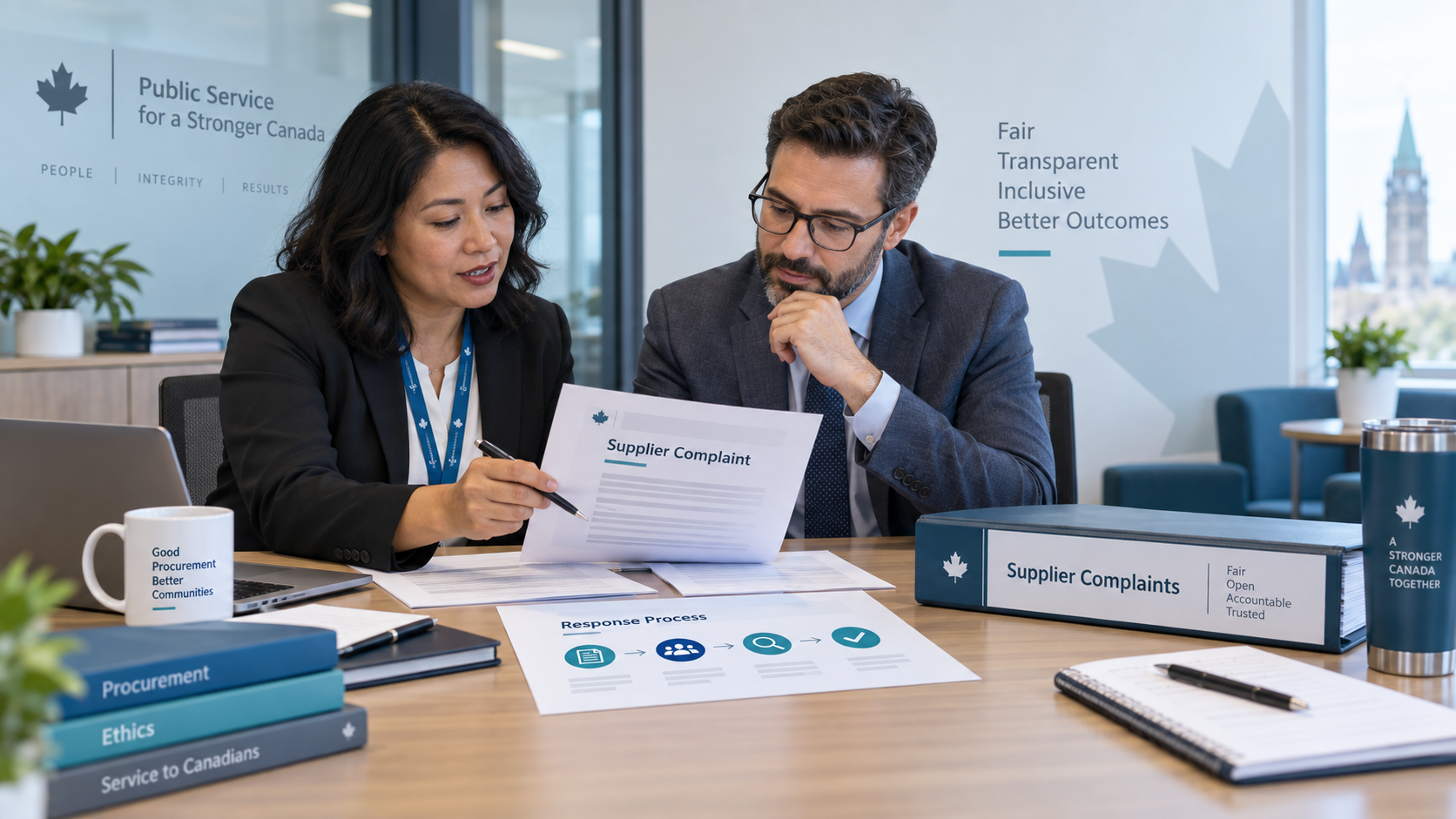
procurement complaint process
Key Takeaways
- A formal complaint route gives suppliers a fair and structured channel for questioning how a public tender was planned, communicated, evaluated, or managed.
- Acting early works in your favour because the facts stay fresh and the response timelines remain open while you gather your thoughts.
- Before escalating anything, read the solicitation documents carefully since they usually explain the steps, contacts, and deadlines you need to follow.
- Contacting the named procurement representative is often the quickest path to clarity, and many concerns can be resolved at this stage without a formal complaint.
This guide uses a general Canadian public-sector framework. Requirements differ among federal, provincial, territorial, municipal, education, health, Crown, and other public organizations. Treat the applicable solicitation, purchasing policy, supplier instructions, and official government resources as the controlling references for your situation. Organizations may also benefit from a procurement procedures manual when documenting consistent internal processes.
A plain-language definition for newcomers
Think of a complaint as a request for an organization to examine a procurement concern and provide an appropriate response. A supplier might ask whether a requirement was applied consistently, whether an addendum was communicated properly, or whether the published evaluation approach was followed. Definitions, eligibility, remedies, and review stages can differ by organization and jurisdiction, so use the terminology in the relevant procurement documents.
Complaints compared with feedback, bid protests, contract disputes, and ethics reports
Several routes can appear similar. Classifying the issue helps direct it to the right contact and prevents a procedural concern from being mixed with a performance, conduct, or contractual matter.
| Category | Typical focus | Likely starting point |
|---|---|---|
| Procurement complaint | Administration, communication, fairness, or process consistency | Named procurement contact or contracting authority |
| Feedback | A suggestion or observation intended to improve future purchasing | Procurement team or feedback channel |
| Bid protest | A challenge to a solicitation, evaluation, or award decision | Process identified in the solicitation or applicable policy |
| Contract dispute | Performance, payment, scope, interpretation, or contract administration | Contract manager and dispute provisions |
| Ethics report | Suspected conflict of interest, fraud, misconduct, or improper influence | Designated integrity, disclosure, or reporting channel |
| Ombudsperson review | Independent examination of an unresolved administrative concern | Eligibility and intake process for the relevant office |
Why getting the category right changes your next step
The category affects the recipient, evidence, timing, and possible outcome. A question about an unclear clause may belong with the procurement contact during an open tender. A challenge to an award may require a specific review form or deadline. A concern about supplier conduct may need an ethics channel rather than the purchasing mailbox. If the situation crosses categories, describe the facts plainly and ask the organization to direct the matter to the appropriate function.
The procurement complaint process, step by step

Start by raising the concern directly with the purchasing organization
Review the solicitation, amendments, question-and-answer record, submission instructions, and contact details. Write down the issue in neutral language, including the procurement number, relevant date, document section, and practical question. Send it to the named procurement contact unless the documents specify another route. Keep a copy of the message and reply.
Speaking up early during an active solicitation
When a tender remains open, early communication may allow the public body to answer a question, issue an addendum, correct an error, or explain the process to all suppliers where required. Do not share confidential information about another bidder. Ask for clarification through the official channel, and check whether responses will be distributed to all participating suppliers. Early action may resolve the concern without immediate escalation.
Requesting a debrief after an unsuccessful bid
A debrief can explain how a submission was assessed against the stated criteria, including strengths, gaps, scoring themes, or procedural information, subject to applicable confidentiality limits. Request one promptly and follow the solicitation or award notice. A debrief does not necessarily change the result, but it can separate a misunderstanding from a genuine process concern and provide a more accurate record.
Submitting a formal complaint and what happens afterwards
If direct clarification does not resolve the issue, the applicable rules may provide a formal complaint route. Follow the required form, address, format, eligibility conditions, and filing period. State the facts, explain the process concern, attach relevant records, and identify a reasonable requested response. A typical sequence may include acknowledgement, an intake or eligibility check, review of procurement records, communication with relevant parties, and a written response. Some organizations may resolve the matter informally during review.
- Identify and document the concern
- Check the solicitation and applicable policy
- Contact the named procurement representative
- Request clarification or a debrief, when available
- Use the formal complaint route if needed
- Receive, review, and retain the response
For teams building shared confidence, Procurement Training for Teams offers a Canadian-focused public sector procurement curriculum. Procurement Training for Teams.
Separate facts from conclusions. Identify the procedural ground, such as inconsistent communication, an apparent departure from the published evaluation method, unequal access to information, or an unclear requirement. Connect each concern to supporting evidence, explain the practical impact on your participation or submission, and state the remedy requested. This might be clarification, a review of the record, corrected communication, a debrief, or another response available under the applicable rules.
A simple template for structuring your complaint
Use a direct subject line and short headings. This structure keeps the document useful to an intake officer, contracting authority, reviewer, or procurement manager:
Subject: Procurement concern, [reference number]

1. Complainant: [name, organization, contact information]
2. Procurement: [title, reference, issuing organization]
3. Concern: [one-sentence description]
4. Timeline: [date, event, source document]
5. Procedural basis: [published instruction or requirement]
6. Evidence: [attached records and relevant page numbers]
7. Impact: [effect on participation or evaluation]
8. Requested response: [specific and reasonable remedy]
Keep the requested response within the recipient’s authority. Asking for a transparent review is more useful than demanding an outcome that the applicable policy does not permit. If you are uncertain about the category, describe the facts and ask that the matter be directed to the appropriate channel.
Evidence and document checklist
Build one indexed file before submitting. Include only records relevant to the concern, and protect confidential information belonging to other suppliers. A practical checklist includes:
- Solicitation, request document, specifications, and evaluation criteria
- Addenda, amendments, and notices issued during the open period
- Questions and answers, clarification requests, and official responses
- Your submitted bid, forms, schedules, and confirmation of receipt
- Award notice, evaluation information, and debrief notes, if available
- Related emails, meeting records, letters, and telephone call notes
- A dated chronology showing when each event occurred
Writing habits that keep your complaint professional and easy to review
Use neutral language, precise dates, and document references. Write “the response appears inconsistent with section 4.2” rather than assigning motives. Distinguish what you observed from what you believe may have happened. Avoid personal criticism, excessive attachments, speculation, and broad claims that the process was unfair without explaining the specific event.
Choosing the right route: who handles procurement concerns in Canada
Possible recipients, from the procurement contact to independent review bodies
Start with the recipient named in the solicitation, supplier instructions, award notice, or purchasing policy. This may be a procurement contact, contracting authority, bid administrator, or designated procurement mailbox. If the issue remains unresolved, the published process may direct you to a procurement manager, senior management, fairness function, ombudsperson office, or an external review body. The correct route depends on the organization and concern, not only on the purchase value.
Why deadlines, forms, and eligibility vary across Canada
Federal, provincial, territorial, municipal, Crown, education, health, and other public organizations may operate under different legislation, trade obligations, policies, delegations, and review arrangements. Filing periods, eligible complainants, required forms, monetary thresholds, confidentiality rules, review powers, and available remedies can differ. A process described by the Canadian Office of the Procurement Ombud should not be treated as a universal rule for every Canadian public body.
Check the current solicitation, amendments, supplier guide, applicable procurement policy, and relevant official government procurement website. Record when you found each instruction. If a deadline may be approaching, ask the named contact which route applies while preserving your right to use any formal channel identified in the governing documents.
A decision tree for choosing your escalation path
- Is the tender still open? Contact the named procurement representative with a clarification or process concern.
- Was your bid unsuccessful? Request a debrief if the applicable instructions provide one. Use a formal bid protest route if you are challenging the solicitation, evaluation, or award.
- Does the issue concern contract performance, payment, scope, or interpretation? Review the contract dispute provisions and contact the contract manager.
- Does it involve suspected fraud, conflict of interest, retaliation, or misconduct? Use the designated ethics, integrity, disclosure, or reporting channel.
- Has an administrative concern remained unresolved? Check whether an ombudsperson or independent review body has jurisdiction.
- Does the matter require legal interpretation or litigation advice? Consider qualified professional advice.
When to seek official guidance or qualified professional advice
Official guidance is appropriate when you need to confirm a form, filing address, eligibility condition, deadline, disclosure limit, or review mandate. Qualified professional advice may be appropriate when the issue involves significant commercial exposure, a complex contract, statutory interpretation, privilege, or possible litigation. NECI provides educational procurement knowledge, not legal advice. Match your action to the controlling documents and keep a complete record of communications.
Strengthening accountability on both sides of the process

For suppliers: habits that make concerns easier to resolve
Suppliers can support a timely, low-conflict review by keeping communications factual, organized, and connected to the procurement record. Use the official contact channel, identify the solicitation reference in each message, and ask one clear question at a time. Keep confirmation emails, portal notices, meeting notes, and submission records together. If the concern is time-sensitive, state the relevant date and explain why a response is needed before the next procurement milestone.
- Use the terminology and instructions in the solicitation.
- Separate observed facts from assumptions about intent.
- Preserve original documents, dates, and delivery confirmations.
- Raise material concerns before an evaluation or closing date when possible.
- Request a specific, reasonable response rather than a preferred outcome alone.
- Protect confidential information belonging to other participants.
For public bodies: a model internal workflow for receiving and reviewing complaints
A public body can bring consistency to complaint handling through a documented internal workflow. Intake may begin with the procurement contact, followed by an acknowledgement recording the date received, assigned reviewer, and any immediate deadline. The reviewer can confirm the issue category, preserve relevant records, consult the contracting authority or evaluation lead, and assess the concern against the solicitation, policy, approvals, and communications.
The written response should address the questions raised, explain the information reviewed, identify disclosure limits, and state the next available route where appropriate. Logging the outcome supports continuity when staff change or a matter moves to another review function. Separation between the person receiving the concern and the person conducting the review can support impartiality, depending on the organization’s structure and policy.
Turning complaint records into continuous improvement
Complaint records are more useful when they inform learning rather than sit in a closed file. Procurement leaders can review recurring themes such as unclear specifications, inconsistent answers, portal visibility, evaluator guidance, approval delays, or gaps in vendor communication. A root-cause review can distinguish an isolated error from a weakness in the procurement framework. Findings may lead to clearer templates, improved intake controls, better records management, updated training, or earlier quality checks before a solicitation is released. Teams can also use RFx templates and a user guide to support more consistent solicitation documentation.
Building foundational confidence through procurement training
Strong complaint handling depends on shared knowledge. Suppliers and public-sector teams benefit when people understand fairness, transparency, documentation, conflicts of interest, evaluation discipline, contract authority, and escalation responsibilities. For organizations building that foundation, Procurement Training for Teams provides a Canadian-focused public sector procurement curriculum. Procurement Training for Teams.
Training does not replace the applicable policy, solicitation terms, or official review instructions. It helps teams interpret those materials carefully, document decisions, communicate with confidence, and respond to concerns in a way that protects public trust.
Frequently Asked Questions
What are the five stages of complaint handling in a procurement complaint process?
A procurement complaint process commonly includes receipt, acknowledgement, assessment, investigation, and response or resolution. The organization first records the concern, confirms whether it falls within the applicable process, reviews documents and facts, then provides a written outcome. Specific stages and timelines may differ by Canadian public-sector organization.
What are the seven steps of the procurement process?
A public procurement process commonly involves planning the purchase, defining requirements, choosing a method, preparing solicitation documents, inviting bids, evaluating submissions, and awarding and managing the contract. A procurement complaint may concern any of these steps. The applicable solicitation and purchasing policy determine the required procedures.
What is improper procurement?
Improper procurement is conduct or administration that does not follow applicable legislation, policy, solicitation instructions, or fair purchasing practices. Examples may include unequal supplier treatment, undisclosed evaluation criteria, poor communication of amendments, conflicts of interest, or an apparent departure from published instructions. A concern requires review of the records before wrongdoing is established.
What are the four types of procurement complaints?
Four common procurement complaint types concern unclear requirements, inconsistent communication, unfair or unequal treatment, and possible departures from the stated evaluation or purchasing procedure. These categories help identify the right contact and supporting records. The applicable organization may use different labels or provide a separate bid protest, ethics, or contract dispute route.
What are the top three reasons suppliers make procurement complaints?
The top three reasons suppliers make procurement complaints are unclear requirements, perceived unequal treatment, and concerns about how bids were evaluated or communicated. Suppliers may also question whether amendments reached all participants or whether published instructions were followed. A clear complaint identifies the procurement reference, event, evidence, and requested response.
How long do you have to file a procurement complaint in Canada?
A procurement complaint must usually be filed within the period stated in the solicitation, award notice, purchasing policy, or applicable review procedure. Deadlines differ among federal, provincial, territorial, municipal, education, health, and Crown organizations. Check the official documents promptly and keep records of submission dates, replies, and relevant procurement events.