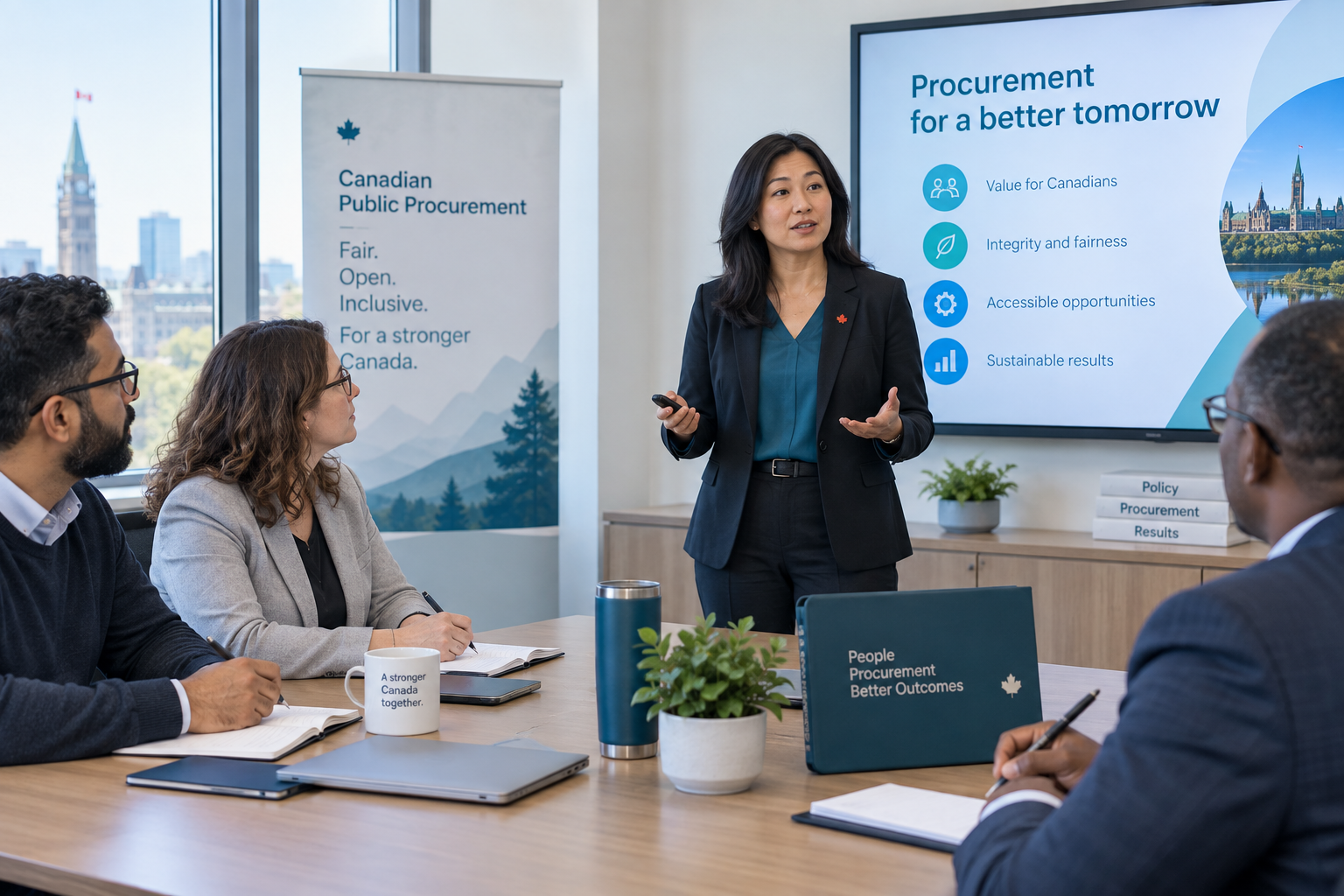
procurement communication skills
Strong procurement communication skills help people make decisions that are clear, fair, and defensible. In public procurement, communication is not limited to speaking well. It includes listening carefully, asking precise questions, explaining requirements, documenting decisions, and adapting a message for suppliers, executives, technical specialists, and the public.
Key Takeaways
- Clear communication gives procurement professionals the confidence to make decisions that are fair, transparent, and easy to defend.
- Effective communicators listen carefully and ask precise questions before explaining requirements to suppliers or stakeholders.
- Different audiences need different messages, so adapting how you speak to suppliers, executives, technical specialists, and the public is a core skill.
- Documenting your decisions as you go creates a record that protects both your process and your organization.
- Communication is a learnable skill, and practicing it daily helps every procurement professional work with greater assurance.
A well-worded conversation can prevent confusion before it becomes a contract issue. A well-kept record can show how requirements were understood and how a decision followed the approved process. These habits support accountability while helping procurement professionals work with greater confidence.
What is procurement communication skills?
Procurement communication skills are the practical abilities used to exchange information throughout the procurement and contract management cycle. They include active listening, plain-language writing, meeting facilitation, negotiation, questioning, presentation, stakeholder engagement, supplier communication, and accurate recordkeeping.
The public-sector setting gives these abilities a specific purpose. A procurement professional must communicate requirements consistently, protect confidential information, avoid giving one supplier an unfair advantage, and make sure important discussions are recorded. Communication must support transparency and accountability, not only personal rapport. A friendly conversation still needs appropriate boundaries when a competitive process is underway.
Active listening illustrates the difference between hearing and understanding. Hearing means receiving the supplier’s words. Listening means checking the meaning, identifying an assumption, and confirming the next step. A useful response might be: “You are saying that the proposed delivery schedule depends on access to the site. Have I understood that correctly?” This approach can reveal a dependency without promising a change that the procurement team has not approved.
Clear communication also changes according to the audience. A technical team may need a detailed statement of work, evaluation criteria, service levels, and acceptance requirements. An executive may need a concise briefing that explains the decision, risk, timing, financial effect, and recommended action. A supplier may need a consistent answer that refers to the solicitation documents and the formal channel for questions.
Benefits of procurement communication skills

Effective communication brings structure to work that often involves competing priorities. Procurement professionals coordinate business needs, policy requirements, budgets, legal review, operational constraints, supplier capacity, and delivery expectations. When these details are expressed clearly, stakeholders can identify the real requirement instead of reacting to vague preferences. That supports a more useful business case, a focused scope, and evaluation criteria that relate to the intended outcome.
These abilities also improve supplier relationships without weakening professional boundaries. A supplier should understand the process, the response deadline, the required format, and the permitted route for questions. Consistent answers reduce avoidable uncertainty. When a concern arises during contract performance, a fact-based discussion can separate the agreed obligation from a new request, an operational problem, or a change that requires authorization.
Good communication supports risk management. Clarifying ownership, milestones, dependencies, deliverables, acceptance, reporting, and escalation points can expose gaps before they affect service delivery. Written confirmation gives the project team a shared reference point. It can also help distinguish an informal comment from an approved instruction, which matters when a contract involves public funds and multiple decision-makers.
Procurement communication skills are especially valuable when explaining compliance issues. Rather than saying that a request cannot proceed, a professional can explain the relevant concern, the decision authority, the information still required, and the available compliant path. This style is direct without being dismissive. It allows internal clients to understand that controls protect the organization, suppliers, and public confidence.
Teams can build these habits through realistic practice. A short exercise might ask one person to brief an executive in three sentences, another to test the requirement with open questions, and a third to identify what belongs in the procurement record. Scenario work can cover a late supplier question, an unclear specification, a conflict of interest disclosure, a contract change request, or a disagreement about acceptance. Feedback should consider accuracy, neutrality, tone, listening, confidentiality, and the quality of the follow-up note.
For organizations building a shared foundation, Procurement Training for Teams provides a Canadian-focused public sector procurement curriculum. The program can help teams develop common language across requisitioning, sourcing, evaluation, negotiation, contract administration, documentation, and ethical decision-making. Procurement Training for Teams also includes a progressive certification pathway from essentials to procurement expert level, with.
How to Choose procurement communication skills
Choose learning that reflects the decisions and conversations you handle in Canadian public procurement. A useful program should move beyond general advice about confidence or presentation style. Look for practical instruction on requirements gathering, active listening, supplier questions, stakeholder briefings, negotiation boundaries, meeting records, contract discussions, and written follow-up. The lessons should explain how fairness, transparency, confidentiality, consistency, and accountability affect communication at each stage.
Relevant scenarios are a strong sign of quality. A good exercise might involve an unclear statement of work, a supplier asking for information during a competitive process, an executive requesting a quick recommendation, or a project lead seeking an unauthorized contract change. The learner should practise asking neutral questions, separating facts from assumptions, confirming responsibilities, and recording the decision. Feedback should assess both the message and the process behind it.
Check whether the learning applies to more than one audience. Procurement staff need to explain policy and process. Technical specialists need to describe operational requirements without narrowing competition unnecessarily. Executives need concise advice about cost, risk, timing, options, and authority. Suppliers need consistent information through the approved communication channel. Training should show how to adapt tone, detail, structure, and format while keeping the underlying information accurate and fair.
For a team, shared learning can be more useful than isolated individual development. When colleagues use the same terms for requirements, risks, approvals, evaluation notes, contract changes, and escalation, handoffs become easier to follow. Ask whether the program supports discussion among procurement professionals, business owners, evaluators, and contract managers. A team activity can reveal different interpretations of the same scenario and create a better basis for local procedures.
custom procurement training for your team is a suitable choice for organizations seeking a Canadian-focused public sector procurement curriculum. It supports a common foundation across communication, sourcing, evaluation, contract administration, ethics, documentation, and stakeholder engagement. The program also offers a progressive certification pathway from essentials to procurement expert level, with.
Before enrolling, identify the communication situations that create the most uncertainty for your group. Review whether the course addresses those situations with realistic practice, clear explanations, and opportunities for reflection. The strongest choice will help learners communicate with precision while respecting public obligations. That combination builds confidence without encouraging informal promises, incomplete records, or negotiation tactics that do not fit a fair procurement process.