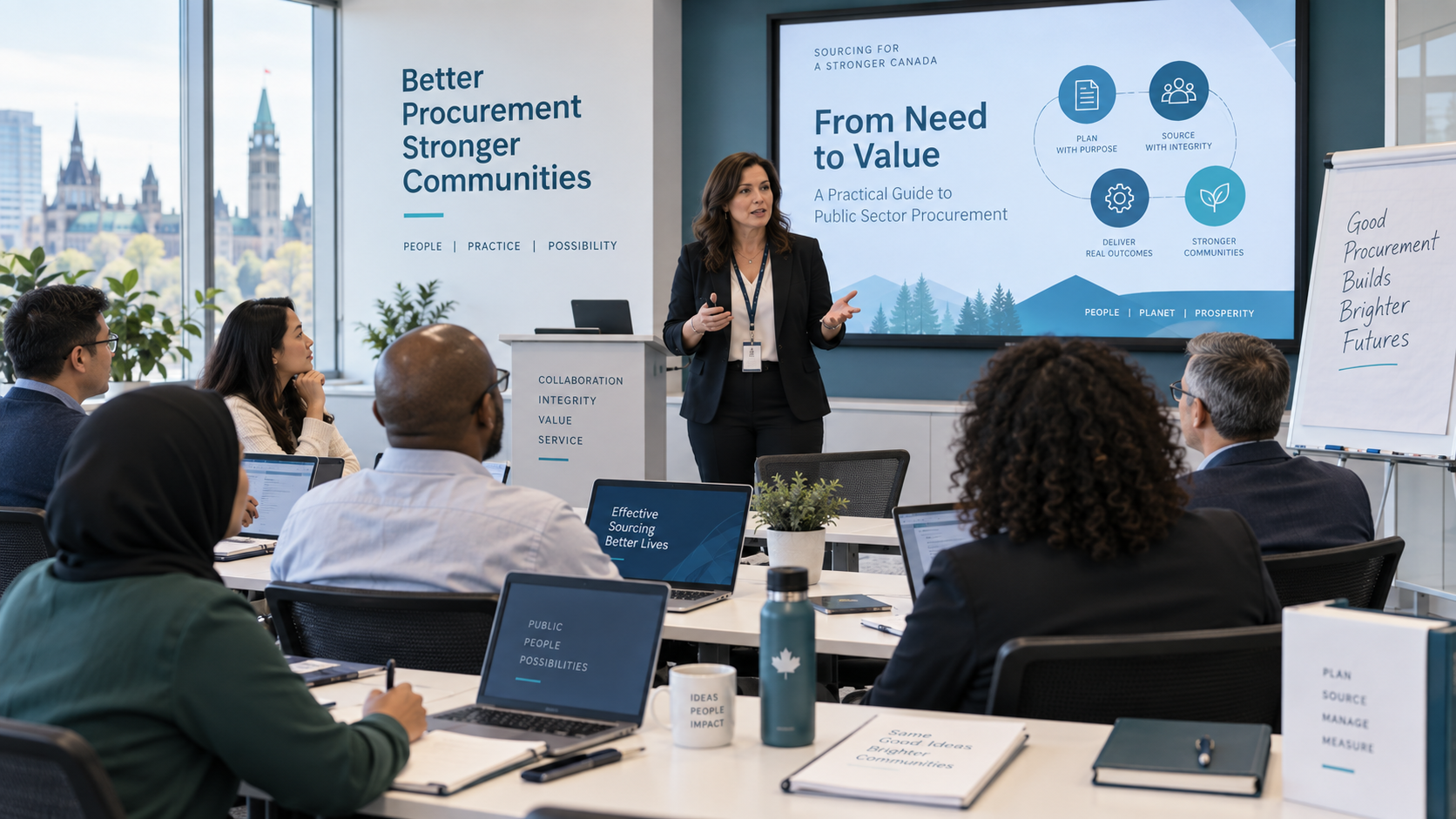
procurement manager workshop
When procurement teams move from processing requests to guiding sourcing decisions, the work becomes more visible, strategic, and accountable. A well-designed procurement manager workshop helps managers connect policy, market knowledge, stakeholder needs, supplier relationships, and contract results in one learning environment.
Key Takeaways
- Procurement’s role expands from processing requests to guiding sourcing decisions, making the work more strategic and accountable.
- A well-planned procurement manager workshop brings together policy, market insights, stakeholder needs, and supplier relationships into a single learning space.
- These workshops equip managers to effectively connect various elements of the procurement process for better contract outcomes.
The aim is not to replace judgement with a script. It is to give buyers, managers, finance partners, operations teams, and technical specialists a common method for making defensible decisions. NECI The Procurement School Inc. supports this work through Procurement Training for Teams, which includes a Canadian-focused public sector procurement curriculum, a progressive certification pathway from essentials to procurement expert level.
Procurement Leadership: Moving Beyond Tactical Buying to Strategic Team Performance
The Challenge: Buyer Burnout and Internal Misalignment
Procurement professionals may spend much of the day resolving urgent requests, correcting specifications, checking supplier information, answering status questions, and managing contracts. These tasks matter, yet constant reaction leaves less time for category planning, risk assessment, market research, and relationship management. Pressure increases when item data is unreliable, supplier lead times have not been validated, or end users change requirements after work begins.
Misalignment adds strain. Procurement may focus on fairness, documentation, competition, and approvals; finance on budget control; operations on continuity; and technical users on performance. Without agreed roles and terminology, routine sourcing decisions become escalations. Newly appointed managers may also question their judgement when expectations are unclear and supplier problems feel personal.
Why Traditional Training Falls Short for Modern Procurement Teams
Generic online courses can introduce terminology and process steps, but isolated learning may not resolve workplace conditions. A buyer can understand evaluation criteria in theory and still struggle to challenge an incomplete statement of work. A manager can know that scope changes require control and still lack a conversation plan for an internal client or supplier.
Lecture-heavy training can also separate functions that must cooperate. It may not show where procurement hands a decision to finance, where technical evaluators need guidance, or who owns supplier performance after award. Public sector work adds expectations around transparency, equal treatment, records, delegated authority, trade agreement awareness, and ethical conduct. These subjects require context and practice.
The Promise of Applied Team Workshops
An applied workshop brings the team together, physically or virtually, to examine realistic procurement decisions. Participants test a procurement strategy, refine a scope of work, build evaluation criteria, practise negotiation, and identify controls for contract changes. The facilitator connects each exercise to policy, governance, risk, documentation, and public trust.
This format makes leadership behaviour visible. Managers learn to set direction, coach buyers, involve stakeholders at the right stage, and respond to supplier concerns fairly. Team members gain shared language for requirements, evaluation, approvals, deliverables, service levels, change control, and escalation. This creates a stronger foundation for strategic sourcing and contract stewardship.
Building Your Procurement Manager Workshop: Core Curriculum and Practical Design
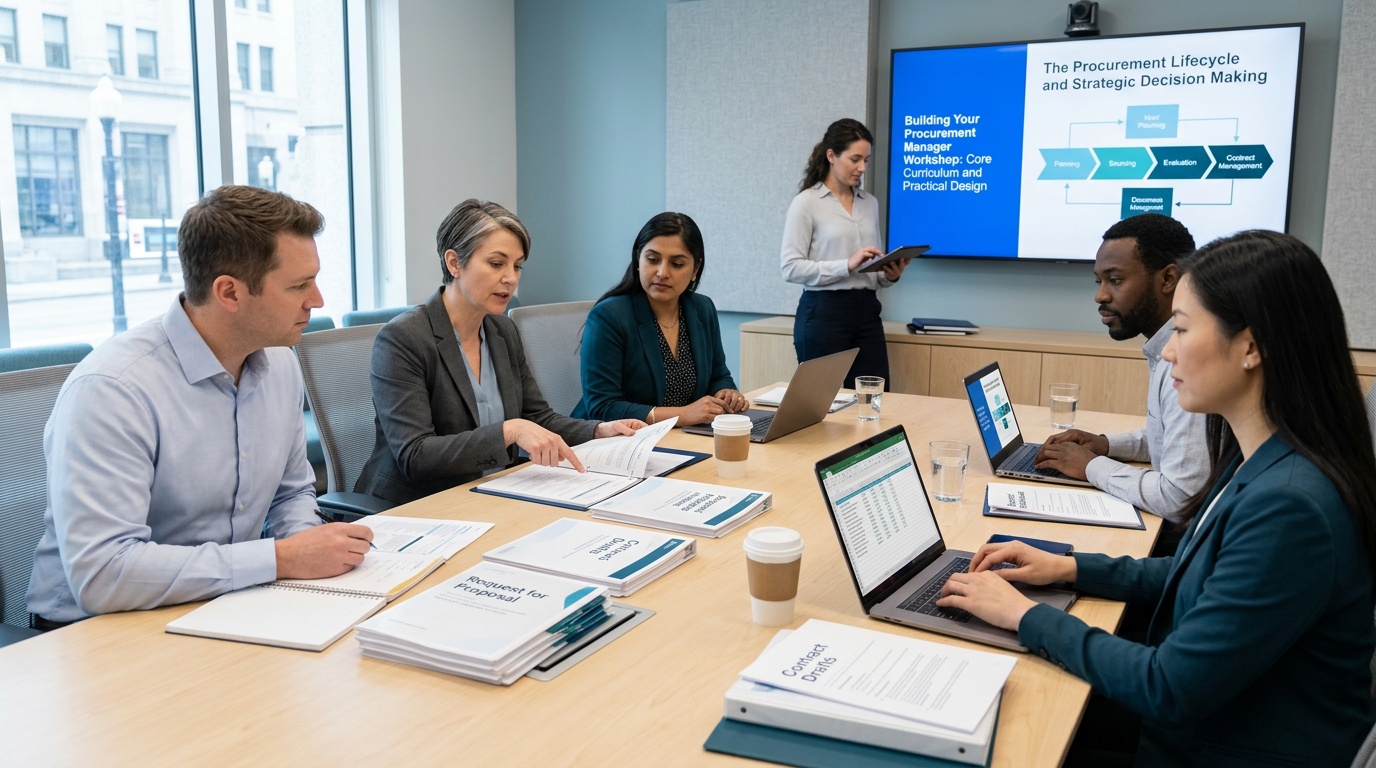
A complete curriculum should follow the procurement lifecycle rather than present disconnected topics. Each module should ask what decision must be made, what evidence supports it, and what record demonstrates accountability. This keeps training practical within the public procurement setting.
Key Workshop Modules: From Sourcing to Contract Accountability
The design should connect commercial judgement with process discipline. Participants need to see how a poorly defined need can create an unsuitable solicitation, weak evaluation criteria can produce inconsistent scoring, and incomplete handover can create contract leakage after award.
| Module | Core capability | Applied exercise | Practical output |
|---|---|---|---|
| Strategic sourcing and needs analysis | Define the business need, scope, risk, market conditions, and requirements. | Review an incomplete request and separate outcomes from preferred solutions. | Needs statement and sourcing approach. |
| RFP design and evaluation | Build clear specifications, mandatory requirements, rated criteria, and scoring guidance. | Test criteria for clarity, relevance, and consistent application. | Draft evaluation framework. |
| Negotiation and stakeholder alignment | Prepare objectives, authority limits, concessions, communications, and approvals. | Practise a supplier discussion involving price, schedule, and service obligations. | Negotiation plan and stakeholder map. |
| Post-award contract management | Monitor deliverables, performance measures, invoices, changes, issues, and remedies. | Assess a scope change and determine the required review path. | Contract administration plan. |
| Compliance, ethics, and accountability | Apply fairness, transparency, conflict disclosure, records management, authority, and trade agreement awareness. | Identify risks in a procurement scenario and document a defensible response. | Accountability checklist. |
Module 1: Strategic Sourcing and Needs Analysis
Start with the outcome the organization requires, not the item a requester names. Examine demand, total cost, timing, service expectations, operational risk, sustainability considerations, and market capacity. Test usage history, supplier lead times, specifications, and inventory information before relying on them.
Module 2: Crafting Effective RFPs and Evaluation Criteria
Cover statements of work, performance requirements, mandatory conditions, rated criteria, weighting, evaluator roles, conflict declarations, and evaluation records. The test is whether evaluators can apply criteria consistently without guessing what the organization meant. Clear documents reduce clarification requests and support a fair, auditable process.
Module 3: Negotiation Fundamentals and Stakeholder Alignment
Negotiation training should cover preparation as well as conversation technique. Participants identify objectives, authority limits, acceptable trade-offs, commercial risks, approval points, and communication responsibilities. Role-play supports listening, documenting commitments, addressing service concerns, and keeping stakeholders aligned with the approved strategy.
Module 4: Post-Award Contract Management and Performance Oversight
Award is not the finish line. Managers need handover covering deliverables, milestones, service levels, invoice checks, issue logs, change requests, renewal dates, records, and escalation routes. Contract management training for teams can reinforce these post-award controls and help contract owners address concerns before disputes develop.
Module 5: Public Sector Compliance, Ethics, and Accountability
Public procurement training should connect operational decisions with public confidence. Examine fairness, transparency, confidentiality, conflicts of interest, delegated authority, documentation, accessibility, privacy, and applicable trade agreement obligations. The objective is to help managers recognize risk, ask sound questions, follow policy, and seek guidance.
Designing for Application: Scenario-Based Learning
Use scenarios reflecting actual work: an incomplete requirement, an evaluator seeking to change scoring, a supplier requesting a material scope change, or an invoice that does not match the contract. Give participants time to decide, explain their reasoning, record the action, and receive feedback. This cycle turns concepts into repeatable habits and provides a safe place to practise difficult conversations.
For teams seeking a structured path, Procurement Training for Teams is designed around Canadian public sector procurement learning and progressive development. Teams can build common foundations while connecting lessons to approval routes, contract portfolios, stakeholder roles, and risk controls.
The Workshop Advantage: Eliminating Friction and Fostering Team Cohesion
A procurement manager workshop brings people who shape, approve, deliver, and monitor a purchase into one practical learning process. The team examines how decisions move from requirements definition to supplier performance. This shared view helps reduce role confusion, vendor friction, inconsistent records, and contract leakage.
Bridging Role Confusion: Clarifying Responsibilities for Buyers and Stakeholders
Role confusion often begins before solicitation. A technical specialist may define a solution without describing the outcome. A buyer may be expected to correct the requirement, manage risk, and answer operational questions without authority. Finance may become involved only when approval is needed. A workshop can map responsibilities across procurement, operations, finance, legal services, and end users.
Participants can identify who owns needs analysis, market research, specifications, evaluation, approvals, supplier communication, invoice review, and contract changes. This gives managers a practical way to set expectations and escalate issues. It also shows stakeholders that procurement supports a fair, defensible process, while business owners remain accountable for the need and contract outcome.
Taming Vendor Friction: Standardizing Communication and Performance
Supplier relationships become difficult when communication is informal or disconnected from the contract. One employee may promise a schedule adjustment while another relies on the original date. A workshop helps participants distinguish clarification from commitment, record decisions, use approved channels, and route performance concerns to the contract owner.
Teams can practise reviewing service levels, deliverables, acceptance criteria, issue logs, meeting notes, and escalation steps. Clear expectations give suppliers a fair opportunity to respond while helping internal teams address late delivery, incomplete work, invoice discrepancies, or requests outside the agreed scope.
Stopping Contract Leakage: Ensuring Post-Award Discipline
Contract leakage occurs when spending, requirements, or service commitments move beyond the approved agreement. Warning signs include unrecorded scope changes, informal extensions, invoices that do not match pricing, unused performance measures, and purchases made without reference to contract terms. Post-award control should be a team responsibility.
Participants can build a governance routine with handover notes, milestone reviews, change-control records, renewal reminders, supplier scorecards, and invoice checks. These controls support continuity when staff change and create evidence for review. They also help managers coach contract owners before exceptions become disputes or audit concerns.
Establishing a Shared Operating Language Across Departments
Terms such as requirement, deliverable, acceptance, risk, change, issue, approval, and performance measure should have the same meaning across departments. A workshop gives participants shared vocabulary and lets them test it against documents, approval routes, supplier conversations, and contract records.
This language supports faster decisions while preserving review. It helps finance recognize a material change, assists technical users in describing measurable outcomes, and gives buyers a clear basis for explaining process requirements. It also makes onboarding easier through examples rather than fragmented instructions.
Comparison: Tactical Purchasing Training vs. Strategic Procurement Management Workshop
| Focus | Tactical purchasing training | Strategic team workshop |
|---|---|---|
| Primary aim | Complete transactions accurately and follow basic steps. | Align decisions, roles, governance, and contract outcomes. |
| Learning method | Individual lessons, explanations, and process references. | Facilitated exercises, role practice, document review, and team discussion. |
| Team connection | Limited opportunity to resolve cross-functional assumptions. | Procurement, finance, operations, and technical participants work through the same decisions. |
| Post-award attention | May end at purchase order or contract award. | Includes handover, performance monitoring, change control, and supplier accountability. |
| Management outcome | Improved task knowledge for individual staff. | Clearer ownership, stronger judgement, consistent records, and a shared operating model. |
Foundational instruction remains valuable because teams need process knowledge before applying it. A strategic workshop connects that knowledge to actual roles, contracts, risks, and decisions, helping managers move from supervising activity to guiding dependable performance.
Planning and Delivering Your Custom Team Procurement Workshop
A successful procurement manager workshop begins with the team’s actual work. Identify where decisions slow down, responsibilities overlap, and contract obligations are missed. Review recent sourcing files, supplier issues, approval delays, scope changes, invoice discrepancies, and stakeholder feedback. Use this evidence to set learning goals connected to operational performance and public accountability.
Identifying Your Team’s Specific Needs and Learning Goals
Separate knowledge gaps from process gaps. A buyer may understand evaluation criteria but lack an approval route. A contract owner may understand service expectations but not how to document a change. Ask which decisions create uncertainty, then set observable goals such as preparing a sourcing plan, documenting evaluation rationale, escalating a supplier issue, or reviewing an invoice against contract terms.
Choosing the Right Delivery Format: In-Person, Virtual, or Hybrid
In-person delivery supports relationship building, table exercises, role-play, and discussion. Virtual delivery can include distributed staff and reduce scheduling barriers when participants have documents, breakout rooms, and collaboration tools. Hybrid delivery requires careful facilitation so remote participants contribute. Choose the format that supports practice, feedback, confidentiality, and participation.
Facilitating Effective Team Dynamics and Participation
Set expectations before the session: challenge the process, not the person; use evidence; protect confidential information; and give each function time to explain its priorities. Mix procurement, finance, operations, technical, and contract-management participants. A facilitator should surface assumptions and turn them into actions, owners, and dates.
Measuring Workshop Success: Outcomes and Organizational ROI
Measure work quality, not attendance alone. Record baseline indicators such as approval rework, incomplete requirements, unresolved supplier issues, missed milestones, undocumented scope changes, or invoice exceptions. Review whether participants use agreed templates, escalation routes, evaluation records, and contract practices. Return may appear through fewer delays, clearer ownership, better supplier performance, stronger audit readiness, and consistent decision records.
Next Steps: Empowering Your Team for Confident Procurement
Turn the workshop into a working plan. Assign owners for updating templates, documenting handover steps, reviewing active contracts, and coaching new team members. Schedule follow-up to examine what changed and where further instruction is needed. Procurement Training for Teams offers Canadian-focused public sector procurement curriculum, a progressive certification pathway from essentials to procurement expert level.
Addressing the Unspoken: Imposter Syndrome and Real-World Procurement Scenarios

New procurement managers may feel pressure when moving from transactions to strategy, stakeholder advice, and supplier performance. Confidence grows when expectations are visible and judgement can be practised safely. A team environment helps participants distinguish uncertainty from incompetence, ask precise questions, and support decisions with policy, evidence, authority, and reasoning.
Navigating Imposter Syndrome: Building Confidence from Within
Use peer review, decision prompts, and facilitator feedback to make judgement observable. Participants can explain the risk, identify the decision owner, list the evidence required, and record the next action. This replaces vague reassurance with a repeatable process. Managers gain confidence through preparation and accountability.
Scenario Walk-Through: Handling Complex Contract Disputes
Consider a supplier that misses a milestone and says the delay resulted from an informal scope change. The contract owner should preserve records, confirm deliverables, review communications, and separate facts from assumptions. Procurement should check change-control provisions and approval authority. The team can meet the supplier with a documented issue statement, request a recovery plan, assess service impact, and record any approved resolution. Participants should identify how handover or communication allowed the disagreement to develop.
Beyond Theory: Building Practical Accountability Habits
End each exercise with three questions: What decision was made? Who owns the next step? What record will demonstrate completion? Repeating this routine builds disciplined habits across sourcing, evaluation, award, and contract administration. The featured Procurement Training for Teams option supports team-wide development through Canadian public sector expectations and progressive professional growth.
Frequently Asked Questions
What are the 5 P's of procurement?
The 5 P’s of procurement are commonly described as people, process, policy, performance, and price. A procurement manager workshop can help teams apply these areas together, from defining responsibilities and following approved procedures to measuring supplier results and achieving fair value.
What are the 5 R's of procurement?
The 5 R’s of procurement are the right quality, right quantity, right time, right place, and right price. A procurement manager workshop helps participants use these checks during needs analysis, sourcing, evaluation, and contract management while also considering risk, fairness, and accountability.
What skills does a procurement manager need?
A procurement manager needs strategic sourcing, negotiation, stakeholder communication, risk assessment, contract management, financial awareness, and ethical decision-making skills. A procurement manager workshop develops these skills through practical exercises involving requirements, evaluation criteria, supplier discussions, approvals, and post-award performance.
How can a procurement manager workshop improve team performance?
A procurement manager workshop improves team performance by giving participants a shared method for making and documenting procurement decisions. Buyers, managers, finance partners, operations staff, and technical specialists practise the same scenarios, clarify responsibilities, and build consistent language for requirements, approvals, supplier performance, and escalation.
Is procurement a dead-end job?
Procurement is not a dead-end job because professionals can progress from buying and contract administration into category management, strategic sourcing, leadership, policy, or specialized public procurement roles. A progressive learning path and practical procurement manager workshop can support growth by building judgement, communication, commercial, and governance skills.
Is procurement a stressful career?
Procurement can be a stressful career when urgent requests, unclear requirements, supplier issues, and competing stakeholder priorities are managed without shared processes. A procurement manager workshop can reduce avoidable pressure by strengthening planning, role clarity, communication, risk assessment, and contract controls while supporting confident professional judgement.