
procurement legal risk
Public procurement is high-stakes work. A decision can be questioned when requirements are unclear, suppliers receive unequal information, evaluators rely on undocumented reasoning, or contract terms differ from the approved procurement. Understanding procurement legal risk supports a defensible path from business need to contract closeout. This article is educational and does not replace advice from qualified counsel or direction from the applicable public organization.
Key Takeaways
- Clear and consistent communication with all suppliers helps prevent legal challenges to your procurement decisions.
- Documenting your evaluation reasoning thoroughly creates a defensible record for the entire process.
- Ensuring contract terms match what was approved during procurement reduces the risk of disputes later.
- Understanding legal risk from the start gives your team confidence to move from need to contract closeout.
- This guide provides educational information, but always consult qualified legal counsel for your specific situation.
Teams can build confidence through consistent reviews, reliable records and timely escalation. The Procurement Training for Teams program provides Canadian-focused public sector procurement training and a progressive certification pathway from essentials to procurement expert level.
Understanding Procurement Legal Risk in Canadian Public Sector
What is Procurement Legal Risk?
Procurement legal risk is the possibility that a purchasing activity, decision or contract conflicts with applicable law, trade obligations, policy, delegated authority, privacy requirements, accessibility duties, or fairness and transparency principles. It can arise before release, during supplier communications, throughout evaluation or after award.
The concern is not limited to a lawsuit. A supplier may challenge a process, an audit may identify weak controls, an oversight body may criticize the record, or an internal review may find a missing approval. A practical review asks whether the organization had authority, treated suppliers consistently, applied the stated rules and preserved evidence explaining the decision.
Public-sector legal risk exists wherever a decision could be unfair, unauthorized, inconsistent with governing requirements or difficult to defend from the record. The safest response is early identification, clear ownership, documented reasoning and timely review by the appropriate procurement, privacy, finance or legal function.
How is Procurement Legal Risk Different from Contract Risk?
Procurement risk concerns how the organization selects a supplier and whether the process is lawful, fair and authorized. Contract risk concerns the agreement and the organization’s ability to manage performance, payment, security, liability, change control and termination. The categories overlap: vague requirements can produce an unsuitable contract, while unclear liability terms can create exposure after award. Procurement staff may review the process, contract managers may monitor delivery, and legal counsel may advise on interpretation or exposure.
Why Canadian Public Sector Procurement Needs a Lifecycle Approach to Legal Risk
Risk begins with the business need, market research, funding decision and procurement method, then continues through solicitation, questions, addenda, evaluation, approvals, award notification, administration, amendments and closeout.
Requirements differ by jurisdiction and organization. Federal, provincial, territorial and municipal teams must consult applicable legislation, trade-agreement obligations, directives, privacy rules, records requirements and delegated authorities. Federal teams can begin with the Government of Canada’s Directive on the Management of Procurement and confirm which local instruments apply.
Common Consequences of Unmanaged Legal Risk
Financial consequences may include administrative work, delayed delivery, dispute costs, duplicate purchasing or payment for poorly defined outcomes. Operational effects can include interrupted services, unsuitable goods, weak supplier performance or difficult-to-justify amendments. Reputational damage may reduce confidence among suppliers, elected officials, oversight bodies and the public, even when the business need was legitimate.
- Delegated authority
- The approved power assigned to a person or role to commit funds, approve a procurement or sign an agreement.
- Solicitation
- A formal request inviting suppliers to submit offers, proposals, quotations or other responses.
- Evaluation record
- Documented evidence showing how compliant submissions were assessed against published requirements.
Navigating Legal Risk Through the Procurement Lifecycle
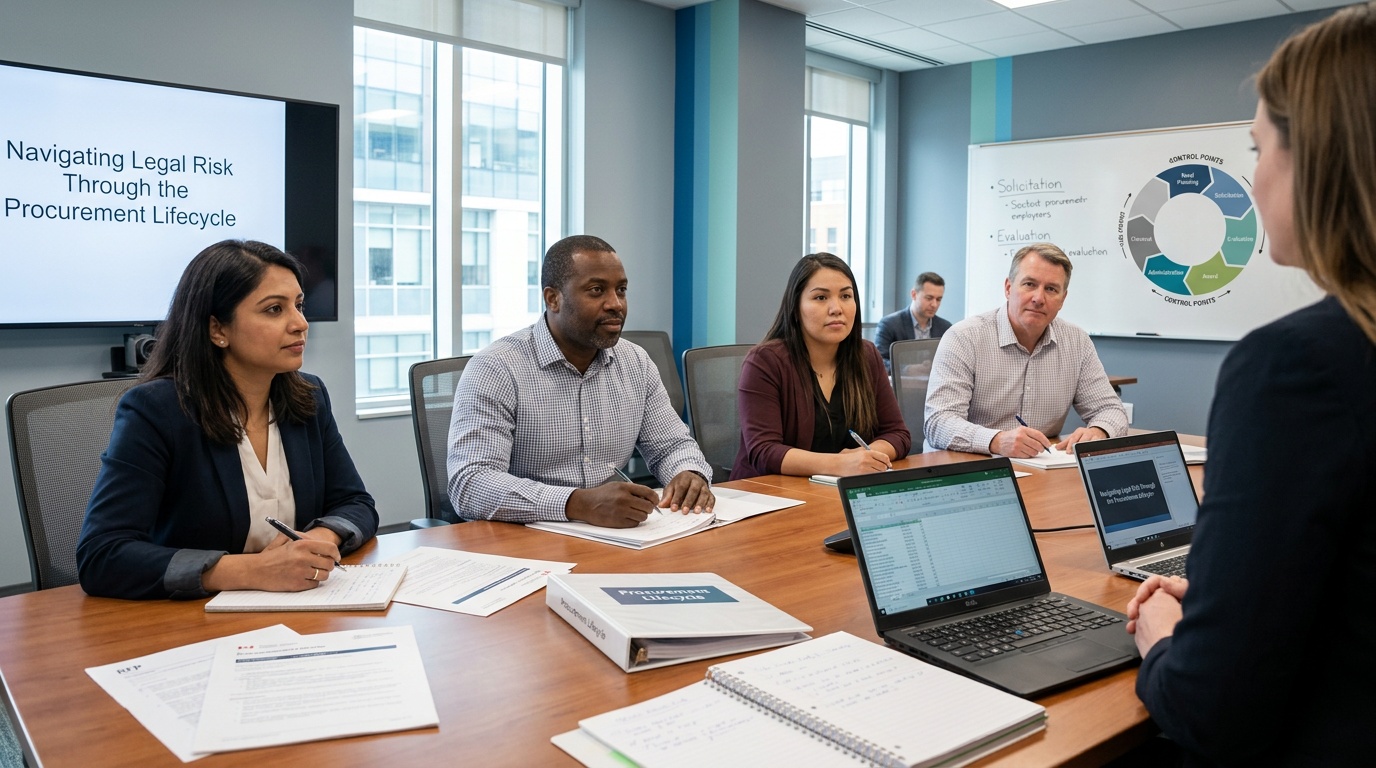
Each phase creates a control point. The lifecycle is need and planning, solicitation, evaluation, award, administration and closeout. At each point, ask what decision is being made, who has authority, what evidence is required and which unresolved issue needs review.
Phase 1: Planning and Preparation, Laying the Groundwork for Risk Reduction
Document the business need, approved funding, scope and procurement strategy. Confirm trade-agreement thresholds, internal policy, accessibility and privacy considerations, supplier-participation timelines, conflicts of interest and strategy approval.
Phase 2: Solicitation, Ensuring Fairness and Transparency
State the requirement, mandatory conditions, rated criteria, weighting, submission instructions, contract terms and basis of award. Criteria must relate to the work and support consistent application. Use an approved channel for questions, share material answers with affected suppliers and issue formal addenda when documents change.
Phase 3: Evaluation, Defensible Decision-Making
Evaluators should use only published criteria and the documented process. Record individual assessments, consensus discussions, clarifications, conflicts and reasons for non-compliance. Do not allow an attractive feature, informal conversation or unapproved criterion to affect the result. The file should let a reviewer follow the reasoning without relying on memory.
Phase 4: Contract Award, Establishing Clear Terms
Before award, confirm approvals, financial authority, supplier eligibility and required notices. The agreement should match the solicitation and successful offer, with clear deliverables, milestones, acceptance standards, pricing, invoicing, insurance, confidentiality, privacy, security, intellectual property, remedies and termination provisions. Material differences require careful review.
Phase 5: Contract Administration, Ongoing Risk Management Post-Award
Assign a contract owner and schedule deliverables, approvals, performance meetings, invoices, issues and renewal dates. Use written change control for scope, price, schedule or service-level changes. Monitor performance, preserve communications and address non-performance promptly. Closeout should confirm acceptance, final payment, records retention and lessons for future procurements.
- Business need, funding and procurement method are documented.
- Applicable policy, trade, privacy, accessibility and records requirements are identified.
- Requirements and evaluation criteria are measurable and aligned.
- Delegated approvals and conflict declarations are confirmed.
- Contract terms, risk allocation and change controls are ready for review.
These controls reduce uncertainty before it becomes a dispute. The Procurement Training for Teams program supports shared practices and.
A Practical Framework for Identifying and Assessing Procurement Legal Risk
A repeatable framework helps teams identify procurement legal risk before a complaint, audit finding or contract dispute. It requires disciplined questions, clear ownership, reliable records and review against policy, delegated authority and applicable legislation.
Step 1: Identify Potential Legal Hazards, Warning Signs
Review the procurement from the perspective of a supplier, evaluator, contract manager and public reviewer. Look for unclear requirements, restrictive specifications, undisclosed information, inconsistent communications, undeclared conflicts, unapproved criteria, weak privacy safeguards and unsupported changes. An issue log can record the concern, affected phase, owner, action and review date.
Warning signs include a request for a preferred supplier, a proposed criterion after submissions arrive or an expanded scope without renewed approval. These situations do not automatically require stopping the procurement, but they call for a documented pause and process review.
Step 2: Assess and Prioritize Risks, Likelihood and Impact
Assess likelihood and potential impact on fairness, service delivery, public funds, privacy, supplier relationships and public confidence. Record the basis for the assessment. Low, moderate and high ratings are useful when each category is defined.
| Assessment | Questions to ask | Typical response |
|---|---|---|
| Lower concern | Is the issue limited, understood and supported by existing controls? | Record the rationale and monitor it. |
| Moderate concern | Could the issue affect supplier treatment, approvals or contract performance? | Assign an owner, add a control and obtain a focused review. |
| Higher concern | Could the issue undermine fairness, authority, privacy or the defensibility of the decision? | Escalate promptly and pause the affected activity when appropriate. |
Step 3: Develop Preventive Controls and Mitigation Strategies
Match each control to its hazard. Involve operational and technical reviewers when requirements are vague; use one communication channel and publish material answers when supplier information is shared; provide scoring guidance, conflict declarations and documented consensus when evaluations may vary.
Mitigation may include revising the solicitation, adding an approval checkpoint, separating duties, restricting confidential information or changing the contract management plan. Identify an owner, completion date, evidence and trigger for further review. A control is useful only when someone can apply and demonstrate it.
Step 4: Documenting Risk Management Activities and Evidence
Keep the business case, market research, strategy, approvals, questions, addenda, evaluation records, conflict declarations, clarification notes, award rationale and contract changes together according to records requirements. Document decisions when they occur. Each entry should connect the relevant fact to the governing requirement, options considered, selected control, approver and evidence.
Step 5: Monitoring and Reviewing Risk Controls
Set checkpoints for release, evaluation completion, award approval, amendments, renewals and closeout. Check whether controls were completed, whether new information changed the assessment and whether feedback reveals a gap. Track recurring issues to improve templates, guidance, training and approval workflows.
Teams can use shared procurement training to build common vocabulary and review habits. The program includes a Canadian-focused public sector procurement curriculum, a progressive certification pathway from essentials to procurement expert level.
When to Seek Legal Counsel: Escalation and Collaboration
Escalation is a control, not an admission of failure. Early legal review can help when a decision may affect fairness, authority, privacy, confidentiality, enforceability or public accountability. Provide counsel with the facts, documents, decision point and timing.
Understanding Delegated Authority and Approval Levels
Delegated authority identifies who may approve a procurement, commit funds, sign an agreement or authorize a change. Levels may depend on value, method, funding source, risk or policy. Confirm authority before release and again before award, amendment, renewal or termination. Follow the documented alternate process when an approver is unavailable.
Common Triggers for Engaging Legal Services
Seek legal services for unclear legal obligations, possible supplier challenges, conflicts of interest, personal information, unusual indemnity or liability terms, intellectual property ownership, security commitments, disputed evaluations or material scope changes. Review is also appropriate when action may depart from the solicitation, contract, trade obligation or policy.
Distinguishing Policy Interpretation from Legal Advice
Procurement specialists can explain internal procedures, forms and approval routes. Legal counsel advises on rights, duties, exposure, privilege, enforceability and legislation or contract language. When the answer depends on statutory interpretation, litigation risk or a novel contractual position, obtain advice from the authorized legal function.
Collaborative Approaches: Procurement and Legal Working Together
Procurement can provide the business need, timeline, solicitation history, communications, evaluation record and proposed decision. Legal can identify concerns, explain options and help shape contract language. The business owner, privacy office, information security team, finance group and records specialist may also have defined roles. Assign actions, document the decision and communicate the approved direction.
Canadian Public Sector Examples: Unclear Criteria, Scope Changes, and Data Sharing
For unclear criteria, ask whether suppliers could understand how submissions would be assessed. For post-award scope changes, compare the proposal with the original requirement, approval and contract terms. For personal-information access, involve privacy and security specialists early. Applicable provincial, territorial, municipal or federal rules depend on the organization and service.
Building Procurement Legal Risk Confidence Through Training and Best Practices

Consistent policies and training help staff recognize concerns early. Training should cover conflicts of interest, confidentiality, freedom of information obligations, records management, accessibility, privacy, evaluation discipline and contract changes. Liability, insurance, security, data use, intellectual property, termination and dispute resolution clauses need planned review.
The Role of Consistent Policies and Team Training
A shared process reduces variation between departments and gives evaluators a common documentation standard. Use checklists, approval gates, role descriptions and practical exercises based on public-sector decisions.
Continuous Improvement: Learning from Experience
After closeout, review supplier feedback, amendments, approval delays and recurring questions. Convert lessons into updated templates, guidance and training. Contract management training can help teams strengthen post-award controls, performance monitoring and change management.
Teams that know when to document, consult and escalate are better prepared to make fair, accountable decisions. This educational guidance is not legal advice. Confirm requirements with the applicable public organization and qualified counsel.
Frequently Asked Questions
What are the five major procurement risks?
The five major procurement risks are unfair supplier treatment, unclear requirements, unauthorized decisions, weak evaluation records and unsuitable contract terms. Public-sector teams can reduce these risks by confirming authority, publishing clear criteria, sharing supplier information consistently, documenting decisions and reviewing the agreement before award. Applicable laws, trade obligations and organizational policies should guide each review.
Can you give me an example of a legal risk in procurement?
A procurement legal risk can arise when an evaluator scores a submission using a criterion that was not published in the solicitation. This approach may treat suppliers inconsistently and make the award difficult to defend. A clear evaluation record, approved criteria and timely escalation to procurement or legal staff can help protect the process.
What are procurement risks?
Procurement risks are possible problems that may affect fairness, authority, compliance, value, delivery or the defensibility of a purchasing decision. Public-sector procurement risks can occur during planning, solicitation, evaluation, award, contract administration or closeout. Common controls include clear requirements, documented approvals, consistent communications and complete records.
What is the difference between legal risk and procurement risk?
Legal risk is the possibility that an action conflicts with law, policy, delegated authority, privacy duties, trade obligations or fairness requirements. Procurement risk is broader and includes legal concerns plus financial, operational, supplier-performance and delivery risks. The categories overlap because a weak procurement process can create legal exposure and contract problems.
What are the four main types of procurement?
The four main types of procurement are direct procurement, indirect procurement, goods procurement and services procurement. Public-sector organizations may also classify methods by competition, such as open, limited or directed procurement, based on applicable rules and approvals. The right classification depends on the organization, the requirement, the value and governing obligations.
How can a public organization reduce procurement legal risk?
A public organization can reduce procurement legal risk by reviewing authority, funding, requirements, trade obligations, privacy, accessibility and conflicts before release. Procurement teams should also use published criteria, share supplier information fairly, document evaluation reasoning and confirm that contract terms match the approved procurement. Early review supports timely decisions when concerns arise.