municipal procurement consulting
Municipal procurement consulting helps a municipality create a fair, documented and workable path from business need to contract outcome. It may include a review of purchasing policy, procurement planning, solicitation support, contract administration, compliance practices and staff capability. The work is practical: it connects governance requirements with the daily decisions made by departments, purchasing staff and approval authorities.
Key Takeaways
- Municipal procurement consulting establishes a clear and documented process to guide a project from initial business need to final contract result.
- Engaging consultants allows municipalities to review and improve essential areas such as purchasing policy, compliance practices and staff capability.
- Professional consulting connects high level governance requirements with the daily operational decisions made by purchasing teams and approval authorities.
This guide explains what support can include, where its boundaries sit and how municipalities can use it responsibly. The right approach depends on the municipality’s jurisdiction, policy framework, applicable trade agreements, accessibility duties, privacy obligations, records requirements and conflict-of-interest controls.
What municipal procurement consulting is (and what it isn’t)
A municipal procurement consultant is an independent professional who helps a municipality improve or manage part of its purchasing and contracting function. The assignment may involve assessing current practice, developing procedures, supporting a specific request for proposals, advising on evaluation design or helping a team administer a contract after award. The consultant supports sound decision-making, but municipal officials remain responsible for approvals and governance decisions.
A plain-language definition for municipalities and public agencies
For a municipality or public agency, municipal procurement consulting is advisory and implementation support for public purchasing. A consultant can help translate organizational needs into clear specifications, a defensible procurement strategy, evaluation criteria, contract terms and an auditable file. Good support also considers supplier communication, documentation, approval routes, fairness, transparency and value over the contract’s full life.
This service is not a substitute for the municipality’s council-approved bylaws, purchasing policy, delegated authority or official legal direction. Requirements can differ among provinces, territories and municipalities. A process that is suitable in one jurisdiction may not meet the rules or internal controls in another.
How consulting differs from training, legal advice, and supplier-side support
Several forms of assistance can appear similar at first. Consulting is focused on a defined organizational need and may produce a policy review, procurement plan, solicitation documents, evaluation structure, contract-management process or improvement roadmap. Training builds knowledge and judgement across a team. Legal advice interprets law, risk and enforceability for a particular situation. Supplier-side support assists a vendor with its own proposal, response strategy or business development. Consulting for a municipality should not become lobbying or create an unfair advantage for a supplier.
| Type of support | Primary purpose | Typical output | Boundary |
|---|---|---|---|
| Municipal consulting | Improve or support a public procurement function | Policy review, procurement plan, RFP support or contract process | Does not replace municipal authority or legal direction |
| Team training | Build shared knowledge and practical capability | Learning sessions, exercises and reference materials | Does not decide the municipality’s specific course of action |
| Legal advice | Interpret legal obligations and protect legal interests | Legal opinion, contract advice or risk assessment | Must come from qualified legal professionals |
| Supplier-side support | Help a vendor prepare its own response | Proposal review, bid planning or response coaching | Must remain separate from municipal evaluation activity |
Why municipalities of every size use advisory support
Large organizations may seek specialized knowledge for construction, fleet, information technology or complex services. Smaller municipalities may have staff who manage procurement alongside finance, operations or administration. In both settings, outside support can provide focused capacity when a policy is outdated, a department joins the process late or a purchase requires more planning than the team can reasonably complete alone.
The purpose is not dependency. A useful engagement leaves clearer roles, stronger records, practical templates and better internal judgement. Teams can also build that foundation through Procurement Training for Teams, which offers a Canadian-focused public sector procurement curriculum. The pathway includes a progressive certification pathway from essentials to procurement expert level.
Common services covered by a municipal procurement consultant
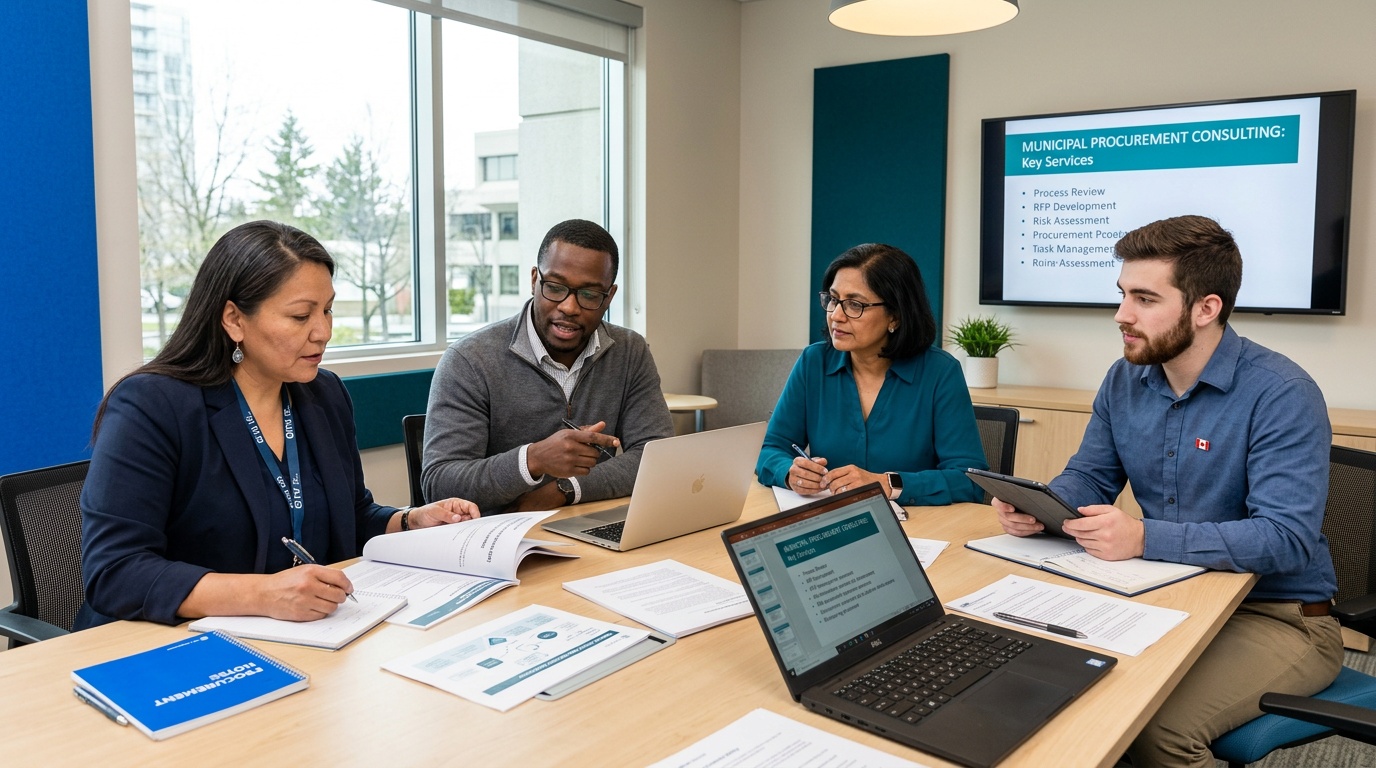
Services should be shaped around the municipality’s risk, capacity and immediate priorities. A consultant may review an existing process, support one complex procurement or work with leadership on a broader procurement strategy. The strongest scope describes the decisions to be supported, the documents to be delivered, the municipal staff who will participate and the knowledge that should remain after the assignment. Organizations seeking implementation support can review municipal procurement consulting services for a defined engagement.
Policy, bylaw, and procedure reviews that update outdated rules
Yes, a consultant can review and help update a municipal procurement policy. The review may examine definitions, roles, approval limits, competitive purchasing methods, emergency purchasing, exemptions, documentation, evaluation practices and contract amendments. Municipalities may also use a public-sector procurement and contracting procedures manual as a practical reference. Final adoption remains with the appropriate municipal authority, with legal review where interpretation or enforceability is involved.
Procurement planning, needs assessment, and market analysis
Planning begins before a solicitation is drafted. Support may include stakeholder interviews, demand analysis, requirements gathering, budget alignment, risk identification, make-or-buy consideration and a procurement schedule. Market analysis can help the team understand supplier availability, contract models, accessibility considerations and realistic specifications without giving any supplier improper influence. Early involvement can prevent vague requirements, rushed timelines and evaluation criteria that do not match the actual need.
Sourcing and solicitation support for specialized purchases
For a request for quotations, invitation to tender, request for proposals or other sourcing method, a consultant may help prepare the procurement strategy, statement of requirements, pricing form, mandatory criteria, rated criteria, questions process and evaluation workbook. Specialized categories such as fleet, construction and software may require careful treatment of lifecycle costs, technical performance, implementation, warranties, cybersecurity, accessibility and service levels. The municipality still determines its objectives, approvals and preferred outcome.
Contract administration and supplier performance after award
Procurement support should not stop when the contract is signed. Contract administration may cover deliverables, invoices, milestones, change control, renewal dates, records, issue escalation and communication with the supplier. A supplier-performance process can define who monitors service, what evidence is retained and how unresolved concerns are addressed. Teams that need to strengthen this area can explore contract management training for teams. This post-award discipline helps the municipality manage the agreement it actually awarded, rather than treating the signed contract as the end of the work.
Compliance reviews, process improvement, and team capability building
A compliance review can test whether files show the requirement, market approach, approvals, conflict declarations, evaluation evidence, award decision and contract record. Process improvement may reduce handoff confusion by clarifying intake, templates, review points, segregation of duties and records management. Capability building adds coaching or workshops so staff can apply the process with confidence. For teams seeking a structured learning option, Procurement Training for Teams can support shared foundational knowledge alongside targeted consulting.
| Common municipal problem | Typical advisory deliverable |
|---|---|
| Departments use inconsistent purchasing steps | Process map, roles matrix and practical procedures |
| Policy does not reflect current operations | Gap assessment and draft policy updates |
| Requirements arrive late or lack detail | Intake form, needs assessment and procurement plan |
| Complex solicitation has several evaluation risks | Solicitation package, evaluation model and evaluator guidance |
| Contract issues are discovered after award | Administration calendar, performance measures and escalation process |
When a municipality should bring in a procurement consultant
Signs your procurement function could benefit from outside support
A municipality may need outside support when procurement responsibilities have grown faster than internal capacity. This can happen when staff manage purchasing alongside finance, operations or administration without formal procurement training. It can also appear through rushed solicitations, unclear approval routes, inconsistent templates, weak specifications or files that do not clearly show how the decision was reached. Municipal procurement consulting can provide focused assistance without requiring a permanent change to the organization.
Early department involvement is another useful signal. If procurement staff are brought in after a scope, budget or delivery date has already been promised, there may be little time to assess the requirement, understand the supplier market or select a suitable purchasing method. A consultant can help reset the plan, identify missing information and establish responsibilities before the solicitation is released.
- Staff are carrying procurement duties without a shared foundation of knowledge.
- Departments submit requirements late or provide specifications that are difficult to evaluate.
- Purchasing files lack consistent approvals, evaluation records or conflict-of-interest declarations.
- A policy, bylaw or procedure is outdated, unclear or applied differently across departments.
- A complex purchase involves technical, operational, financial or contract-management risks.
- The municipality needs temporary capacity for a specific procurement, audit response or policy project.
Consulting, internal delivery, training, or legal advice: choosing the right path
The right form of help depends on the problem. Internal staff are often well placed to explain the operational need, approve priorities and manage relationships with departments. Training is suitable when the municipality wants to build shared knowledge and give staff a common process. The Procurement Training for Teams option can support that goal through a Canadian-focused public sector procurement curriculum.
Consulting is more suitable when the municipality needs an assessment, a defined deliverable or hands-on support with a live procurement. Legal counsel should address legal interpretation, enforceability, disputes or jurisdiction-specific risk. Many assignments use a combination: internal staff provide context, a consultant supports procurement design and implementation, training builds capability, and qualified legal professionals review legal questions.
| Situation | Most suitable first step | Municipal role |
|---|---|---|
| Staff need a common foundation | Team training | Set learning objectives and apply the material internally |
| A process or policy needs review | Consulting assessment | Provide records, confirm priorities and approve changes |
| A legal obligation or dispute is uncertain | Qualified legal advice | Supply the facts and follow the appropriate authority route |
| A department has enough capacity and a routine purchase | Internal delivery | Follow policy, document decisions and maintain the procurement file |
| A complex purchase needs several kinds of support | Combination of consulting, training and legal review | Define ownership, approvals and communication among contributors |
Getting help with one specific RFP or a complex purchase
A consultant can support one request for proposals or another complex procurement. The scope might cover needs assessment, market research, statement-of-work development, evaluation criteria, pricing schedules, evaluator orientation, supplier questions, documentation and award recommendations. This targeted model can suit a small municipality that does not need a broad organizational review. The municipality should retain decision authority, ensure fair supplier treatment and confirm that the engagement does not create a conflict of interest.
What a typical consulting engagement looks like, step by step
A well-defined engagement should make the work visible from the beginning. Municipal procurement consulting is not simply a report delivered at the end. It is a structured process with agreed outputs, municipal responsibilities, review points and a plan for transferring knowledge. The exact schedule depends on the assignment, purchasing method, internal approvals and the complexity of the requirement.
Assess and prioritize: where the gaps actually are
The first phase establishes a reliable starting point. The consultant may review policies, bylaws, templates, procurement files, approval practices, contract records and staff workflows. Interviews with departments can show where intake, specifications, evaluation, records management or supplier communication tend to slow down. The municipality then confirms which issues require immediate attention and which can be scheduled later.
Design and implement: updated policies, plans, and processes
Once priorities are agreed, the work moves into practical design. Outputs may include a procurement plan, revised procedure, intake form, evaluation model, approval map, contract-management tool or implementation schedule. The consultant should explain the reason for each change and test the process with the staff who will use it. Municipal leaders remain responsible for approvals, resourcing and alignment with the applicable policy framework.
Coach and hand over: building capability your team keeps
Knowledge transfer should be part of the scope, not an optional extra. Coaching may involve working sessions, document walkthroughs, evaluator preparation, scenario exercises and feedback on draft files. Staff should know who owns each step, which records must be retained, when escalation is required and how to apply the process to future purchases. The Procurement Training for Teams program can complement this work when several employees need consistent procurement education.
Review and measure: what successful outputs look like
The final phase checks whether the agreed outputs are usable and complete. Success may mean that staff can locate the current procedure, explain approval responsibilities, prepare a defensible procurement file and monitor contract obligations. A review meeting can identify remaining questions, assign owners and establish a future check-in. Useful measures should relate to the engagement’s purpose, such as completed templates, documented training, clearer handoffs or consistent file requirements. Avoid promising savings or faster cycle times unless the municipality has evidence to support those claims.
Getting ready: a readiness checklist and how to choose the right consultant

Preparation makes advisory support more useful. Before speaking with a consultant, gather the documents and practical information that show how purchasing currently works. This gives the municipality a clear starting point and helps separate an immediate assignment from a longer capability-building plan.
A municipal procurement readiness checklist covering policy, people, process, and documentation
- Policy: Confirm that the purchasing policy, bylaw, delegated authorities, thresholds and approval routes are current and accessible.
- People: Identify procurement roles, departmental contacts, evaluators, approvers and staff who require foundational training.
- Process: Map intake, planning, solicitation, evaluation, award, contract administration and renewal activities.
- Technology: Record the systems used for requests, electronic bids, approvals, records, contract dates and supplier information.
- Documentation: Gather templates, recent procurement files, evaluation notes, approvals, conflict declarations and contract records.
- Supplier management: Note how performance, invoices, changes, disputes, insurance, deliverables and closeout are monitored.
Use the checklist to identify missing information rather than to judge staff performance. A small municipality may begin with one process map and a sample file review. A larger organization may need separate workstreams for policy, technology, category planning and contract governance.
What to look for when selecting a consultant
- Experience with Canadian public-sector purchasing and municipal operating realities.
- A proposed scope that names activities, deliverables, review points and municipal responsibilities.
- Practical implementation ability, not only recommendations or presentation materials.
- Independence, transparent conflicts-of-interest practices and appropriate supplier boundaries.
- Comfort working with policy, records, accessibility, privacy and contract-management considerations.
- A knowledge-transfer plan that leaves staff with usable tools and stronger judgement.
- Clear limits between educational guidance, procurement advice and qualified legal advice.
Where to build internal capability next, and a note on official guidance
Choose the next learning step according to the gap. Staff may need introductory concepts, applied practice, evaluator preparation or a shared approach across departments. Procurement Training for Teams provides a Canadian-focused public sector procurement curriculum. Its progressive certification pathway from essentials to procurement expert level can support continuing development. Procurement Training for Teams may be paired with targeted consulting support when the team needs both education and implementation assistance.
NECI The Procurement School Inc. can help organizations build foundational knowledge through training programs, custom team training and consulting support. The best next step is one that leaves the municipality more prepared to make documented, fair and accountable decisions independently.