government procurement workshops
Public procurement is accountable work. Government procurement workshops give practitioners a focused way to learn about planning, solicitation, evaluation, contract management and public accountability in a Canadian setting.
Key Takeaways
- Workshops give new practitioners a structured path through the full procurement cycle, covering planning, solicitation, evaluation and contract management in one setting.
- Training designed for the Canadian public sector helps learners connect lessons directly to the rules and accountability expectations they will face on the job.
- Guided learning builds confidence before practitioners take on live procurements, reducing the risk of costly missteps along the way.
- Teams that train together develop shared vocabulary and consistent practices, which strengthens collaboration across an organization’s procurement function.
- Choosing a workshop that matches your role and experience level makes the learning practical, whether you are new to procurement or support it as part of a broader job.
A well-designed session can also help a team establish shared vocabulary. That common foundation supports clearer communication, more consistent records and better handoffs between program areas, finance, legal services and procurement staff.
What is a government procurement workshop?
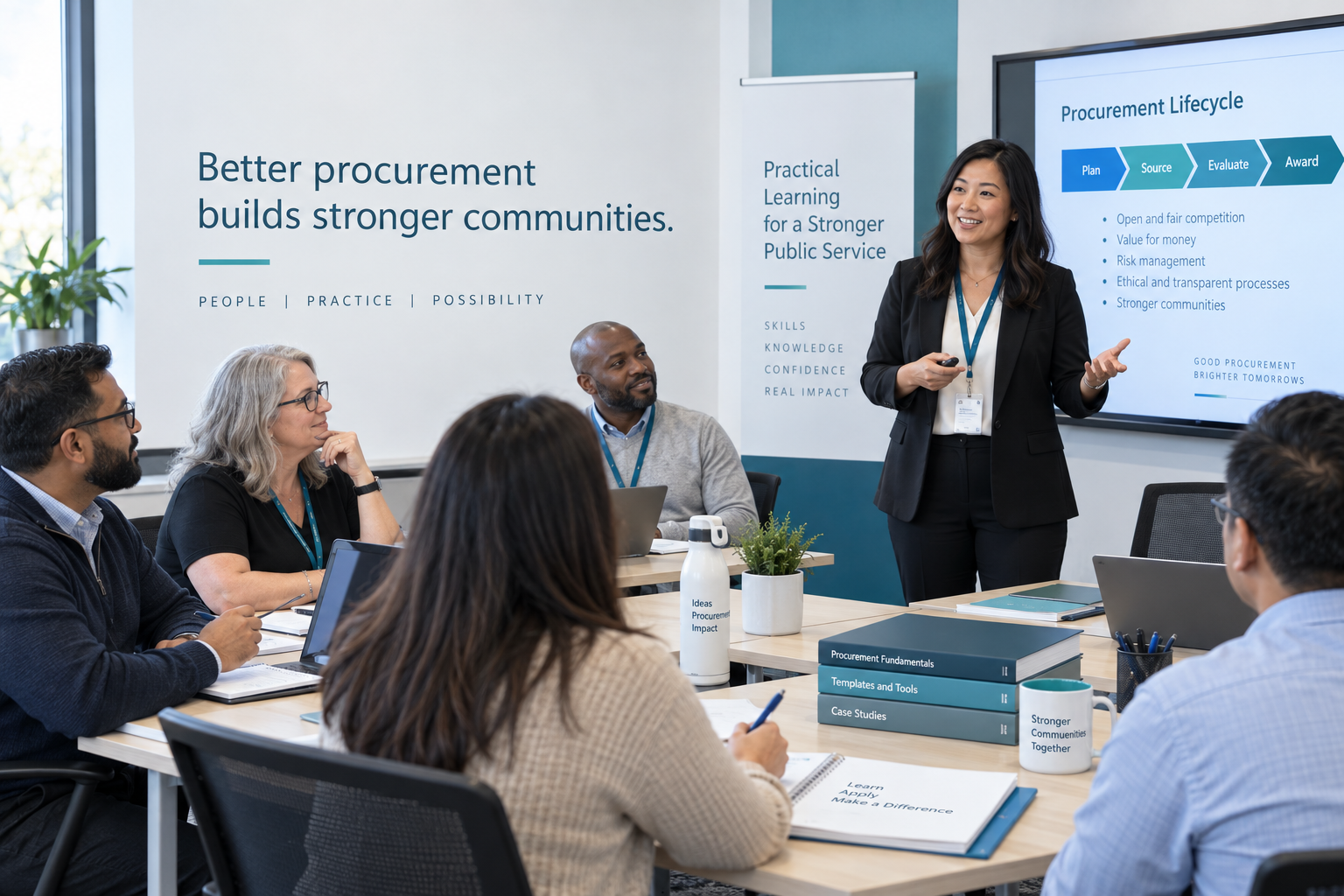
A government procurement workshop is a focused learning session that helps participants apply public purchasing principles to realistic situations. It may combine instruction, discussion and practical exercises covering needs identification, market research, specifications, competitive bidding, evaluation, supplier communication, documentation and contract management.
A plain-language definition
Unlike a presentation built mainly around listening, a workshop gives participants time to work through examples. They might review a statement of requirements, identify unclear evaluation criteria, practise scoring proposals or examine a contract file. The facilitator then connects the activity to fairness, accountability, conflict-of-interest controls and a clear record of the decision.
This format can support people who have recently inherited purchasing responsibilities, private-sector professionals working with public buyers, procurement officers, contract managers and teams building shared foundations. It does not require every participant to arrive with specialist knowledge.
How a workshop differs from other learning formats
A workshop is usually narrower and more applied than a full course. A webinar may focus on a presentation or update, while a workshop sets aside time for questions, group analysis and feedback. A certificate program follows a wider curriculum across several subjects. A conference session is often a short presentation with limited time for guided practice.
These formats can work together. A workshop may suit a team with a defined capability gap, such as evaluation scoring, procurement planning or contract-file organization. Someone building knowledge from the ground up may prefer a longer learning pathway that begins with fundamentals.
How long do workshops last?
Workshops may be offered in half-day, full-day or two-day formats, either in person or virtually. A sample agenda could move from public procurement principles and planning to requirements, solicitation design, evaluation exercises, supplier communication and contract administration.
Before registering, ask whether the schedule includes practice, facilitator feedback, take-home resources and a clear learning outcome. Professional development recognition varies by provider and program, so confirm the details directly rather than assuming a session qualifies for a particular designation or credit.
Why Canadian context matters
Training should reflect the jurisdiction in which participants work. Federal, provincial, territorial and municipal organizations may follow different legislation, directives, bylaws, policies, delegations and approval practices. Trade obligations may also apply to some procurements. The Canadian Free Trade Agreement and the Canada-European Union Comprehensive Economic and Trade Agreement provide official starting points for understanding the broader context. Participants should confirm current requirements with the relevant government source and their organization.
Why team learning can help
Procurement Training for Teams provides a Canadian-focused public sector procurement curriculum for organizations that want shared foundations. It includes team pricing; confirm current terms before enrolling and multiple course levels from PSPP® 101 (Essentials) through PSPP® 301 (Expert). Procurement Training for Teams can be considered when onboarding several staff members or creating a common professional development plan.
For a team, shared learning can make everyday handoffs easier. Participants practise using the same terminology for requirements, specifications, evaluation criteria, approvals, contract amendments and supplier performance. Each organization remains responsible for confirming its own legislation, policy, delegation of authority and trade-agreement requirements.
Canadian-focused instruction also presents procurement as more than a purchasing task. It is a governance activity supported by planning, fairness, transparency, competition, privacy, accessibility, risk management and stewardship of public funds. The most useful sessions connect those principles to everyday decisions without presenting general education as legal advice.
What should participants practise?
Useful sessions give participants realistic materials to work with. Activities may include identifying an unclear requirement, drafting measurable criteria, separating mandatory conditions from rated criteria, applying an evaluation score, preparing supplier communication or reviewing a contract file for missing documentation.
A workshop should also make roles and controls easier to understand. A program manager may explain the business need, an evaluator may document independent scoring, and a contract manager may monitor deliverables and changes. Clear responsibilities help reduce informal decisions, unmanaged conflicts of interest and gaps in the procurement record.
How do you decide whether a workshop is suitable?
Choose a focused workshop when the learning need is specific and participants will benefit from immediate practice. A half-day session may suit an introduction or targeted refresher. A full day can provide more room for planning, solicitation design and evaluation work. A longer format may help when the group needs to connect the procurement cycle with contract administration and case-based exercises.
Before registering, confirm the intended audience, learning outcomes, delivery method, class activities, facilitator experience, participant materials and any professional development recognition. Ask whether the content fits the organization’s jurisdiction and reflects public-sector accountability rather than private purchasing alone.
Teams should also plan what happens after the session. Updated templates, peer review, coaching or a documented onboarding plan can help participants apply what they learned. The learning should have somewhere to land.
Choose training by capability need, not job title alone

The strongest training decision starts with the work participants must perform after the session. A new buyer may need fundamentals and terminology. An evaluator may need practice with rated criteria, consensus discussions and evidence-based scoring. A contract manager may need guidance on deliverables, amendments, performance monitoring, payment controls and closeout records. Targeted contract management training for teams can address those post-award responsibilities.
Write the learning need in observable terms before selecting a program. “Improve procurement knowledge” is broad. “Apply a documented evaluation method to a sample solicitation” is specific. Other useful outcomes include preparing a clear statement of requirements, identifying approval points, recording a conflict-of-interest declaration or planning supplier communications.
A practical selection checklist
Review the program description against five questions. Is it designed for Canadian public-sector work? Does it fit the participant’s jurisdiction and level of responsibility? Will learners practise decisions rather than only hear presentations? Are the facilitator’s experience and learning outcomes clear? Can the organization apply the material through templates, coaching or a revised procedure?
- Audience: new practitioners, program staff, evaluators, managers, suppliers or experienced procurement professionals.
- Subject: planning, market research, solicitation, evaluation, award, contract administration or supplier performance.
- Format: in-person, virtual, blended or self-paced learning.
- Evidence of learning: exercises, discussion, feedback, a knowledge check or an applied work product.
- Follow-through: a plan for supervisors and participants to use the learning in active files.
Cost belongs in the decision, but it should not be the only measure. A session that misses the actual capability gap may leave staff unable to apply the process. A focused program is easier to assess when the proposal connects it to onboarding, consistent documentation, evaluation quality, reduced rework and stronger contract oversight.
Build a business case for team learning
Training requests are easier to assess when they identify a business problem, affected roles, proposed learning outcomes and a way to check progress. Useful evidence may include repeated staff questions, inconsistent templates, delayed approvals, incomplete contract files, unclear evaluator notes or findings from an internal review. The Government of Canada public procurement resources offer an authoritative starting point for public purchasing information.
A proposal can include registration costs, staff time, delivery format, accessibility needs, travel requirements and post-session support. It should also explain what may change afterward, such as a common planning checklist, a standard evaluation briefing, clearer records-management expectations or a defined route for questions and review.
A sensible recommendation for teams
When several employees need a common foundation, Procurement Training for Teams is a practical option to evaluate. Its Canadian-focused public sector procurement curriculum and team pricing, subject to confirmation of current terms and multiple course levels from PSPP® 101 (Essentials) through PSPP® 301 (Expert) can support a planned development approach. Confirm the available format, outcomes and fit with the organization’s current priorities before enrolling.
Make the learning continue after the session
Attendance alone does not create consistent procurement practice. Within a few weeks, supervisors can ask participants to identify one process improvement, share a useful template and discuss a recent file without disclosing confidential supplier information. A short peer review can test whether requirements are measurable, evaluation records explain the decision and approvals align with delegated authority.
Organizations can also maintain a learning register that records completed sessions, role-based development goals and future needs. This supports onboarding when staff move into procurement-related duties. It also helps leaders distinguish between a knowledge gap, an unclear policy, insufficient capacity and a system problem that training cannot solve by itself.