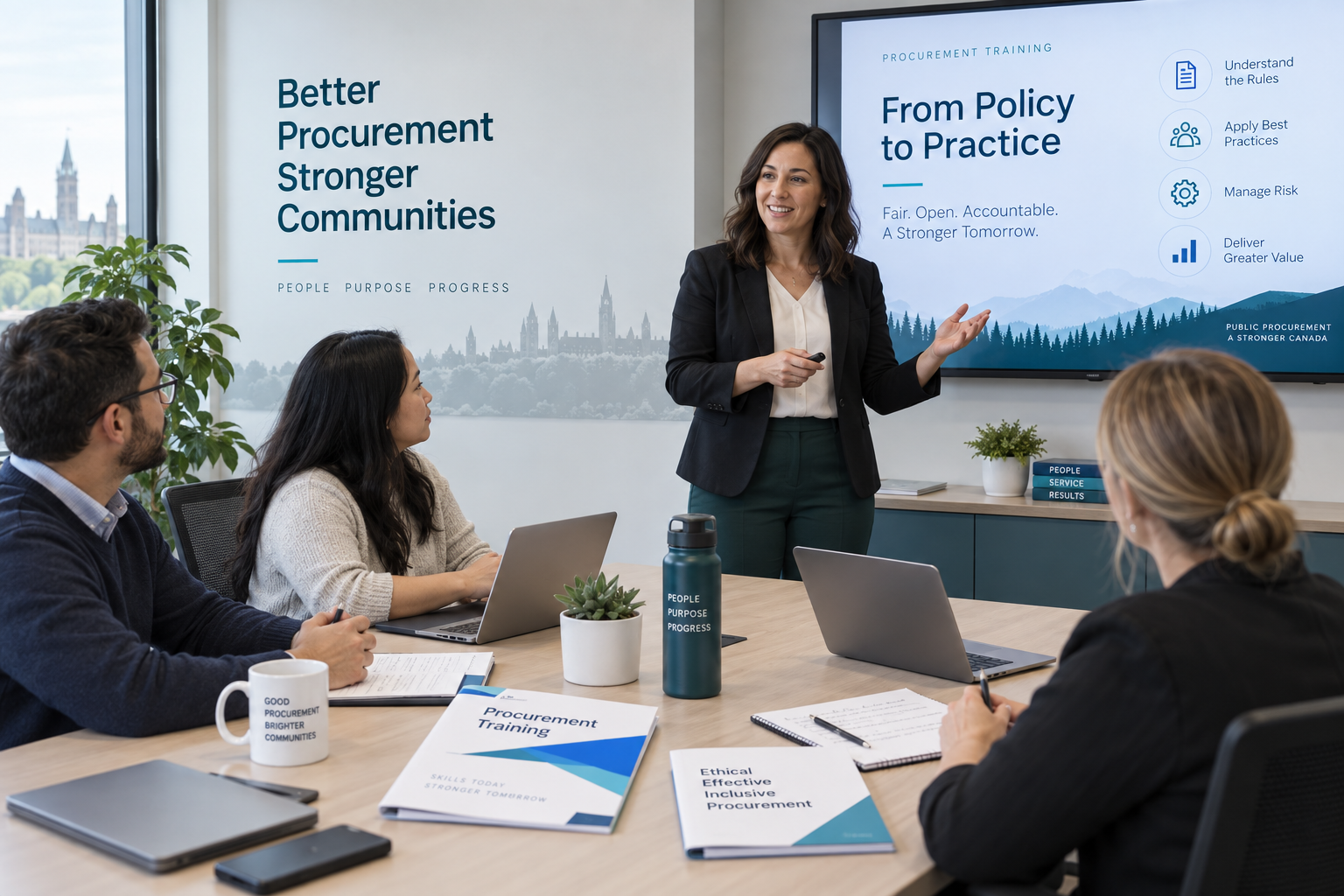
custom procurement training
Public procurement involves more than buying goods or services. Teams must understand requirements, follow approved processes, document decisions and work fairly with suppliers. Custom procurement training connects those responsibilities to the decisions people make in their daily work.
Key Takeaways
- Public procurement asks teams to balance clear requirements, approved processes and fair treatment of suppliers in every purchase they make.
- Custom training bridges the gap between procurement rules and the practical decisions staff face in their day-to-day roles.
- Learning designed around your organization’s real workflows helps people apply policies with confidence rather than guesswork.
- Documentation habits and fair supplier relationships are teachable skills, not just expectations written in policy manuals.
- Tailored education prepares newcomers to carry out procurement responsibilities properly from their very first assignment.
A focused learning plan can support new practitioners, experienced professionals, managers and cross-functional teams. It can give people a common vocabulary and a clearer understanding of their roles when policy, timelines, budgets and stakeholder needs meet.
What is custom procurement training?
Custom procurement training is learning designed around an organization’s roles, procedures, purchasing environment and development goals. Rather than giving every participant the same material, it connects core principles with relevant work such as needs analysis, market research, solicitation planning, evaluation, contract award, supplier performance and contract administration.
The process may begin with a needs assessment. A provider can then consider the team’s experience, internal controls, approval authorities, procurement policies, risk profile and common contract types. Activities might include guided discussions, case exercises, templates and scenario-based practice. Training does not replace organizational policy, legal review or delegated authority. It helps people apply approved requirements with care and consistency.
Key insight: Useful training reflects the decisions learners make. A buyer may need practice with specifications and supplier communications, while a manager may need more time on governance, oversight, delegated authority and risk.
Benefits of custom procurement training

The clearest benefit is relevance. Participants can work through situations close to their responsibilities, such as defining a need, preparing evaluation criteria or recording a contract decision. That practice helps them connect concepts with the steps, approvals and records required in their own organization.
Shared learning also helps different groups understand their responsibilities. Procurement, finance, operations, legal, program and executive staff may each influence a purchasing decision. A common discussion can make handoffs clearer and create space to address fairness, transparency, confidentiality, conflicts of interest and supplier communication.
Organizations may use a tailored program to introduce newcomers, refresh established practitioners, prepare staff for new duties or address a recurring process gap. Training for My Team is designed for organizations seeking a coordinated learning experience. The Procurement School states that it has provided procurement training since 1980 and supported more than 435 organizations, including government bodies across Canada.
Learning has more value when it continues after the session. Teams can leave with questions to ask, documentation habits to practise and clear next steps. That follow-through helps connect education with accountability, professional judgement and ethical procurement practice. Training for My Team offers a starting point for organizations building capability together.
How to choose custom procurement training
Start by identifying the capability your organization wants to build. Who will attend? What decisions do they make? Where does uncertainty appear in the procurement cycle? New practitioners may need foundations in public purchasing, policy, ethics and documentation. Experienced staff may need applied practice in sourcing, evaluation, contract administration or supplier performance. Managers may need learning on governance, approval authority, risk and oversight.
Ask a provider how it will understand your environment before designing the program. Discovery may cover organizational objectives, learner experience, procedures, purchasing categories, contract types and recurring challenges. Ask how much time will be devoted to practice. Scenarios, templates, decision records and facilitated discussion can make a session more useful than presentation alone.
Questions to ask a training provider
Request a clear outline of learning objectives, delivery format, preparation requirements and expected outcomes. Confirm whether the program can accommodate different roles, locations, schedules and levels of experience. Ask how confidential information will be handled and how questions requiring policy or legal interpretation will be managed. Training should support internal authorization and professional advice, not take their place.
- Relevance: Does the content reflect public procurement responsibilities, contract management and ethical decision-making?
- Application: Will learners practise needs definition, market research, solicitation, evaluation, award and administration?
- Accessibility: Are materials, facilitation and activities suitable for the team’s experience and working context?
- Accountability: Are roles, records, approvals, fairness and conflict-of-interest considerations addressed?
- Follow-through: Will participants leave with usable tools, reflection prompts or an implementation plan?
Key insight: The best fit is not necessarily the broadest course. It is the program that gives the right people relevant practice, a shared vocabulary and a dependable way to apply learning within approved organizational processes.
Agree on how learning will be reviewed after delivery. Possible indicators include participant confidence, completion of practical exercises, the quality of procurement records and feedback from managers. Use these measures to identify knowledge gaps and coaching needs, not to create pressure for artificial scores.
Before committing, confirm the full scope: facilitator expertise, preparation meetings, participant materials, accessibility, technology, scheduling, privacy expectations and post-session support. A careful selection process can help your organization choose learning that fits its people and working context.