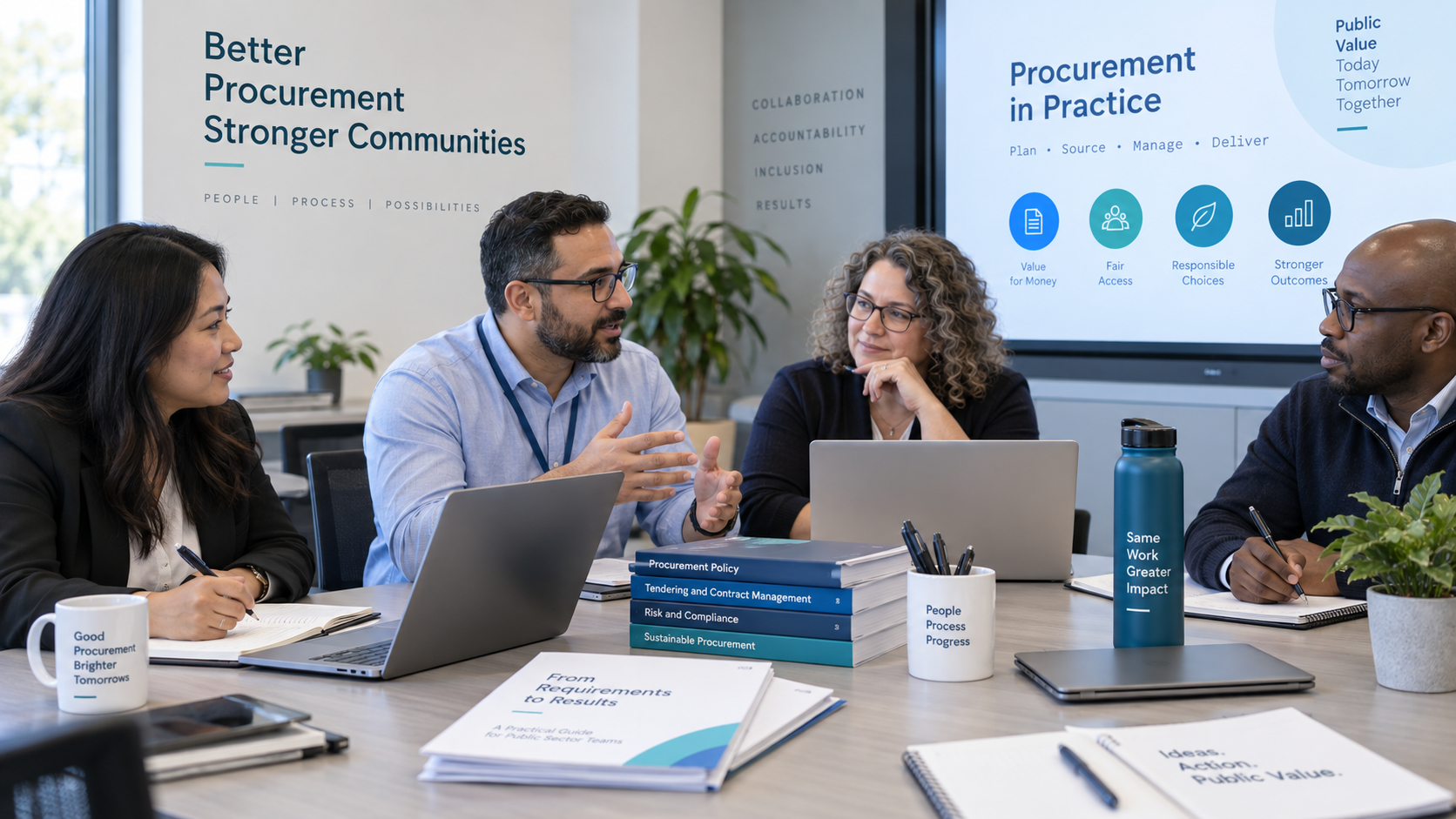
cross functional procurement training
Public procurement works best when the people who request, review, approve, buy, and manage goods or services understand how their responsibilities connect. Cross functional procurement training gives these participants a shared foundation, helping them contribute to consistent decisions, complete records, and accountable contract management.
Key Takeaways
- Cross functional training brings together everyone who requests, reviews, approves, buys, and manages goods or services, so all participants work from the same base of knowledge.
- When colleagues across departments share a common understanding of the procurement cycle, decisions stay consistent and records remain complete at every stage.
- Seeing how one role affects the next, from planning through contract award to supplier performance, helps each person make choices that support the whole process.
- A shared foundation builds accountability, because every participant can explain their contribution to the file and stand behind the outcome with confidence.
- This style of training is especially helpful for newcomers in operations, finance, legal, or program delivery who want to contribute meaningfully from the start.
This learning is not limited to procurement specialists. Finance, legal, operations, program staff, technical experts, managers, and evaluation committee members all influence purchasing outcomes. Each group needs practical guidance for its own role, without needing to become a procurement professional.
What is cross functional procurement training?
Cross functional procurement training is coordinated learning for people across an organization who take part in purchasing and contract management. It connects procurement requirements with everyday work, including defining needs, preparing requisitions, evaluating submissions, approving commitments, communicating with suppliers, managing contracts, and maintaining records.
A role-based program gives each participant a clear view of where their responsibility starts, where it ends, and when to involve procurement or another control function. End users might practise writing a clear statement of requirements. Finance staff might review budget confirmation and segregation of duties. Evaluators might work through scoring, confidentiality, and conflict-of-interest declarations.
The shared curriculum can then connect those contributions across the procurement process. A vague requirement can make evaluation harder. An undocumented supplier conversation can create questions about fairness. An unclear approval path can delay a purchase. Working through these connections helps participants see how small decisions affect the complete procurement record.
Canadian public procurement practices vary among federal, provincial, territorial, regional, and municipal organizations. Training should provide a practical foundation while directing participants to the applicable laws, policies, delegations, templates, and official government guidance for their organization. It should support sound judgment, not replace organization-specific direction or qualified professional advice.
Benefits of cross functional procurement training
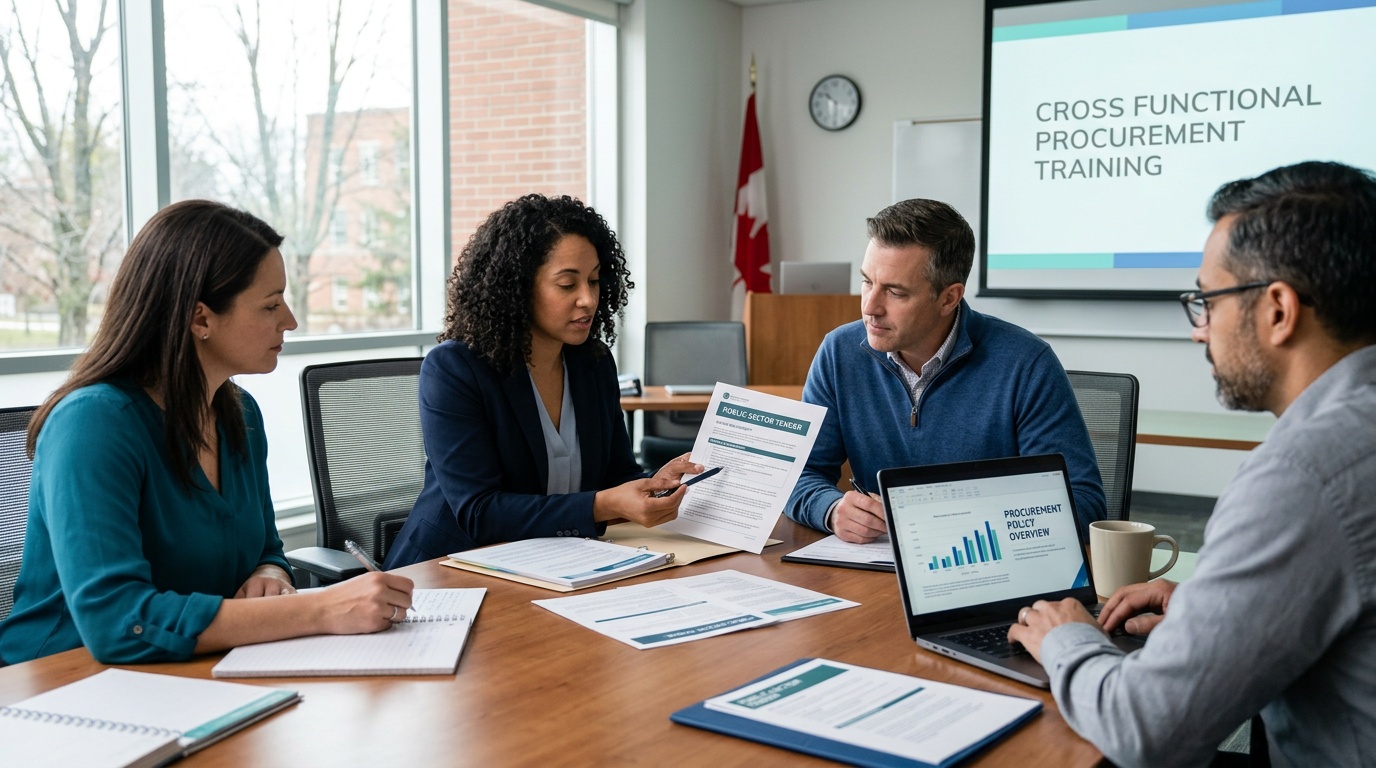
The main benefit is a shared working language. Procurement can explain the purpose of a competitive process, operations can describe the requirement, and finance can identify funding controls. Earlier, clearer conversations help the team address requirements, timelines, approvals, supplier performance, and public accountability before problems reach the file.
Shared learning can also improve requirements and evaluations. Participants are better prepared to describe deliverables, use published criteria, record reasons for evaluation scores, protect confidential information, and disclose potential conflicts of interest. These practices help keep decisions connected to the documented process.
Training can make the correct purchasing route easier to recognize. Staff may not know when to contact procurement, which approvals apply, or what commitments they must avoid making to a supplier. A practical session can walk through the organization’s workflow and show what information should be ready before a request moves forward.
Contract management benefits from the same connection between roles. After award, the operational owner may monitor deliverables and acceptance, while procurement supports supplier performance information and the contract record. Participants can practise documenting issues, escalating concerns, and distinguishing routine administration from a change that requires review under the organization’s procedures.
For leaders, the goal is a repeatable team capability rather than a single event. The Procurement School offers Training for My Team for organizations seeking structured learning that can reflect their people, procedures, and responsibilities. The right program gives participants a common starting point while leaving room for role-specific practice.
How to Choose cross functional procurement training
Start with the work your team must perform, not with a course catalogue. Map the procurement journey from planning and requisition through solicitation, evaluation, approval, contract award, administration, and closeout. Then identify who contributes at each stage. Include end users, finance, legal, operations, information technology, project leads, delegated authorities, procurement staff, and anyone who may serve on an evaluation committee. This role map shows where people need shared knowledge and where they require role-specific instruction.
A suitable program should reflect Canadian public-sector responsibilities. Look for practical coverage of fairness, transparency, confidentiality, conflict-of-interest declarations, segregation of duties, delegated authority, approval thresholds, documentation, records retention, and audit readiness. Depending on the organization, the curriculum may also need to address the Canadian Free Trade Agreement, privacy considerations, Indigenous procurement objectives, accessibility, sustainable purchasing, emergency procurement, and contract amendments. Training should explain these topics in relation to daily decisions, rather than present them as detached definitions.
Key insight: Ask whether participants will practise the decisions they make at work. A useful session may include a vague statement of requirements, an incomplete requisition, a proposed sole-source purchase, an evaluation scoring exercise, and a contract change request. Scenarios should reveal who approves each step, which records belong in the file, and when procurement or another control function must be consulted.
Check how the provider adapts content to your organization. Generic instruction can establish a foundation, but team learning becomes more useful when it reflects your policy manual, purchasing thresholds, delegation schedule, templates, approval workflow, standing offers, and common risk areas. Ask for a discovery conversation before delivery. The provider should be able to explain how it will handle different experience levels, municipal or broader public-sector context, virtual or in-person participation, accessibility needs, and examples that protect confidential information.
Assess the learning design as carefully as the subject matter. Look for clear learning objectives, plain-language explanations, facilitated discussion, realistic exercises, feedback from an experienced instructor, and materials that participants can use after the session. A completion certificate can document attendance, but it does not show whether staff can write defensible requirements or apply evaluation rules. Ask how learning will be reinforced through job aids, manager follow-up, refresher sessions, coaching, or a review of procurement files.
Finally, define how success will be observed without promising unsupported financial returns. Establish practical indicators such as more complete requisitions, earlier procurement involvement, better evaluator declarations, stronger contract files, fewer avoidable approval delays, and clearer ownership after award. Confirm delivery scope, participant numbers, customization, education hours, facilitator experience, and follow-up support in writing. The Procurement School’s Training for My Team is a suitable option to investigate when an organization wants coordinated learning built around its people, procedures, and procurement responsibilities. Choose a path that helps staff act with confidence while preserving accountability at every decision point.