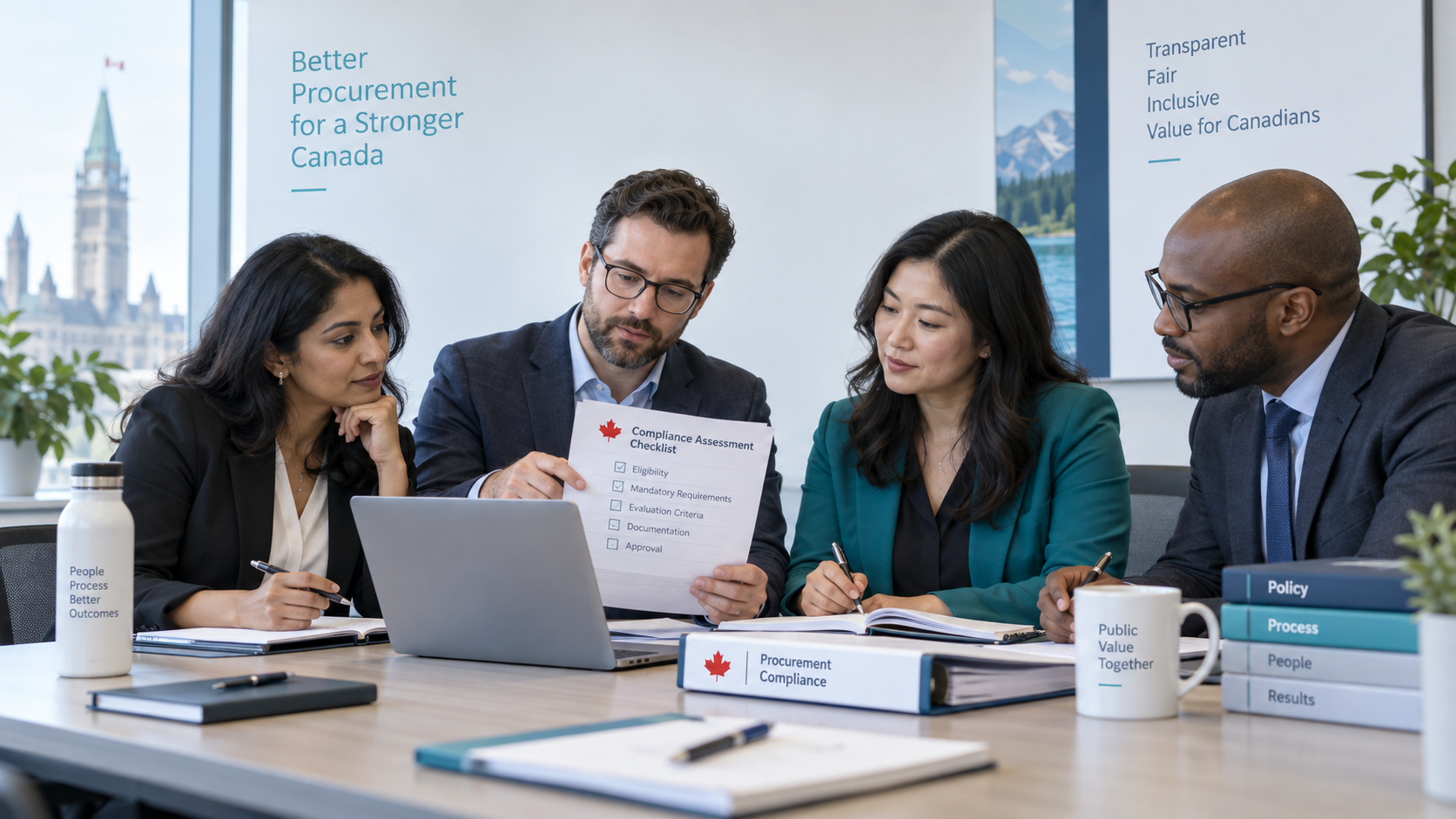
procurement compliance assessment
Public procurement decisions must be fair, documented, authorized, and connected to a legitimate public need. A procurement compliance assessment gives a municipality, agency, or public organization a structured way to examine whether its purchasing practices align with applicable legislation, trade obligations, internal policy, delegated authority, funding conditions, and ethical expectations.
Key Takeaways
- A procurement compliance assessment gives public organizations a clear method to check if their purchasing decisions follow legal rules, trade agreements, and internal policies.
- This structured review helps ensure that every purchase is fair, properly authorized, and linked to a real public need.
- Regular compliance checks identify gaps in meeting funding conditions and ethical expectations, which supports accountability.
- By using a compliance assessment, municipalities and agencies can confidently show that their procurement practices are transparent and defensible.
The purpose is not to find fault with individuals. It is to make the process understandable and defensible. By reviewing approvals, competition methods, supplier communication, contract records, and payment controls, a team can see where practice is working and where clearer guidance, training, or ownership is needed.
What is procurement compliance assessment?
A procurement compliance assessment is a planned review of how an organization acquires goods, services, and construction. It compares actual practice with the requirements that govern the organization. Those requirements may include provincial or federal legislation, municipal bylaws, procurement directives, financial controls, signing authority, privacy obligations, accessibility expectations, funding agreements, and applicable trade-agreement procedures.
The review normally follows the full procurement lifecycle. It may examine needs analysis, planning, market research, specifications, solicitation design, evaluation criteria, conflict-of-interest declarations, approvals, award notices, contract formation, amendments, performance monitoring, records retention, and closeout. A useful checklist should identify the control being tested, the evidence expected, the responsible role, the finding, and the recommended action.
This work differs from a formal audit. An audit may be conducted under a defined mandate and produce an assurance opinion or formal findings. An assessment is often a practical readiness and improvement exercise. It can be scoped before an audit, after a policy change, during a process review, or when leaders need a clearer view of operational risk. Requirements vary by jurisdiction, organization, procurement type, funding source, and contract value, so the review scope should be confirmed with the appropriate internal authority.
Benefits of procurement compliance assessment

A well-planned procurement compliance assessment turns broad principles into observable practices. Instead of asking whether procurement is “compliant” in general, the team can examine specific questions: Was the requirement approved? Was the procurement method appropriate? Were suppliers given consistent information? Can the evaluation be followed from the published criteria to the award decision? Is the contract manager monitoring deliverables, insurance, renewal dates, and amendments?
This approach supports accountability across procurement, finance, legal, operations, program areas, and contract management. Clear responsibility reduces stalled approvals and prevents important controls from being treated as someone else’s task. It also helps leaders distinguish a policy gap from a training need, a system limitation, a documentation weakness, or a decision that requires legal review.
Key insight
Compliance is easier to maintain when the required evidence is known before a purchase begins. A complete file should tell a coherent story: the business need, available authority, chosen process, supplier treatment, evaluation record, approval trail, contract terms, and ongoing oversight.
Early review can reduce avoidable exposure. Incomplete procurement files, inconsistent evaluations, unauthorized commitments, weak segregation of duties, poor spend visibility, and unmanaged contract changes can create financial, operational, reputational, and supplier-relations concerns. Finding these conditions during a controlled review gives the organization time to correct records, update procedures, assign owners, and establish practical monitoring before a complaint, audit, or service disruption occurs.
The process also supports better public value. Strong documentation helps demonstrate fairness and transparency, while sound specifications and evaluation methods support effective competition and fit-for-purpose outcomes. Contract oversight can reveal missed deliverables, renewal risk, payment discrepancies, performance concerns, or opportunities to improve service levels. These findings should be prioritized according to impact and urgency, not treated as a long list of faults.
Shared learning is another benefit. Teams can use anonymized findings to build common language around solicitation, delegation, bid security, conflict management, records retention, supplier performance, and corrective action. For organizations building capability, Procurement Training for Teams provides a Canadian-focused public sector procurement curriculum. The program includes a progressive certification pathway from essentials to procurement expert level.
Procurement Training for Teams can be a practical next step when an assessment shows that several roles need consistent foundational knowledge. Training does not replace organization-specific policy or professional advice. It helps people understand the process, recognize their responsibilities, ask better questions, and make documented decisions with greater confidence.
How to Choose procurement compliance assessment
Choosing the right procurement compliance assessment begins with defining the decision you need the review to support. A municipality may need to understand whether delegated authority is being used correctly. An agency may want to test solicitation files, contract amendments, or supplier communications. A public organization preparing for a policy change may need a broader review of roles, procedures, systems, and records. The scope should reflect the organization’s jurisdiction, procurement types, funding sources, internal policy, and risk profile.
Look for a method that follows the complete procurement lifecycle rather than examining isolated transactions. The review should consider planning, needs definition, market research, specifications, procurement method, approval thresholds, competition, evaluation, conflict-of-interest declarations, award documentation, contract execution, amendments, payment, performance monitoring, renewal, and closeout. It should also identify the evidence required for each control. A finding is more useful when it explains the expected practice, the record reviewed, the gap observed, the likely risk, and the owner responsible for corrective action.
Key insight
A practical review does not ask only whether a rule exists. It asks whether staff can apply the rule consistently, whether approval responsibilities are understood, and whether the file demonstrates how the decision was made.
Assess the reviewer’s understanding of Canadian public procurement before selecting an approach. The work should account for applicable legislation, regulations, trade-agreement obligations, municipal bylaws, directives, financial controls, signing authority, privacy requirements, accessibility commitments, records-retention rules, and funding conditions. Requirements can differ between a federal department, a provincial organization, a municipality, and a publicly funded entity. A sound scope note should identify which instruments were considered and where legal or policy interpretation must be confirmed internally.
Ownership and follow-through matter as much as the checklist. Ask whether procurement, finance, legal, operations, program teams, and contract managers will participate where their responsibilities apply. The process should protect confidential supplier information, distinguish high-risk findings from administrative corrections, and provide a practical action plan with priorities, deadlines, and accountable owners. Useful outputs may include a control matrix, file-review template, approval map, training needs, procedure updates, and a schedule for monitoring progress.
Finally, choose an assessment that builds capability rather than leaving the organization with a report that few people can use. Reviewers should explain findings in plain language and connect each recommendation to a daily task, such as documenting rationale, checking delegation, recording supplier questions, or tracking contract performance. When several roles need a shared foundation, team procurement training programs can support consistent learning across an organization. Its progressive certification pathway from essentials to procurement expert level can support consistent learning across a team, with. Procurement Training for Teams is best considered alongside organization-specific procedures, not as a replacement for required approvals or professional advice.