procurement practitioner training
Procurement practitioner training helps buyers move beyond issuing purchase orders toward defensible, strategic decisions. The right learning path connects daily work with requirements planning, market research, solicitation design, evaluation, contract administration, supplier performance and public accountability.
Key Takeaways
- Training shifts your focus from routine ordering to strategic decisions that can be defended under public scrutiny.
- A complete learning path covers the full procurement cycle, from requirements planning through contract administration and supplier performance.
- Skills in market research and solicitation design help you run fair, transparent processes that attract competitive bids.
- Understanding evaluation methods and public accountability prepares you to make choices that stand up to audit and review.
- Practical training connects daily tasks with the bigger picture of value, risk, and compliance in public procurement.
For a new buyer, this structure provides a practical way to learn. It also helps experienced purchasing staff identify capabilities needed for complex sourcing, contract management and stakeholder work.
Understanding Procurement Practitioner Training: Your Career Launchpad
Practitioner training is applied education for people who manage purchasing and procurement activities in real organizations. It covers the full procurement lifecycle, not only order processing. Learners practise defining needs, engaging internal clients, assessing suppliers, documenting decisions, managing risk and monitoring contract results. In a public setting, work must also reflect transparency, fairness, competition, delegated authority and applicable trade obligations.
What Is Practitioner Training in Procurement?
Practitioner training turns procurement policy and theory into repeatable workplace habits. A useful curriculum follows a purchase from the first statement of need through specifications, market analysis, competitive process, evaluation, award, contract formation and supplier management. It explains why each stage exists, what evidence belongs in the file and how buyers should communicate with technical specialists, finance, legal advisers and vendors.
This differs from narrow instruction on enterprise resource planning systems or purchase order workflows. Those tools have a place, but purchasing is not the whole profession. A practitioner must understand scope, commercial terms, approval limits, conflict-of-interest controls, records management and contract performance. Applied exercises, realistic scenarios and feedback help transfer these lessons into daily work. The recommended Custom Training for Teams option can help organizations organize learning around their procedures, roles and procurement challenges.
Why Formal Training Matters for Buyers
Many new buyers receive tasks before they receive a clear framework. They may know how to create a requisition, contact a vendor or issue an order, yet feel uncertain when a requirement is ambiguous, a supplier challenges an evaluation or an internal client requests a preferred brand. Formal learning gives them a shared decision process and a vocabulary for raising concerns early.
It supports sound professional judgement by teaching buyers to separate a business need from a preselected solution, test whether specifications are measurable, maintain an audit trail and ask when specialized advice is needed. This can reduce rework, vendor confusion and stress during extended sourcing cycles. A structured curriculum is especially useful for teams seeking consistent onboarding instead of informal instruction that varies by supervisor.
Bridging the Tactical to Strategic Divide: The Core Challenge
Tactical work is visible and immediate: processing orders, checking invoices, responding to requests and correcting transaction details. Strategic procurement asks broader questions. What outcome does the organization need? Which risks matter? How will the market respond? What contract structure supports performance over time? A buyer can be competent at transactions and still need new skills for category planning, sourcing strategy and supplier relationship management.
The transition begins by connecting each activity to its purpose. Instead of copying a specification, the buyer examines the required function and acceptable outcomes. Instead of selecting the lowest apparent price without context, the buyer considers quality, implementation, service, risk and operating cost. This shift demonstrates judgement, not just task completion. Learners rehearse decisions involving competing needs, incomplete information and accountable documentation.
Essential Competencies for Today’s Procurement Professional
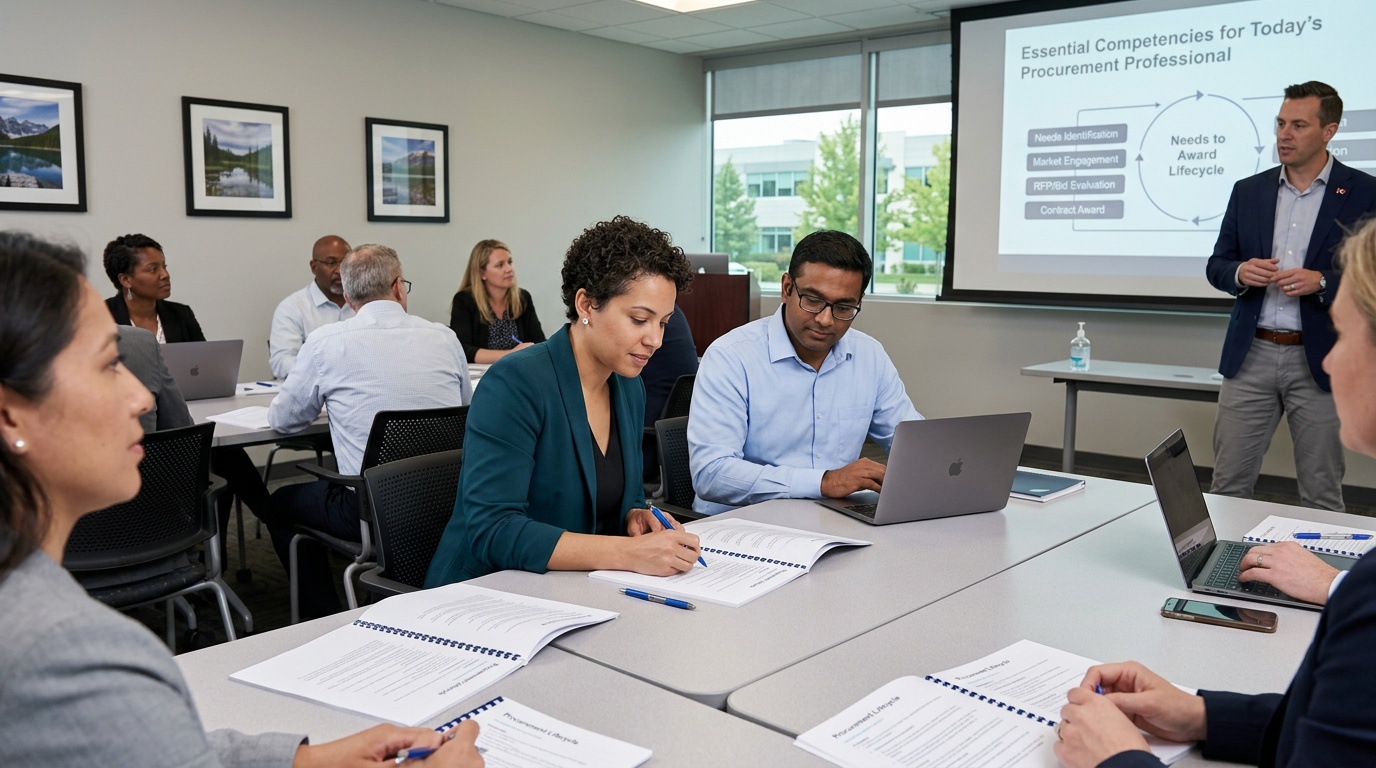
Foundational Procurement Lifecycle Skills: Needs to Award
A sound curriculum starts with the complete procurement lifecycle. Learners should know how to confirm the business requirement, identify stakeholders, assess urgency, estimate value, conduct market research and select an appropriate sourcing approach. They should practise writing clear statements of work, mandatory requirements, rated criteria, deliverables, service levels and payment terms. These skills prevent a common failure: inviting suppliers to respond to a requirement that has not been defined well enough to evaluate.
The award stage requires equal care. A practitioner needs to understand responsive bids, evaluation records, conflicts of interest, approvals, debriefings and award communications. Training should address file organization, version control and decision notes. These create a reliable record of how the organization moved from an identified need to a contract decision.
Beyond the Basics: Evaluation, Negotiation, and Risk Management
Evaluation requires more than reading proposals and choosing a preferred supplier. Buyers need to help teams apply criteria consistently, distinguish mandatory conditions from rated factors and document evidence against published requirements. Technical evaluators may understand operations deeply while having limited procurement experience. The buyer supports a fair process without taking over subject-matter judgement.
Negotiation and risk management may involve price, scope, schedule, warranties, insurance, privacy, cybersecurity, intellectual property, business continuity and remedies. Training should show how to identify risks before solicitation, assign ownership and monitor controls during contract administration. It should also explain when negotiation is permitted and when the process must remain based on stated solicitation terms.
Understanding Total Cost of Ownership and Value
Price is one part of a purchasing decision. Total cost of ownership includes acquisition, implementation, training, maintenance, support, energy, licences, replacement and disposal. A lower initial price may not represent better value if a product requires intensive servicing or creates operational downtime. A higher upfront investment may be reasonable when it supports durability, accessibility, reliability or lower operating costs.
Practitioner training should teach buyers to define value for the specific requirement rather than rely on assumptions. Useful questions include: Which costs will the department carry after award? What performance measures will show success? Which risks could change expected cost? Can sustainable, social or lifecycle considerations be included without compromising fairness and competition? Clear answers improve business cases and give evaluators a stronger basis for decisions.
Navigating Canadian Public Sector Procurement Frameworks: High-Level Overview
Public procurement adds obligations that may not apply in the same way to a private purchase. Buyers may need to work within departmental, provincial, territorial or municipal policy; delegated financial authority; open competition requirements; records and privacy rules; accessibility expectations; and applicable Canadian trade agreements, including the Canadian Free Trade Agreement and the Canada-European Union Comprehensive Economic and Trade Agreement where the organization and procurement are covered.
The exact process depends on the public body, procurement value, commodity, funding source and governing policy. A responsible curriculum does not present one checklist as universal law. It teaches learners to identify the applicable authority, confirm thresholds and exemptions, seek current guidance and document their rationale. Public buyers must protect fairness, openness and public confidence alongside the operational objective.
Practitioner Competency Checklist
Use this checklist to assess whether a learning program addresses the work buyers perform:
- Needs analysis, stakeholder engagement and requirement definition
- Market research, supplier outreach and sourcing strategy
- Specifications, statements of work and measurable deliverables
- Solicitation structure, evaluation criteria and scoring discipline
- Ethical conduct, conflicts of interest and confidentiality
- Negotiation principles, commercial terms and contract risk
- Total cost of ownership, value assessment and lifecycle thinking
- Contract award, records management and supplier communications
- Performance monitoring, issue escalation and change control
- Public-sector policy, trade agreement awareness and delegated authority
A program covering these areas gives learners a practical foundation without reducing procurement to transaction processing. It also gives managers a basis for identifying capability gaps, assigning coached practice and measuring progress through better documentation, clearer requirements and more consistent contract decisions.
For organizations building common capability, Custom Training for Teams can be considered when shared examples, role-specific practice and a consistent internal vocabulary are priorities.
Structured Pathways: From Onboarding to PSPP® Certification
Starting a procurement role can feel demanding when responsibilities arrive before formal support. Procurement practitioner training gives new buyers a sequence for building judgement, confidence and practical capability. The aim is to connect guided learning with sourcing files, stakeholder conversations, supplier issues, evaluation records and contract administration rather than collect credentials without workplace application.
The New Buyer’s Journey: Overcoming Imposter Syndrome and Burnout
Imposter syndrome often grows when a buyer manages unfamiliar work without a reliable framework. A new practitioner may understand purchase orders but feel unprepared when an engineering team provides conflicting specifications, a vendor disputes a requirement or an internal client requests an exception. These situations show why onboarding should include coached practice, decision templates, escalation routes and time for questions.
Burnout also has a practical dimension. Repeated vendor disputes, unclear scopes and prolonged approvals consume attention when roles and contract terms are not defined. A structured plan helps buyers recognize issues earlier, separate urgent matters from important ones and document decisions before confusion spreads. Managers can support progress through staged assignments rather than assigning a complex competitive process without preparation.
Mapping Your Training: Key Credentials and Applied Learning
Map learning to the work you need to perform, not only to a course catalogue. Begin with organizational policy, ethics, delegated authority, records management and procurement technology. Continue with requirements development, market research, solicitation planning, evaluation, negotiation, contract award and supplier performance. Each topic should produce a workplace output, such as a statement of work, evaluation plan, risk register or contract management checklist.
Credentials can provide structure, but applied learning determines whether knowledge transfers into practice. Ask whether the program includes cases, facilitator feedback, peer discussion and realistic public-sector scenarios. A broad supply chain credential may address inventory, logistics, forecasting and operations. Those topics can be useful, while a public procurement pathway gives greater attention to fairness, transparency, competition, governance and defensible records.
| Learning route | Useful when | What to confirm |
|---|---|---|
| Self-paced online | The learner needs flexibility around operational duties | Practical exercises, feedback and current Canadian content |
| Facilitated virtual | The learner benefits from discussion and accountability | Live participation, case work and opportunities to ask questions |
| Team-based learning | An organization needs shared procedures and language | Role-specific examples, group activities and workplace application |
Focus on PSPP®: A Canadian Public Procurement Pathway
PSPP® can be considered by learners seeking education centred on public procurement practice in Canada. Its relevance comes from understanding public accountability alongside commercial judgement. Learners should examine how policy, trade obligations, delegated authority, accessibility, confidentiality and open competition affect the procurement file. They should also distinguish a private-sector preference from a public-sector requirement supported by documented authority.
Before selecting a PSPP®-aligned plan, confirm current program requirements, learning sequence and assessment expectations with the responsible program provider. Treat certification as one development stage, not the finish line. Continue building capability through supervised sourcing, contract reviews, supplier meetings and post-award performance monitoring.
Comparing Training Formats: Online, Virtual, and Team-Based Learning
Format should match the learner’s environment. Online study can suit an experienced professional who needs independent pacing and workplace coaching. Virtual instruction provides structure without travel and supports discussion of evaluation dilemmas or contract scenarios. Team learning is useful when inconsistent practices create rework, because participants can examine the same case, language and approval path together.
- First 30 days: learn policy sources, approval roles, systems, ethics expectations and file standards.
- Next 60 days: practise requirement definition, market research, solicitation preparation and evaluation support.
- By 90 days: manage a supervised procurement file and review lessons with a knowledgeable practitioner.
- Ongoing: pursue PSPP® learning, maintain professional development and apply feedback to increasingly complex contracts.
For organizations that need learning tied to internal procedures, Custom Training for Teams offers a practical format for shared discussion and role-based application. Custom Training for Teams may suit new buyers, technical evaluators and contract managers who need a common approach to public procurement work.
Maximizing Training ROI: Practical Application and Team Impact
Training creates value when it changes daily decisions, not when learners merely complete modules. A useful program helps buyers communicate requirements clearly, identify uncertainty early and keep the procurement file aligned with the contract outcome. Procurement practitioner training works best when participants apply each lesson to realistic sourcing, evaluation and contract management situations.
Applying Learning: Reducing Contract Disputes and Vendor Friction
Many supplier disputes begin before award. An unclear statement of work, inconsistent evaluation record or incomplete change process can create different expectations for the buyer, vendor and internal client. Applied learning lets practitioners examine these pressure points before they appear in a live file. They can practise writing measurable deliverables, confirming responsibilities, recording assumptions and establishing methods for questions, amendments and performance concerns.
This work improves conversations with technical and operational teams. A buyer does not need to become an engineer or service specialist, but must ask whether a specification is necessary, measurable and open to reasonable competition. Shared review can expose technical gaps early, reduce clarification rounds and support an orderly contract relationship after award.
Building a Shared Procurement Language with Team Training
Teams work more consistently when terms such as mandatory requirement, rated criterion, deliverable, acceptance, change order and supplier performance have a common meaning. Without that foundation, one person may treat a request as a specification while another sees it as a preferred product. Team learning creates space to discuss roles, approval points, ethics, escalation and documentation using the organization’s examples.
Custom Training for Teams is a suitable option when an organization wants instruction connected to its procedures and workplace challenges. It can bring buyers, program staff, technical evaluators and contract managers into the same conversation, supporting continuity from planning through supplier oversight. The intended outcome is a shared method for reaching and recording sound decisions.
What to Look For in a Practitioner Training Program
Use a short quality check before committing a training budget. Look for a program that:
- Uses Canadian public procurement examples alongside broadly applicable commercial practice
- Connects policy, ethics and accountability with practical workplace decisions
- Includes cases, exercises, discussion and feedback rather than passive content alone
- Addresses requirements, evaluation, contract terms, supplier conduct and post-award administration
- Supports different experience levels without assuming that every learner starts from the same point
- Provides materials that managers can use during onboarding and coaching
- Explains how learners can continue developing after the formal course ends
Ask how progress will be observed. Useful indicators include clearer statements of work, better evaluation notes, fewer preventable clarification cycles, stronger approval records and more timely supplier issue management. These measures connect education with operational performance and public trust more effectively than completion alone.
Your Next Step: Building Confidence in Public Procurement
Choose the next learning step according to the gap in front of you. A new buyer may need structured onboarding and coached file work. An experienced purchasing employee may need support with sourcing strategy, contract administration or stakeholder leadership. A manager may need team development that establishes one approach across departments.
NECI The Procurement School Inc. brings training heritage since 1980 and subject matter experts with approximately 25 years of industry experience. For a team seeking practical, role-based development, Custom Training for Teams can provide a focused next step. With preparation, reflection and ethical practice, buyers can move from transactional uncertainty toward confident, defensible procurement decisions.
Frequently Asked Questions
Which certification is best for procurement?
The best procurement certification depends on your role, sector and career goals, with Canadian public procurement learners often seeking programs that cover the full procurement lifecycle. Choose training that includes requirements planning, competitive processes, evaluation, contract administration, ethics and public accountability, not only purchasing software or order processing.
What are the 5 P’s in procurement?
The 5 P’s in procurement do not have one universally accepted definition, so the framework can vary by organization or course. Many programs focus on people, process, product or service, price and performance, while practitioner training also addresses planning, risk, fairness and documented decision-making.
What is the best training for procurement?
The best procurement training combines practical exercises with the full purchasing and contract lifecycle. Look for learning on needs definition, market research, solicitation design, evaluation, negotiation, approvals, supplier performance and records management, with examples that reflect Canadian public sector requirements when that is your work setting.
Are there any free procurement training courses available?
Free procurement training courses are available through some public agencies, professional associations, colleges and online learning providers. Free resources can introduce terminology and basic purchasing steps, while structured practitioner training is often a better choice for applied practice, feedback, public sector procedures and contract management skills.
What are some good procurement courses for beginners?
Good procurement courses for beginners explain the complete lifecycle from business need to supplier performance and use realistic workplace exercises. A strong starting course covers specifications, market research, sourcing methods, evaluation records, approvals, ethics, contract terms and communication with internal clients, finance, legal advisers and suppliers.
How long does it take to become a procurement practitioner?
Becoming a procurement practitioner usually requires a combination of formal training, workplace practice and guided feedback rather than one fixed time period. Beginners can build a foundation through an introductory course, then develop stronger judgement by handling requirements, evaluations, contracts, supplier issues and documented decisions with appropriate supervision.