🍂 Thanksgiving Deals: save up to $250 on courses & webinars. Ends Nov 30, 2026
Call Now to Connect with an Expert : 250-370-0041
Canadian Procurement & Contracts Training

Procurement Accessibility Requirements Guide

Procurement Accessibility Requirements Guide

procurement accessibility requirements

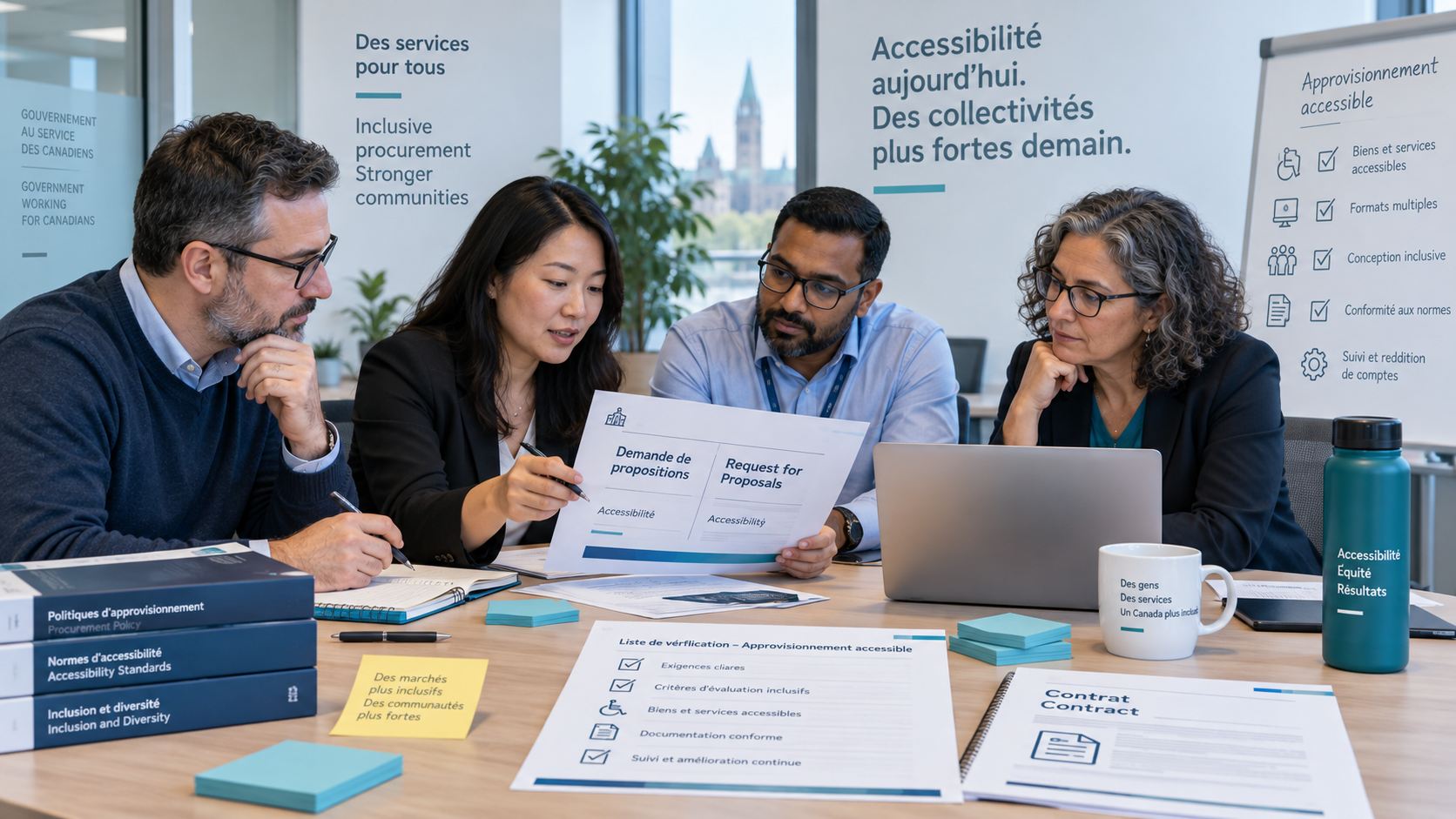
Accessibility belongs in public procurement from the first planning conversation, not as a repair task after a contract is signed. Procurement accessibility requirements describe the accessibility outcomes, features and evidence an organization expects when it buys goods, services or facilities.

Key Takeaways

  • Accessibility works best when it shapes procurement planning from day one, not when it is patched in after a contract is awarded.
  • Well-written accessibility requirements spell out the outcomes, features, and evidence a buyer expects from suppliers of goods, services, and facilities.
  • Setting measurable accessibility criteria in solicitation documents makes it easier to evaluate supplier responses fairly and consistently.
  • Addressing accessibility early helps organizations avoid costly fixes later and supports more inclusive results for the people who use what is purchased.
  • Buyers new to the field can build confidence by learning to describe accessibility expectations in clear, plain language.

For a team new to this work, the practical starting point is straightforward: identify who will use or be affected by the purchase, check the obligations that apply to your organization, and build clear accessibility criteria into the solicitation and contract. Teams that want a shared foundation can explore Procurement Training for Teams, which supports a Canadian-focused public sector procurement curriculum.

What procurement accessibility requirements mean in plain language

A simple definition you can share with your team

Procurement accessibility requirements are specific conditions that help people with disabilities access, use or benefit from a purchased product, service, facility or communication. They can address physical access, digital usability, communication formats, assistive technology, customer support and staff training. In a public purchase, accessibility criteria may appear in the business need, statement of work, specifications, supplier instructions, evaluation method, award decision and contract administration plan.

Why accessibility belongs at the buying table, not after contract signature

Accessibility decisions made before award give the buying organization meaningful influence over the result. A solicitation can ask suppliers to describe their approach, provide supporting documentation, demonstrate a system, and explain how issues will be corrected. The contract can then record deliverables, testing responsibilities, reporting, acceptance criteria and remedies.

When accessibility is raised only after implementation, the organization may face redesign, delay, additional cost and a difficult supplier discussion. Early planning also supports fair competition because each proponent receives the same information and can price the required work. In our work with municipalities and agencies, we see that a short review at the planning stage often reveals affected users, service channels and technical dependencies that a procurement team might otherwise discover too late.

Which purchases usually call for accessibility requirements

Accessibility review is often appropriate when a purchase affects public access, employee work, information exchange or movement through a facility. Common categories include:

  • Software and web content: websites, portals, mobile applications, records systems and online forms.
  • Kiosks and self-service terminals: payment devices, ticketing stations, check-in points and public information screens.
  • Built facilities and renovations: entrances, counters, washrooms, pathways, meeting rooms, lighting and wayfinding.
  • Customer-facing services: call centres, reception, appointment systems, public programs and delivery channels.
  • Documents and training materials: forms, reports, presentations, videos, captions, transcripts and accessible file formats.

This list is a prompt for review, not a universal threshold. A routine purchase can still affect accessibility if it changes how people receive information or obtain a public service. Include procurement, program, information technology, facilities, accessibility and contract management representatives early. Procurement Training for Teams can help teams build consistent practice across those roles.

The Canadian framework: which accessibility laws and standards apply where
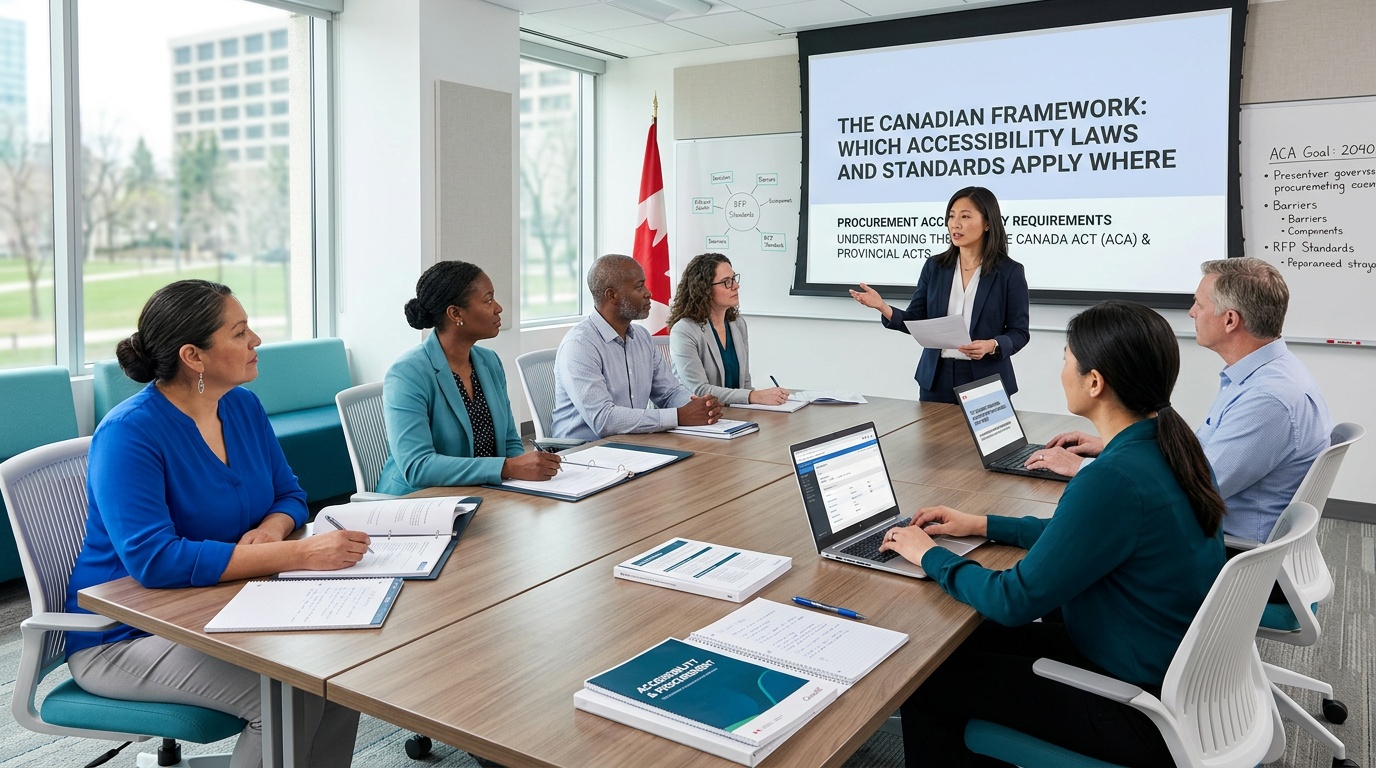
The Canadian framework: which accessibility laws and standards apply where

Federal expectations under the Accessible Canada Act

The federal Accessible Canada Act establishes a goal of a barrier-free Canada by 2040. The Government of Canada identifies the procurement of goods, services and facilities as one of the Act’s priority areas. For federal organizations covered by the Act, procurement is connected to the wider duty to identify, remove and prevent barriers. The Act does not automatically determine the obligations of every provincial, territorial or municipal buyer, so readers should confirm their organization’s coverage.

Provincial acts that reach municipalities, school boards and agencies

Provincial accessibility legislation can apply beyond a provincial department. Depending on the statute and organization, the scope may include municipalities, school boards, hospitals, agencies, universities or other public bodies. Examples include Ontario’s Accessibility for Ontarians with Disabilities Act, Manitoba’s Accessibility for Manitobans Act, Nova Scotia’s Accessibility Act and British Columbia’s Accessible British Columbia Act.

Requirements may involve accessibility planning, service standards, public information, employment, built environments or digital communication. They are not interchangeable across Canada. A buyer should read the applicable statute, regulations, standards and organizational policy before drafting a tender or request for proposals.

A short cross-border note on Section 508 and ADA Title II

Canadian suppliers serving United States buyers may encounter Section 508, which addresses information and communication technology used by the United States federal government. They may also encounter Title II of the Americans with Disabilities Act, which concerns accessibility within state and local government services. These frameworks can inform a supplier’s documentation, but they do not replace Canadian legal or policy review.

For web content and information and communication technology, WCAG 2.1 Level AA is a commonly referenced technical baseline. A statement that a product is “fully compliant” should be supported by defined scope, test methods, known exceptions and current evidence.

How to confirm what applies to your organization

Start with the organization’s legal status, funding structure, service responsibilities and procurement policy. Ask the policy office or accessibility lead which statute, regulation, standard and internal directive governs the purchase. Then involve information technology, facilities, program owners, legal counsel and the contract manager before the solicitation is issued.

Record the source of each requirement and distinguish mandatory conditions from rated criteria. This article provides orientation, not legal advice. Confirm the current position through the relevant official government source and your organization’s qualified advisers. A documented review gives the procurement team a defensible foundation for accessible specifications, supplier questions, evaluation notes and contract oversight.

How to turn accessibility needs into usable solicitation criteria

Once the applicable obligations are understood, translate them into requirements that a supplier can read, price and demonstrate. Begin with the user outcome, then identify the feature or service condition that supports it. A broad statement such as “the solution must be accessible” gives evaluators little to assess. A stronger requirement identifies the relevant user group, operating context, technical standard, evidence expected and process for addressing defects.

For digital purchases, the solicitation may request the applicable WCAG version and conformance level, accessibility testing records, keyboard operation, screen-reader compatibility, captioning, alternative text, focus order and accessible authentication. For facilities, criteria may address entrances, circulation routes, counters, washrooms, signage, lighting and emergency communication. Service requirements may cover interpretation, accommodation requests, accessible appointment channels, staff instruction and response times.

Separate mandatory conditions from rated criteria

Mandatory criteria define the minimum conditions that a submission must meet. They should be specific, necessary and verifiable. Rated criteria allow the organization to assess differences in supplier approaches, such as the quality of an accessibility plan, testing methodology, support model or implementation schedule. Avoid making a claim mandatory when the organization cannot reasonably verify it during evaluation or contract performance.

Evaluation records should show how each response was assessed against the published method. Ask suppliers to identify limitations rather than relying on broad declarations. A conformance report, product demonstration, sample document, test result or accessibility roadmap may provide more useful evidence than a general promise. The procurement file should explain the rationale for the requirement, the evidence reviewed and any approved exception.

Assign responsibilities before issuing the solicitation

Accessibility work is shared work. The procurement lead coordinates the process and protects fairness. The program owner describes the service need and affected users. An accessibility subject matter expert helps identify barriers and appropriate accommodations. Information technology reviews technical specifications, integrations and testing evidence. Facilities staff assess the built environment. Legal counsel or the policy office confirms the organization’s obligations, while the contract manager monitors delivery after award.

These roles do not need to be assigned to separate individuals in every organization. A smaller municipality may combine responsibilities, provided that the required knowledge is available and decisions are recorded. Early collaboration also helps resolve practical questions, such as whether an accessibility feature belongs in the base requirement, whether an alternative can meet the same outcome, and who will approve a temporary exception.

Carry the requirements through contract management

Accessibility should remain visible after the award. The contract can identify deliverables, review points, acceptance testing, user feedback, correction periods, change control and reporting. For software, the buyer may schedule testing before launch and after major updates. For training or communications, approval may depend on accessible files, captions, transcripts or alternative formats. For construction, inspections can confirm that documented design intentions are reflected in the completed work.

Keep an issue log that records the barrier, affected service, supplier response, agreed correction and verification date. This creates a practical record for governance and continuous improvement. It also gives the contract manager a clear basis for conversations when performance does not match the solicitation or agreement.

Build shared capability for accessible procurement

Build shared capability for accessible procurement

Teams make better accessibility decisions when procurement knowledge is shared across functions. Training can help new practitioners understand solicitation design, evaluation fairness, supplier evidence, contract administration and ethical decision-making without treating accessibility as a specialist task owned by one person. NECI’s Procurement Training for Teams provides a Canadian-focused public sector procurement curriculum and a progressive certification pathway from essentials to procurement expert level.

For organizations building a common foundation, Procurement Training for Teams includes a 20% teams discount on all courses. Use that learning alongside your organization’s policy, accessibility plan and official jurisdictional guidance. The aim is practical readiness: a team that can identify barriers, write measurable criteria, evaluate evidence carefully and manage the resulting contract with accountability.

Well-designed procurement accessibility requirements support equitable access while giving suppliers a fair opportunity to explain their solution. Begin with the people affected by the purchase, confirm the rules that apply, document the evidence and keep accessibility in view through delivery. That disciplined approach helps teams procure with confidence.

The strongest approach is to treat accessibility as a procurement quality decision, not as a compliance paragraph added at the end of a template. Make it part of the business case, user research, market engagement, solicitation design, evaluation record and contract plan. This creates a traceable connection between the public need and the supplier’s responsibilities.

Start with the purchase’s effect on people. Ask whether someone must read, hear, see, move through, operate or understand the product or service. Include people who use screen readers, keyboard navigation, captions, magnification, mobility devices, plain-language support or alternative communication methods. A short accessibility impact discussion can identify risks that a technical specification alone may miss.

Next, choose requirements that can be tested. Specify the relevant standard, required functions, documentation, demonstrations and acceptance checks. Do not accept a general statement that a solution is accessible without defining the scope of that claim. The evidence should relate to the actual version, configuration, content and service that the organization intends to buy.

What useful supplier evidence looks like

Useful evidence is specific enough for a procurement team to examine and a contract manager to revisit. Depending on the purchase, it may include an accessibility conformance report, test results, a product demonstration, sample accessible documents, a remediation schedule, user support procedures or details about third-party components. Ask the supplier to identify known limitations, affected functions, testing dates and the person responsible for corrective action.

Evidence should also match the risk. A small document purchase may require accessible samples and a quality review. A public-facing information system may call for independent testing, user acceptance testing, defect tracking and review after material updates. The goal is not to collect paperwork for its own sake. The goal is to establish whether the promised experience can be delivered and maintained.

A readiness check before publication

Before issuing a tender or request for proposals, review the file from four perspectives: the affected user, the evaluator, the supplier and the future contract manager. Each perspective reveals a different weakness. Users may identify barriers. Evaluators need measurable criteria. Suppliers need enough detail to respond fairly. Contract managers need practical methods for confirming performance.

  • Need: Have affected users, service channels and operating conditions been identified?
  • Authority: Has the organization confirmed the applicable legislation, policy, standard and approval route?
  • Specification: Are accessibility outcomes and technical requirements stated in clear, testable language?
  • Evaluation: Are mandatory conditions, rated criteria and evidence instructions distinct?
  • Delivery: Does the draft agreement address acceptance, updates, defects, accommodation and reporting?
  • Record: Can another reviewer understand the decisions, assumptions and approvals in the procurement file?

This review is also a useful control against unsupported supplier claims. When requirements and evidence are defined before responses arrive, evaluators can assess submissions consistently rather than rewarding the most confident wording. That supports transparency, proportionality and fair treatment of proponents.

Future considerations for sustainable accessibility

Future considerations for sustainable accessibility

Accessibility needs can change during a contract. Software receives updates, public services adopt new channels, facilities are modified and user expectations develop. A requirement that was adequate at award may need review when the scope, technology or delivery model changes. Build a scheduled accessibility review into governance rather than waiting for a complaint or failed implementation.

Future-ready contract management can include named contacts, accessible change notices, periodic testing, user feedback, staff refreshers and a documented process for urgent barriers. It can also address subcontractors and integrated tools, since an accessible primary platform may still create barriers through a payment service, document library, authentication method or external content provider.

Procurement teams should watch for three signals: repeated accommodation requests, defects that remain open across releases and supplier evidence that no longer reflects the live service. These signals can guide corrective action, renewal decisions and future specifications. They also help organizations move from one-time compliance activity toward dependable service design.

The final verdict

Procurement accessibility requirements are most effective when they describe a real user outcome, request credible evidence and remain enforceable after award. No single template can suit every Canadian organization. The dependable method is to confirm jurisdiction, involve the right expertise, write measurable criteria and preserve a clear decision record.

Teams that build this discipline are better prepared to identify barriers, challenge vague assurances and manage supplier performance with care. Keep learning connected to daily practice, use official sources for current obligations, and ask qualified advisers for organization-specific direction. With preparation and accountability, accessible procurement becomes a manageable part of responsible public buying.
View Training Programs

article-references” aria-label=”References”>

References

Frequently Asked Questions

What do procurement accessibility requirements include?

Procurement accessibility requirements can address physical access, digital usability, communication formats, assistive technology compatibility, customer support and staff training. They may appear in the business need, statement of work, specifications, supplier instructions, evaluation method, award decision and contract administration plan. This gives buying organizations a consistent way to state and verify the accessible performance they expect.

What are the legal requirements for accessibility in Canadian procurement?

Legal requirements for accessibility depend on which federal and provincial statutes cover your organization. The Accessible Canada Act sets a barrier-free Canada goal by 2040 and names procurement a priority area for federally regulated bodies. Provincial acts in Ontario, Manitoba, Nova Scotia and British Columbia can also reach municipalities, school boards and agencies, and their requirements are not interchangeable across Canada.

What are the ADA accessibility requirements for 2026?

The key ADA requirement for 2026 is the Title II rule on web and mobile accessibility, which points US state and local governments to WCAG 2.1 Level AA, with compliance dates in April 2026 or April 2027 depending on population size. Canadian suppliers serving US buyers may need supporting documentation, though this does not replace Canadian legal or policy review.

What are some examples of accessibility requirements in procurement?

Common examples include accessible websites, portals and online forms, usable kiosks and self-service terminals, barrier-free entrances, counters, washrooms and wayfinding, captioned videos with transcripts, and accessible file formats for documents and training materials. Even a routine purchase can carry accessibility requirements if it changes how people receive information or obtain a public service.

Where should accessibility criteria appear in a solicitation and contract?

Accessibility criteria can appear in the business need, statement of work, specifications, supplier instructions, evaluation method, award decision and contract administration plan. Placing them in the solicitation gives every proponent the same information and lets them price the required work, which supports fair competition. The contract can then record deliverables, testing responsibilities, reporting, acceptance criteria and remedies.

What is WCAG 2.1 Level AA and why do buyers reference it?

WCAG 2.1 Level AA is a technical standard for web content and information and communication technology, and it serves as a commonly referenced baseline in procurement. Buyers use it as measurable evidence of digital accessibility instead of relying on a supplier’s statement that a product is fully compliant. Suppliers serving US buyers may see similar expectations under Section 508.

How does a team new to accessible procurement get started?

A team new to accessible procurement starts by identifying who will use or be affected by the purchase, checking the obligations that apply to the organization, and building clear accessibility criteria into the solicitation and contract. Involving procurement, program, IT, facilities, accessibility and contract management representatives early makes the work much easier. NECI’s team-based Procurement Training supports a Canadian-focused public sector curriculum.

NECI The Procurement School Inc. provides Canadian procurement and contracts training for public-sector professionals, teams, and organizations. Its expert-led courses, webinars, and resources focus on practical procurement skills, accountability, ethics, compliance, and better contract outcomes.

Last reviewed: August 28, 2026 by the NECI The Procurement School Inc. Team

Disclaimer: The views and opinions expressed in this article are those of the Subject Matter Experts and do not necessarily reflect the official policy or position of The Procurement School.


Leave a Reply

Your email address will not be published. Required fields are marked *

Procurement Accessibility Requirements Guide

procurement accessibility requirements

Accessibility belongs in public procurement from the first planning conversation, not as a repair task after a contract is signed. Procurement accessibility requirements describe the accessibility outcomes, features and evidence an organization expects when it buys goods, services or facilities.

Key Takeaways

  • Accessibility works best when it shapes procurement planning from day one, not when it is patched in after a contract is awarded.
  • Well-written accessibility requirements spell out the outcomes, features, and evidence a buyer expects from suppliers of goods, services, and facilities.
  • Setting measurable accessibility criteria in solicitation documents makes it easier to evaluate supplier responses fairly and consistently.
  • Addressing accessibility early helps organizations avoid costly fixes later and supports more inclusive results for the people who use what is purchased.
  • Buyers new to the field can build confidence by learning to describe accessibility expectations in clear, plain language.

For a team new to this work, the practical starting point is straightforward: identify who will use or be affected by the purchase, check the obligations that apply to your organization, and build clear accessibility criteria into the solicitation and contract. Teams that want a shared foundation can explore Procurement Training for Teams, which supports a Canadian-focused public sector procurement curriculum.

What procurement accessibility requirements mean in plain language

A simple definition you can share with your team

Procurement accessibility requirements are specific conditions that help people with disabilities access, use or benefit from a purchased product, service, facility or communication. They can address physical access, digital usability, communication formats, assistive technology, customer support and staff training. In a public purchase, accessibility criteria may appear in the business need, statement of work, specifications, supplier instructions, evaluation method, award decision and contract administration plan.

Why accessibility belongs at the buying table, not after contract signature

Accessibility decisions made before award give the buying organization meaningful influence over the result. A solicitation can ask suppliers to describe their approach, provide supporting documentation, demonstrate a system, and explain how issues will be corrected. The contract can then record deliverables, testing responsibilities, reporting, acceptance criteria and remedies.

When accessibility is raised only after implementation, the organization may face redesign, delay, additional cost and a difficult supplier discussion. Early planning also supports fair competition because each proponent receives the same information and can price the required work. In our work with municipalities and agencies, we see that a short review at the planning stage often reveals affected users, service channels and technical dependencies that a procurement team might otherwise discover too late.

Which purchases usually call for accessibility requirements

Accessibility review is often appropriate when a purchase affects public access, employee work, information exchange or movement through a facility. Common categories include:

  • Software and web content: websites, portals, mobile applications, records systems and online forms.
  • Kiosks and self-service terminals: payment devices, ticketing stations, check-in points and public information screens.
  • Built facilities and renovations: entrances, counters, washrooms, pathways, meeting rooms, lighting and wayfinding.
  • Customer-facing services: call centres, reception, appointment systems, public programs and delivery channels.
  • Documents and training materials: forms, reports, presentations, videos, captions, transcripts and accessible file formats.

This list is a prompt for review, not a universal threshold. A routine purchase can still affect accessibility if it changes how people receive information or obtain a public service. Include procurement, program, information technology, facilities, accessibility and contract management representatives early. Procurement Training for Teams can help teams build consistent practice across those roles.

The Canadian framework: which accessibility laws and standards apply where

The Canadian framework: which accessibility laws and standards apply where

Federal expectations under the Accessible Canada Act

The federal Accessible Canada Act establishes a goal of a barrier-free Canada by 2040. The Government of Canada identifies the procurement of goods, services and facilities as one of the Act’s priority areas. For federal organizations covered by the Act, procurement is connected to the wider duty to identify, remove and prevent barriers. The Act does not automatically determine the obligations of every provincial, territorial or municipal buyer, so readers should confirm their organization’s coverage.

Provincial acts that reach municipalities, school boards and agencies

Provincial accessibility legislation can apply beyond a provincial department. Depending on the statute and organization, the scope may include municipalities, school boards, hospitals, agencies, universities or other public bodies. Examples include Ontario’s Accessibility for Ontarians with Disabilities Act, Manitoba’s Accessibility for Manitobans Act, Nova Scotia’s Accessibility Act and British Columbia’s Accessible British Columbia Act.

Requirements may involve accessibility planning, service standards, public information, employment, built environments or digital communication. They are not interchangeable across Canada. A buyer should read the applicable statute, regulations, standards and organizational policy before drafting a tender or request for proposals.

For web content and information and communication technology, WCAG 2.1 Level AA is a commonly referenced technical baseline. A statement that a product is “fully compliant” should be supported by defined scope, test methods, known exceptions and current evidence.

How to confirm what applies to your organization

Start with the organization’s legal status, funding structure, service responsibilities and procurement policy. Ask the policy office or accessibility lead which statute, regulation, standard and internal directive governs the purchase. Then involve information technology, facilities, program owners, legal counsel and the contract manager before the solicitation is issued.

Record the source of each requirement and distinguish mandatory conditions from rated criteria. This article provides orientation, not legal advice. Confirm the current position through the relevant official government source and your organization’s qualified advisers. A documented review gives the procurement team a defensible foundation for accessible specifications, supplier questions, evaluation notes and contract oversight.

How to turn accessibility needs into usable solicitation criteria

Once the applicable obligations are understood, translate them into requirements that a supplier can read, price and demonstrate. Begin with the user outcome, then identify the feature or service condition that supports it. A broad statement such as “the solution must be accessible” gives evaluators little to assess. A stronger requirement identifies the relevant user group, operating context, technical standard, evidence expected and process for addressing defects.

For digital purchases, the solicitation may request the applicable WCAG version and conformance level, accessibility testing records, keyboard operation, screen-reader compatibility, captioning, alternative text, focus order and accessible authentication. For facilities, criteria may address entrances, circulation routes, counters, washrooms, signage, lighting and emergency communication. Service requirements may cover interpretation, accommodation requests, accessible appointment channels, staff instruction and response times.

Separate mandatory conditions from rated criteria

Mandatory criteria define the minimum conditions that a submission must meet. They should be specific, necessary and verifiable. Rated criteria allow the organization to assess differences in supplier approaches, such as the quality of an accessibility plan, testing methodology, support model or implementation schedule. Avoid making a claim mandatory when the organization cannot reasonably verify it during evaluation or contract performance.

Evaluation records should show how each response was assessed against the published method. Ask suppliers to identify limitations rather than relying on broad declarations. A conformance report, product demonstration, sample document, test result or accessibility roadmap may provide more useful evidence than a general promise. The procurement file should explain the rationale for the requirement, the evidence reviewed and any approved exception.

Assign responsibilities before issuing the solicitation

Accessibility work is shared work. The procurement lead coordinates the process and protects fairness. The program owner describes the service need and affected users. An accessibility subject matter expert helps identify barriers and appropriate accommodations. Information technology reviews technical specifications, integrations and testing evidence. Facilities staff assess the built environment. Legal counsel or the policy office confirms the organization’s obligations, while the contract manager monitors delivery after award.

These roles do not need to be assigned to separate individuals in every organization. A smaller municipality may combine responsibilities, provided that the required knowledge is available and decisions are recorded. Early collaboration also helps resolve practical questions, such as whether an accessibility feature belongs in the base requirement, whether an alternative can meet the same outcome, and who will approve a temporary exception.

Carry the requirements through contract management

Accessibility should remain visible after the award. The contract can identify deliverables, review points, acceptance testing, user feedback, correction periods, change control and reporting. For software, the buyer may schedule testing before launch and after major updates. For training or communications, approval may depend on accessible files, captions, transcripts or alternative formats. For construction, inspections can confirm that documented design intentions are reflected in the completed work.

Keep an issue log that records the barrier, affected service, supplier response, agreed correction and verification date. This creates a practical record for governance and continuous improvement. It also gives the contract manager a clear basis for conversations when performance does not match the solicitation or agreement.

Build shared capability for accessible procurement

Build shared capability for accessible procurement

Teams make better accessibility decisions when procurement knowledge is shared across functions. Training can help new practitioners understand solicitation design, evaluation fairness, supplier evidence, contract administration and ethical decision-making without treating accessibility as a specialist task owned by one person. NECI’s Procurement Training for Teams provides a Canadian-focused public sector procurement curriculum and a progressive certification pathway from essentials to procurement expert level.

For organizations building a common foundation, Procurement Training for Teams. Use that learning alongside your organization’s policy, accessibility plan and official jurisdictional guidance. The aim is practical readiness: a team that can identify barriers, write measurable criteria, evaluate evidence carefully and manage the resulting contract with accountability.

Well-designed procurement accessibility requirements support equitable access while giving suppliers a fair opportunity to explain their solution. Begin with the people affected by the purchase, confirm the rules that apply, document the evidence and keep accessibility in view through delivery. That disciplined approach helps teams procure with confidence.

The strongest approach is to treat accessibility as a procurement quality decision, not as a compliance paragraph added at the end of a template. Make it part of the business case, user research, market engagement, solicitation design, evaluation record and contract plan. This creates a traceable connection between the public need and the supplier’s responsibilities.

Start with the purchase’s effect on people. Ask whether someone must read, hear, see, move through, operate or understand the product or service. Include people who use screen readers, keyboard navigation, captions, magnification, mobility devices, plain-language support or alternative communication methods. A short accessibility impact discussion can identify risks that a technical specification alone may miss.

Next, choose requirements that can be tested. Specify the relevant standard, required functions, documentation, demonstrations and acceptance checks. Do not accept a general statement that a solution is accessible without defining the scope of that claim. The evidence should relate to the actual version, configuration, content and service that the organization intends to buy.

What useful supplier evidence looks like

Useful evidence is specific enough for a procurement team to examine and a contract manager to revisit. Depending on the purchase, it may include an accessibility conformance report, test results, a product demonstration, sample accessible documents, a remediation schedule, user support procedures or details about third-party components. Ask the supplier to identify known limitations, affected functions, testing dates and the person responsible for corrective action.

Evidence should also match the risk. A small document purchase may require accessible samples and a quality review. A public-facing information system may call for independent testing, user acceptance testing, defect tracking and review after material updates. The goal is not to collect paperwork for its own sake. The goal is to establish whether the promised experience can be delivered and maintained.

A readiness check before publication

Before issuing a tender or request for proposals, review the file from four perspectives: the affected user, the evaluator, the supplier and the future contract manager. Each perspective reveals a different weakness. Users may identify barriers. Evaluators need measurable criteria. Suppliers need enough detail to respond fairly. Contract managers need practical methods for confirming performance.

  • Need: Have affected users, service channels and operating conditions been identified?
  • Authority: Has the organization confirmed the applicable legislation, policy, standard and approval route?
  • Specification: Are accessibility outcomes and technical requirements stated in clear, testable language?
  • Evaluation: Are mandatory conditions, rated criteria and evidence instructions distinct?
  • Delivery: Does the draft agreement address acceptance, updates, defects, accommodation and reporting?
  • Record: Can another reviewer understand the decisions, assumptions and approvals in the procurement file?

This review is also a useful control against unsupported supplier claims. When requirements and evidence are defined before responses arrive, evaluators can assess submissions consistently rather than rewarding the most confident wording. That supports transparency, proportionality and fair treatment of proponents.

Future considerations for sustainable accessibility

Future considerations for sustainable accessibility

Accessibility needs can change during a contract. Software receives updates, public services adopt new channels, facilities are modified and user expectations develop. A requirement that was adequate at award may need review when the scope, technology or delivery model changes. Build a scheduled accessibility review into governance rather than waiting for a complaint or failed implementation.

Future-ready contract management can include named contacts, accessible change notices, periodic testing, user feedback, staff refreshers and a documented process for urgent barriers. It can also address subcontractors and integrated tools, since an accessible primary platform may still create barriers through a payment service, document library, authentication method or external content provider.

Procurement teams should watch for three signals: repeated accommodation requests, defects that remain open across releases and supplier evidence that no longer reflects the live service. These signals can guide corrective action, renewal decisions and future specifications. They also help organizations move from one-time compliance activity toward dependable service design.

The final verdict

Procurement accessibility requirements are most effective when they describe a real user outcome, request credible evidence and remain enforceable after award. No single template can suit every Canadian organization. The dependable method is to confirm jurisdiction, involve the right expertise, write measurable criteria and preserve a clear decision record.

Teams that build this discipline are better prepared to identify barriers, challenge vague assurances and manage supplier performance with care. Keep learning connected to daily practice, use official sources for current obligations, and ask qualified advisers for organization-specific direction. With preparation and accountability, accessible procurement becomes a manageable part of responsible public buying.

View Training Programs

article-references” aria-label=”References”>

References

Frequently Asked Questions

What do procurement accessibility requirements include?

Procurement accessibility requirements can address physical access, digital usability, communication formats, assistive technology compatibility, customer support and staff training. They may appear in the business need, statement of work, specifications, supplier instructions, evaluation method, award decision and contract administration plan. This gives buying organizations a consistent way to state and verify the accessible performance they expect.

What are the legal requirements for accessibility in Canadian procurement?

Legal requirements for accessibility depend on which federal and provincial statutes cover your organization. The Accessible Canada Act sets a barrier-free Canada goal by 2040 and names procurement a priority area for federally regulated bodies. Provincial acts in Ontario, Manitoba, Nova Scotia and British Columbia can also reach municipalities, school boards and agencies, and their requirements are not interchangeable across Canada.

What are some examples of accessibility requirements in procurement?

Common examples include accessible websites, portals and online forms, usable kiosks and self-service terminals, barrier-free entrances, counters, washrooms and wayfinding, captioned videos with transcripts, and accessible file formats for documents and training materials. Even a routine purchase can carry accessibility requirements if it changes how people receive information or obtain a public service.

Where should accessibility criteria appear in a solicitation and contract?

Accessibility criteria can appear in the business need, statement of work, specifications, supplier instructions, evaluation method, award decision and contract administration plan. Placing them in the solicitation gives every proponent the same information and lets them price the required work, which supports fair competition. The contract can then record deliverables, testing responsibilities, reporting, acceptance criteria and remedies.

What is WCAG 2.1 Level AA and why do buyers reference it?

WCAG 2.1 Level AA is a technical standard for web content and information and communication technology, and it serves as a commonly referenced baseline in procurement. Buyers use it as measurable evidence of digital accessibility instead of relying on a supplier’s statement that a product is fully compliant.

How does a team new to accessible procurement get started?

A team new to accessible procurement starts by identifying who will use or be affected by the purchase, checking the obligations that apply to the organization, and building clear accessibility criteria into the solicitation and contract. Involving procurement, program, IT, facilities, accessibility and contract management representatives early makes the work much easier. NECI’s team-based Procurement Training supports a Canadian-focused public sector curriculum.

NECI The Procurement School Inc. provides Canadian procurement and contracts training for public-sector professionals, teams, and organizations. Its expert-led courses, webinars, and resources focus on practical procurement skills, accountability, ethics, compliance, and better contract outcomes.

Last reviewed: August 28, 2026 by the NECI The Procurement School Inc. Team

Disclaimer: The views and opinions expressed in this article are those of the Subject Matter Experts and do not necessarily reflect the official policy or position of The Procurement School.


Leave a Reply

Your email address will not be published. Required fields are marked *

Latest Blogs