
procurement scope statement
Clear tender documents begin before the tender is posted. A well-written procurement scope statement translates an internal need into requirements suppliers can understand, price, and deliver. It gives procurement, technical teams, evaluators, and contract managers a shared reference point.
Key Takeaways
- A clear scope statement turns a vague internal need into specific requirements that suppliers can price and deliver.
- Writing the scope before the tender is posted gives everyone on the evaluation and contract teams a single shared reference.
- A well defined scope statement reduces the chance of misunderstandings, amendment requests, and late bid questions.
- Collaboration between procurement, technical staff, and end users early in the process makes the scope more accurate.
- Linking the scope directly to your evaluation criteria helps ensure bids are compared fairly and on the same terms.
This guide covers defining the need, separating deliverables from assumptions, and setting boundaries before suppliers respond. Teams building this foundation together may also benefit from Procurement Training for Teams, which provides a Canadian-focused public sector procurement curriculum for shared learning.
Understanding the Procurement Scope Statement: Your Tendering Foundation
A procurement scope statement describes the goods, services, or outcomes an organization intends to obtain through an RFx or tender. It explains the business need, required deliverables, boundaries, conditions, timing, and responsibilities. It should be specific enough to support fair supplier responses without prescribing an unnecessary solution.
What is a Procurement Scope Statement?
This statement bridges an internal requirement and an external procurement document. A department may begin with, “We need better fleet records.” The scope develops that request into a defined requirement, such as a hosted system that records vehicle inspections, provides role-based access, supports specified reports, and includes implementation and training.
The scope describes the intended result, included work or supply, operating context, and information suppliers need to prepare a responsive bid. It should not be an unedited technical wish list. Each requirement should have a purpose, owner, and reasonable verification method. This reduces clarification questions, supports consistent evaluation, and gives contract administration a reliable starting point.
Procurement Scope Statement vs. Project Scope Statement vs. Statement of Work (SOW)
These terms can overlap, but they serve different functions. A project scope statement defines the boundaries of an entire project for internal planning. A statement of work describes work a supplier is expected to perform. A procurement scope statement is shaped for sourcing, so it must support competition, comparable bids, evaluation, and a future contract.
| Document | Main purpose | Typical focus | Procurement connection |
|---|---|---|---|
| Project scope statement | Guide internal project planning | Objectives, boundaries, stakeholders, exclusions, and project outcomes | Provides context for the procurement request |
| Procurement scope statement | Define what the organization intends to source | Requirements, deliverables, assumptions, constraints, timing, and supplier responsibilities | Supports the RFx, pricing, evaluation, and contract drafting |
| Statement of Work, or SOW | Describe contracted work or services | Tasks, outputs, standards, reporting, dependencies, and performance expectations | May become part of the solicitation and the resulting agreement |
Why it Matters: Preventing Disputes and Ensuring Clarity in Canadian Tendering
Public procurement must give suppliers a fair opportunity to understand the requirement and submit comparable responses. Clear scope language supports openness, fairness, transparency, and non-discrimination. It also helps the organization explain why a requirement exists and how responses will be assessed.
Weak language permits competing interpretations. A supplier may price only the visible task while the department expects a complete outcome, including configuration, documentation, data migration, or support. That gap can cause change requests, cost pressure, schedule friction, and disagreement about completion. A defensible scope does not remove every contract issue, but it gives the parties a common record for resolving them.
Building Blocks of a Defensible Procurement Scope Statement
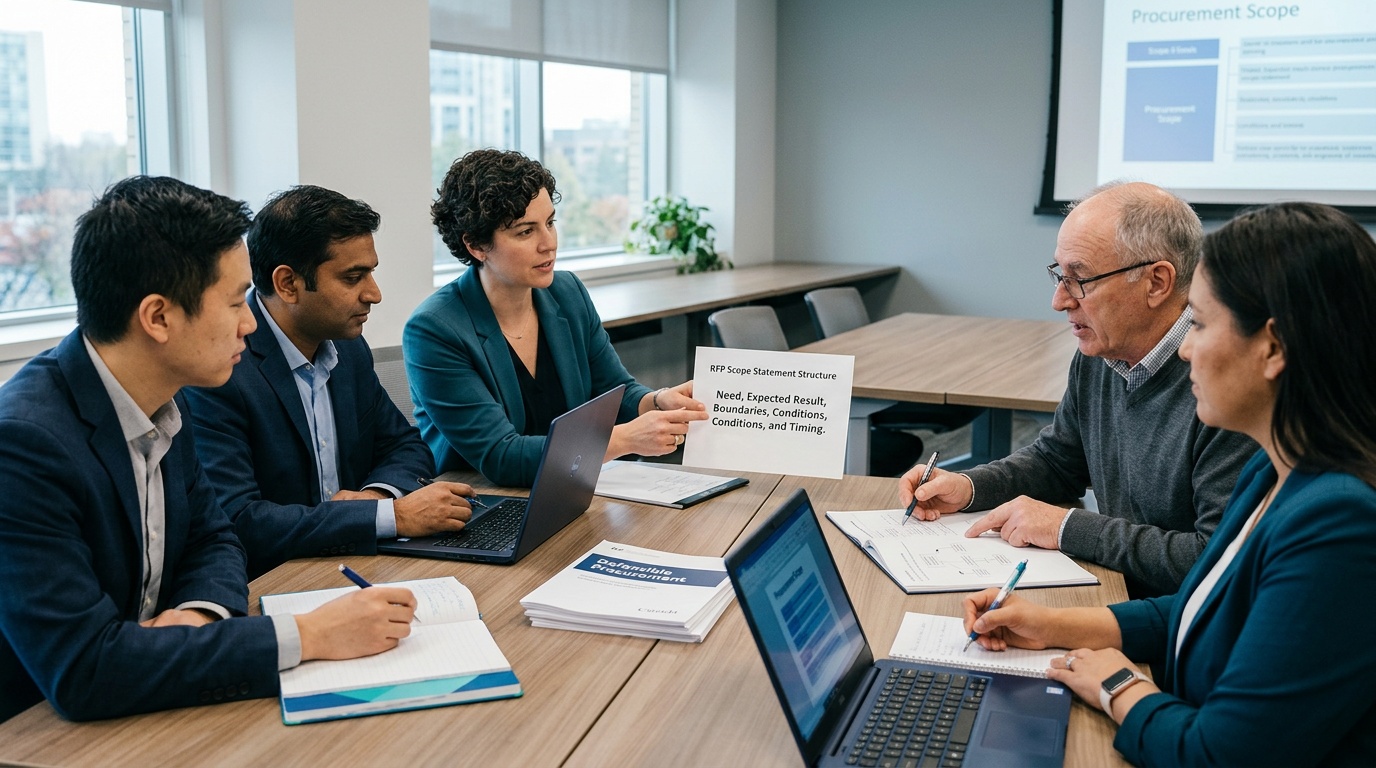
Follow a consistent structure: need, expected result, boundaries, conditions, and timing. Technical contributors should explain the operational problem rather than provide a preferred product or unedited feature list. Procurement can then test whether the requirement is clear, measurable, proportionate, and suitable for an open tender.
Defining the Need: Background and Objectives
Begin with background covering the service, operational gap, legislative or policy context, user group, location, and relevant existing environment. Keep internal history and unrelated departmental detail out of the supplier-facing explanation.
State the objective as an outcome. “Purchase a new platform” describes an action; “Provide authorized staff with timely access to accurate inspection records” describes a result. Objectives explain the problem while leaving room for compliant solutions and helping evaluators distinguish essentials from preferences.
Specifying Deliverables: What You Need and What You Do Not
List tangible deliverables separately from supplier tasks. Deliverables may include equipment, configured software, reports, training materials, data conversion, manuals, testing records, or support services. Tasks may include reviewing data, workshops, configuration, or user training. Both may be needed, but they should not be blended into a vague paragraph.
For each deliverable, identify its description, quantity or coverage, format, delivery point, due date, dependencies, and review method. State exclusions where a supplier could reasonably assume an activity is included. If the organization provides facilities, data, licences, personnel, or approvals, say so to support accurate pricing and reduce disputes about additional work.
Setting Boundaries: In-Scope vs. Out-of-Scope
Create two lists. The in-scope list identifies goods, services, locations, user groups, integrations, support periods, and implementation activities included in the procurement. The out-of-scope list records related work the organization will not buy through this contract.
Consider neighbouring responsibilities: ongoing maintenance or only initial installation; after-hours support; network access and security approvals; future locations as included, optional, or excluded. Clear answers support complete pricing and help the contract manager distinguish a genuine change from an omitted activity.
Identifying Assumptions and Constraints
Assumptions are expected conditions, such as access to subject-matter experts, accurate source data, completed approvals, or an existing facility. Constraints are limits such as a fixed service window, security requirement, funding approval, accessibility obligation, staffing capacity, or integration with a specified system.
Record the owner and consequence of each important assumption. If the organization supplies data by a particular date, explain what happens if that date changes. If work occurs in an occupied facility, describe access, safety, scheduling, and privacy conditions. This supports realistic bids and helps assess delay responsibility.
Establishing Timelines and Milestones
Show progress from award to completion through milestones such as kickoff, discovery, design approval, delivery, configuration, testing, training, implementation, and final acceptance. Identify dependencies and distinguish fixed dates from target dates or dates dependent on organizational decisions.
Include the contract term, renewal or optional periods where applicable, delivery windows, reporting frequency, and response times. Check that the schedule matches evaluation, approvals, funding, operational calendars, and transition needs. A compressed schedule can restrict competition if suppliers cannot organize resources. A supported timeline helps suppliers plan and gives the organization a clearer path from tender to performance.
Drafting Clear, Unbiased Specifications for RFx Documents
A procurement scope statement becomes useful in an RFx when it converts an internal request into requirements suppliers can interpret consistently. The drafting team must balance technical accuracy with fairness, providing enough information for a responsive bid without favouring one product, supplier, or established method.
From Internal Needs to External Requirements: Bridging the Gap
Technical departments understand the operational problem, while procurement teams express it in a transparent sourcing process. Begin with interviews, process maps, existing records, and user needs. Ask what must be achieved, who will use the result, what conditions apply, and how completion will be verified.
Remove shorthand, personal preferences, and unexplained assumptions. “We need the system our neighbouring municipality uses” is not a requirement. A useful version may describe user access, reporting, data retention, response time, accessibility, security controls, and implementation support. This gives suppliers room to propose compliant solutions and evaluators criteria they can apply consistently.
Focusing on Functionality and Performance, Not Brand Names
Functional specifications describe what a solution must do. Performance specifications describe the expected result, capacity, quality, or response. Together, they communicate the need without prescribing a manufacturer, model, platform, or design. A requirement might state that authorized users must retrieve a specified record within an identified response time, with access controlled by defined roles.
If a named product, standard, or proprietary feature seems necessary, document the operational reason and consider whether an equivalent solution could meet the objective. Confirm that any reference is permitted by applicable procurement rules and the solicitation structure. Technical detail should serve the requirement, not narrow competition without justification.
Writing for Canadian Public Sector Compliance and Fairness
Public sector specifications should support openness, fairness, transparency, and non-discrimination. Define mandatory requirements separately from rated requirements and desirable features. Explain the evidence expected for each mandatory condition, such as a certification, sample, test result, service description, or declaration.
Review the draft against applicable procurement policy, trade agreement obligations, accessibility requirements, privacy considerations, security expectations, and relevant threshold or approval processes. Contract A and Contract B considerations can make solicitation and agreement wording significant. Procurement staff should obtain internal legal or policy review when risk, value, or complexity calls for it. Training helps teams recognize these questions early but is not legal advice.
Avoiding Restrictive Specifications: Promoting Competition
A specification may restrict competition by requiring an unnecessary brand, exact configuration, uncommon credential, narrow delivery history, or solution design unrelated to the outcome. Ask: Is it necessary for the business need? Can suppliers demonstrate compliance objectively? Could a different approach produce the same result?
Ask technical reviewers to explain the risk managed by each requirement. If the concern is service continuity, specify availability, recovery, support coverage, and reporting rather than preferred technology. If it is quality, define inspection methods, tolerances, testing, and documentation. This reduces supplier questions and limits claims that the winning bid was judged against an undisclosed preference.
Leveraging Examples: Ambiguous vs. Defensible Phrasing
Examples show the difference between a wish and a testable requirement. The defensible version identifies the output, condition, measure, evidence, or responsibility and matches the evaluation method.
| Ambiguous wording | More defensible wording | Drafting lesson |
|---|---|---|
| Provide a user-friendly reporting tool. | Provide role-based reports that authorized users can filter by date, location, and status, with export in the specified format. | Describe the function and evidence of completion. |
| Use a leading security platform. | Protect information using the listed security controls and provide the required compliance documentation. | State the risk control instead of a market opinion. |
| Complete implementation promptly. | Complete configuration, testing, training, and production launch within the milestone schedule in the RFx. | Replace subjective timing with defined outputs and dates. |
Teams can practise this translation together through Procurement Training for Teams. Its Canadian-focused public sector procurement curriculum supports shared terminology and a progressive certification pathway from essentials to procurement expert level. Procurement Training for Teams.
Ensuring Success: Acceptance Criteria and Contract Protection
A clear scope protects the organization when the contract explains how completion will be judged. Acceptance criteria connect deliverables to evidence, review steps, approvals, and payment decisions. This matters for implementation, professional services, software configuration, equipment installation, and dependent outputs.
Defining Acceptance Criteria: How to Know When It Is Done Right
For each deliverable, state the required condition, evidence, and reviewer. A completed training program may require materials, attendance records, accessible formats, and confirmation that specified users received training. Avoid “satisfactory quality” unless the contract identifies the review standard and process for correcting deficiencies.
Acceptance may occur in stages. Define submission, review, correction, retesting, and final approval. State whether silence constitutes acceptance, if applicable under approved contract terms, and identify review periods. Ensure these provisions align with the solicitation, evaluation method, insurance requirements, payment schedule, and policy.
Linking Scope to Performance Verification and KPIs
Performance indicators should measure an outcome that matters. Measures may include response time, service availability, delivery accuracy, milestone completion, defect rates, resolution time, reporting frequency, or user adoption. Each needs a definition, data source, calculation method, reporting owner, and review frequency.
Do not add key performance indicators, or KPIs, after award without checking the contract’s change provisions. An undisclosed measure may create an unfair new obligation. When a target depends on organization-supplied information, record that dependency. A fair performance framework helps both parties identify problems and agree on corrective action.
How a Strong Scope Statement Protects Downstream Contract Management
Contract managers need a baseline for monitoring delivery, reviewing invoices, approving changes, and documenting performance. The scope, schedule, deliverables, assumptions, exclusions, acceptance tests, and reporting duties should point to the same outcome. Use the baseline at kickoff and maintain a decision record throughout performance.
When a supplier requests additional work, compare it with the agreed boundaries. If it is outside the original requirement, follow the contract’s change control process, including authority, pricing, schedule impact, and written approval. This prevents informal commitments from becoming disputed obligations.
Reviewing Your Scope Statement: A Pre-Tender Checklist
Before release, involve the business owner, technical contributor, procurement professional, finance representative, and, where appropriate, privacy, security, accessibility, or legal reviewers. Use this checklist:
- The intended outcome and business need are clearly stated.
- Deliverables, supplier tasks, quantities, locations, and dependencies are distinct.
- In-scope and out-of-scope work is recorded.
- Mandatory requirements are separated from rated and optional features.
- Specifications are functional or performance-based where practical.
- Milestones, acceptance tests, reporting duties, and responsible reviewers are identified.
- Pricing assumptions, organization-provided resources, and constraints are disclosed.
- Evaluation criteria can test the requirements actually written.
- The draft supports openness, fairness, transparency, and non-discrimination.
- Contract managers can administer the resulting obligations without relying on private background knowledge.
Frequently Asked Questions
What is an example of a procurement scope statement?
A procurement scope statement might require a hosted fleet records system that supports vehicle inspections, role-based access, specified reports, implementation, training, and ongoing support. The statement should explain the business need, required deliverables, exclusions, timing, supplier responsibilities, and how the organization will review completion without requiring one named product.
How do you write a procurement scope of work statement?
A procurement scope of work statement is written by defining the need, desired outcome, deliverables, boundaries, assumptions, responsibilities, conditions, and timing. Separate supplier tasks from tangible outputs, identify quantities and delivery points, list exclusions, and describe reasonable review methods so suppliers can prepare comparable bids.
What is a statement of scope in procurement?
A statement of scope in procurement defines the goods, services, or outcomes an organization intends to obtain through a tender or other RFx. The statement gives suppliers enough information to understand the requirement, price their responses, and identify what is included, excluded, or dependent on the organization.
What is the difference between scope and objective?
Scope defines the work, goods, services, boundaries, and conditions included in a procurement, while an objective states the result the organization wants to achieve. A procurement objective might be timely access to accurate inspection records, while the scope sets the system, implementation, training, support, and limits needed to achieve that result.
What is a procurement scope with an example?
A procurement scope describes the full boundary of a purchase, including what the supplier will provide and what the organization will handle. For a records system, the scope could include configuration, data conversion, user training, manuals, testing, and support, while excluding unrelated departmental systems or future enhancements.
Why should a procurement scope statement include exclusions?
A procurement scope statement should include exclusions because suppliers may otherwise make different assumptions about the work they must price and deliver. An out-of-scope list can identify activities such as ongoing maintenance, unrelated integrations, or organization-managed approvals, helping support fair bids and reduce later change discussions.