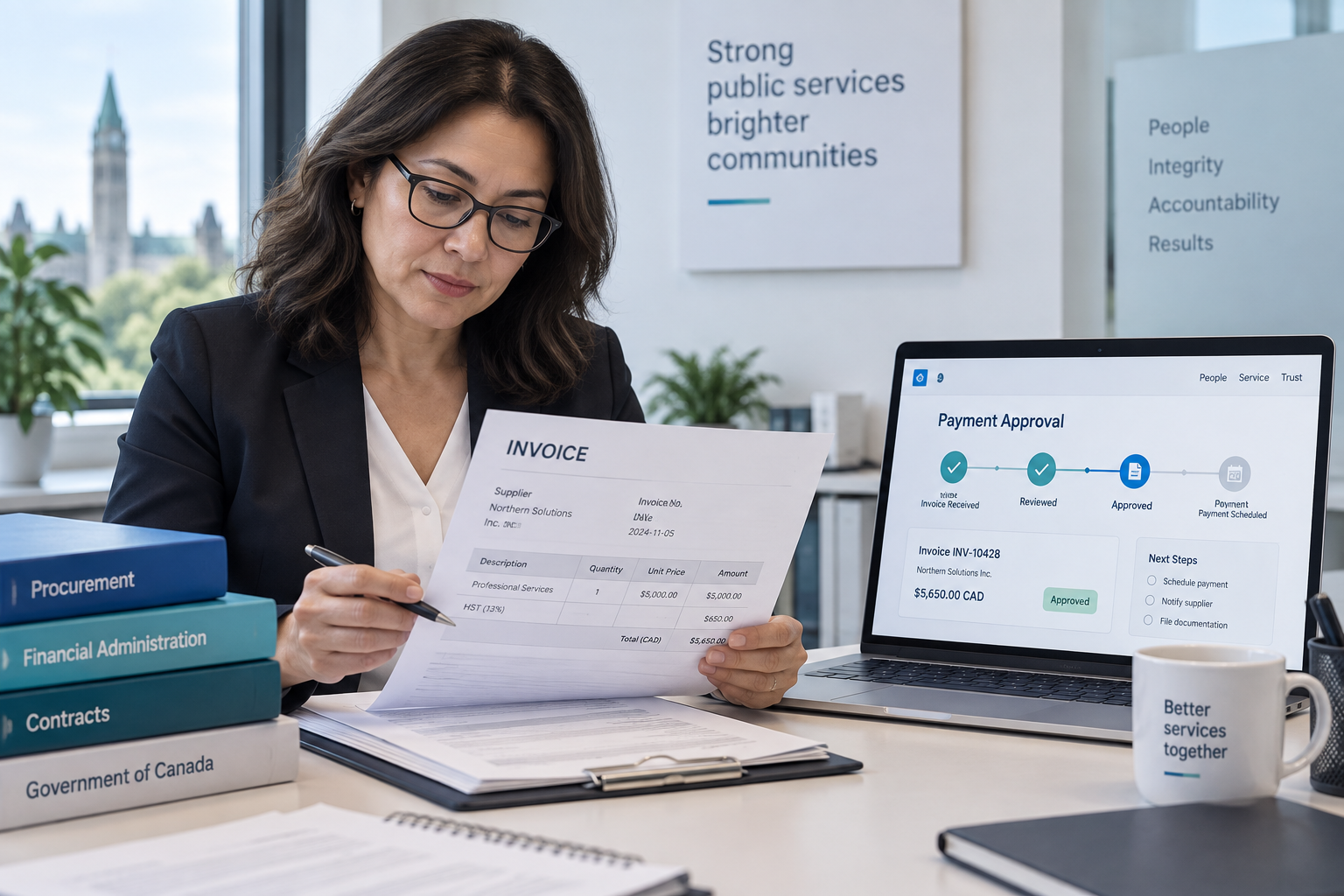
contract payment controls
Payment is not the final administrative step after a contract is signed. It is part of contract management, with a direct connection to public accountability, supplier confidence and the organization’s ability to show that funds were released for work properly delivered. Well-designed contract payment controls give each payment a clear evidence trail, from the agreed price or rate through to approval and release.
Key Takeaways
- Treat payment as an active part of contract management rather than a routine task that happens once the contract is finished.
- Good payment controls protect public accountability by showing that funds were released only for work that was properly delivered.
- Every payment should follow a documented evidence trail, from the agreed price or rate through each approval to the final release of funds.
- Paying on time and with clear justification builds supplier confidence, which strengthens relationships and supports future competition.
- Establishing payment controls early gives teams the confidence that each payment decision is transparent and defensible.
For teams building shared knowledge, Contract Management Training for Teams provides a practical way to develop consistent contract administration skills. The focus is not only on paying invoices. It is on making each decision fair, documented and connected to the contract.
What contract payment controls are, in plain language
A simple definition of contract payment controls
Contract payment controls are the agreed checks, records and approvals used to confirm that a supplier should be paid, that the amount is correct, and that the payment follows the contract and applicable organizational requirements. These checks can include reviewing an invoice against pricing, confirming delivery or service completion, validating a milestone, checking approval authority and retaining supporting documents.
Where payment controls fit after contract award
Once a contract is awarded, payment controls connect the statement of work, pricing schedule, delivery requirements, acceptance criteria and invoice process. The contract manager or another designated employee confirms whether the supplier’s claim matches the agreed obligations. A finance or accounts-payable function may then review the transaction, apply authorization rules and release the payment. The exact responsibilities depend on the organization’s policy and the contract structure, so they should be assigned before the first invoice arrives.
This separation creates a defensible record for the buyer and a predictable process for the supplier. It also helps prevent an approval delay from becoming an unintended non-payment issue, especially where timesheets, progress reports or completion certificates require review from several people.
The remedy is not to add unnecessary administration. It is to define who checks what, which evidence is sufficient and when an exception must be escalated. That discipline is the foundation of effective contract payment controls and supports ethical supplier relationships.
Payment structures and the evidence each one needs

Fixed-price, milestone, time-based and progress payments explained
A fixed-price arrangement pays an agreed amount for the contract scope, subject to the stated deliverables and acceptance terms. A milestone structure divides payment into defined stages, such as design approval, equipment delivery or final acceptance. Time-based payment uses approved rates multiplied by verified hours, days or units. Progress payments relate payment to the portion of work completed, often in a construction or implementation setting.
Comparing payment structures and their verification focus
| Payment structure | Primary verification | Evidence to retain |
|---|---|---|
| Fixed price | Scope and final deliverable acceptance | Acceptance record, inspection notes and invoice |
| Milestone | Completion of the stated stage | Milestone certificate, report or approval record |
| Time based | Authorized time and applicable rates | Approved timesheets, work records and rate schedule |
| Progress payment | Measured work, materials or units completed | Site records, measurement sheets, photographs or inspection documentation |
Setting objective milestone evidence before work begins
Each payment trigger should answer three questions: what must be completed, how will completion be measured, and who will accept it? A useful milestone includes a date or sequence, a defined output, quality requirements, required documentation and the name or role of the approver. Avoid relying on a percentage without explaining the calculation. “Fifty percent complete” is difficult to verify unless the contract identifies the work packages, quantities or deliverables that make up that percentage.
Before signing, procurement and contract-management staff should test every payment term against the evidence available in practice. Clear requirements protect the buyer from unsupported claims while giving the supplier a fair understanding of how payment will be assessed. This is where contract payment controls become part of contract design, rather than a repair made after an invoice dispute.
Teams seeking a shared foundation can also consider Contract Management Training for Teams, which supports consistent post-award practices across procurement, operations and finance.
Core internal controls for contract payments
Separation of duties: sharing the payment process
Separation of duties means that one person does not control every stage of a payment. The employee who confirms delivery or service completion should normally be different from the person who approves the invoice and the person who releases funds. This division creates an independent review and reduces the risk that an error, unsupported claim or unauthorized change will pass through unnoticed.
Responsibilities should be assigned in the contract administration plan or internal procedure. A contract manager may review performance, a receiving employee may confirm delivery, and accounts payable may validate the invoice and process payment. Smaller teams may not have enough staff for a complete division, so a manager can add a secondary review, periodic sampling or documented reconciliation. The control should fit the organization while preserving accountability.
Three-way matching: contract, receipt and invoice
A three-way match compares three records before payment: the contract or purchase order, evidence that the goods or services were received, and the supplier’s invoice. The contract establishes the authorized scope, price, rates, terms and limits. The receipt record confirms that delivery or performance occurred. The invoice states the amount requested. Differences should be resolved and recorded before approval, rather than corrected informally after payment.
For a service contract, the match may involve an approved timesheet, rate schedule and invoice. For a construction claim, it may involve a progress certificate, site measurement, approved change order and payment application. A match is meaningful only when the supporting evidence is specific enough to establish quantity, quality, timing and acceptance.
Authorization levels and approval workflows
Authorization levels identify who may approve a payment, change order, credit, retention release or exception at each value threshold. The workflow should state the required approver, backup approver, evidence, deadline and escalation route. Approval should be recorded by a named person, with the date and decision visible in the contract file or financial system.
Clear routing also helps prevent unpaid claims caused by an approver bottleneck. If a timesheet or milestone report is complete but remains in a queue, the process should notify the designated alternate and preserve the original submission date. An alternate reviewer should assess the evidence, not approve automatically.
Preventive versus detective controls, with examples
Preventive controls are designed to stop an error before money leaves the organization. Detective controls identify an issue after a transaction or at a later review point. A sound payment process uses both: prevention reduces exposure, while detection provides a way to find and correct weaknesses.
| Control type | Purpose | Public-sector example | Construction-style example |
|---|---|---|---|
| Preventive | Block an unsupported or unauthorized payment | System approval limits prevent release above delegated authority | Payment requires an approved progress certificate and change order |
| Detective | Find errors, duplicates or unusual activity | Monthly review compares paid invoices with contract records | Site records are reconciled to quantities billed and amounts paid |
These controls support contract payment controls by creating checks that are visible, repeatable and proportionate to risk. The objective is not to delay legitimate payment. It is to make approval dependable for the buyer, supplier and people responsible for public or organizational funds.
A step-by-step payment verification and approval workflow
A practical checklist from invoice to payment release
A reliable workflow gives every invoice the same basic path, while allowing contract-specific requirements. The following payment control spine can be adapted to goods, services, professional work and construction claims:
- Receive and register: record the invoice date, supplier, contract number, amount, billing period and receiving channel.
- Verify the claim: compare prices, rates, quantities, taxes, credits, retainage and approved changes with the contract.
- Confirm performance: obtain the delivery record, acceptance note, approved timesheet, milestone evidence or measured progress record.
- Check compliance: confirm that required certifications, insurance evidence, safety documents, reports or statutory declarations are current where the contract requires them.
- Check for duplicates: search the supplier, invoice number, amount, contract and billing period for an earlier submission or payment.
- Document exceptions: record discrepancies, partial acceptance, disputed amounts and communications with the supplier.
- Obtain authorization: route the complete package to the person with the proper delegated authority.
- Release and retain: issue payment through the approved system and preserve the invoice, evidence, approvals and reconciliation record.
Compliance checks before payment: documents and certifications
Compliance review should be tied to the contract, purchase order and applicable organizational procedure. A checklist can include tax information, insurance, licensing, security documentation, accessibility requirements, timesheet approval, subcontractor declarations and evidence of deliverable acceptance. Do not request documents without a defined reason, and do not treat a document as proof that performance occurred. Each item answers a different question.
When information is missing, identify the precise gap and give the supplier a clear response route. A complete claim should move promptly. A deficient claim should be paused with a documented explanation, rather than left unanswered. This approach supports fair administration and helps prevent a client-side delay from becoming an avoidable dispute.
Avoiding duplicate payments and payment fraud
Duplicate-payment checks should cover revised invoices, credit notes, split billing, recurring charges and invoices submitted through more than one channel. Compare invoice identifiers and amounts, but also review near matches, such as a changed invoice number with the same billing period and value. Any request to change banking information should follow an independently verified procedure, using contact details already held in the supplier record.
How contract management and payment systems help
Contract lifecycle management and enterprise resource planning systems can place the contract, purchase order, invoice, approval history and performance evidence in a connected record. Useful features include automated routing, duplicate checks, expiry alerts, delegated-authority rules, version control and exception reporting. Automation supports consistency, but it does not decide whether a deliverable meets the required standard. A knowledgeable reviewer remains responsible for that judgement.
Teams can improve contract payment controls by mapping the workflow before selecting or configuring a system. Define the evidence, approval path, escalation timing and audit record first. For shared capability building, Contract Management Training for Teams offers Canadian procurement and contracts training specifically designed for the public sector, including a structured progressive learning path from essentials to expert level with professional certification. Contract Management Training for Teams is designed for public-sector teams.
Payment controls in Canadian public procurement: accountability and next steps

How public-sector accountability shapes payment practices
Public procurement involves stewardship of public funds. A payment decision should be supported by the contract, evidence of performance, proper authority and a record that another reviewer can understand. This does not mean every invoice requires the same level of administration. It means the review should be proportionate to the value, risk, complexity and sensitivity of the purchase.
Accountability also extends beyond the payment office. Procurement, contract management, program staff, receiving teams and finance may each hold part of the evidence trail. Clear roles help protect supplier relationships while maintaining fairness, transparency and value for the organization. A supplier should know how a claim will be reviewed, which documents are required and how an exception will be handled.
Rules vary by jurisdiction: where to check official guidance
Canadian public procurement requirements are not identical across federal, provincial, territorial and municipal organizations. Payment practices may be shaped by legislation, trade agreements, treasury or financial administration policies, delegated-authority rules, prompt-payment requirements, contract terms and local procedures. A process suitable for one public body may not meet the requirements of another.
Before establishing a workflow, check the contracting authority’s official procurement policy, finance manual, standard clauses and contract templates. Federal teams should consult the relevant Government of Canada sources. Provincial, territorial and municipal teams should use their own government procurement and financial administration resources. Keep a record of the guidance reviewed, the policy version and any internal interpretation supplied by the appropriate authority.
Questions teams commonly ask
- What commonly causes payment failures?
- Unclear acceptance criteria, incomplete records, mismatched quantities, expired supporting documents and approval queues are frequent causes. A documented escalation path can prevent a valid claim from sitting without a decision.
- How can an approval workflow reduce fraud risk?
- Use independent review, delegated authority, supplier-record verification, duplicate checks and a documented response to banking-change requests. Do not allow urgency to replace evidence or segregation of responsibilities.
- Who is responsible for payment in a contracting chain?
- The contracting organization remains responsible for administering its agreement according to its terms and applicable requirements. Supplier arrangements with subcontractors may create separate obligations. The prime contract, subcontract terms and jurisdiction-specific guidance should be reviewed before assigning responsibility.
Building your team’s payment-control confidence
A practical next step is to map one recent invoice from submission to release. Identify each reviewer, required document, decision point, exception route and retained record. Then test the process against a routine claim, a partial delivery, a disputed milestone and a request to change banking details. This exercise reveals gaps without requiring a system purchase.
For teams that need a shared foundation, Contract Management Training for Teams offers Canadian procurement and contracts training specifically designed for the public sector. Contract Management Training for Teams follows a structured progressive learning path from essentials to expert level with professional certification.
Frequently Asked Questions
How do contract payment controls protect public funds?
Contract payment controls protect public funds by confirming that a supplier delivered the required goods or services, charged the agreed amount and received approval from the right authority. A clear record should connect the contract, invoice, delivery evidence, acceptance decision and payment release, supporting accountability and fair supplier treatment.
What are the four types of financial controls used in contract payments?
The four common types of financial controls are authorization, segregation of duties, verification and documentation. Contract payment processes use these controls by assigning approval authority, separating delivery checks from payment release, matching invoices to contract terms and retaining evidence for review.
What evidence is needed to approve a contract invoice?
A contract invoice should be supported by evidence that the billed work was delivered and accepted under the agreement. Depending on the payment structure, useful records may include delivery receipts, approved timesheets, inspection notes, milestone certificates, progress measurements, photographs and signed acceptance records.
What are the four main payment methods in contract administration?
The four main contract payment methods are fixed price, milestone, time based and progress payment. Each method requires a different check, such as final acceptance for fixed price, stage completion for milestones, approved hours and rates for time based work, or measured work completed for progress payments.
What are the five most common payment methods for suppliers?
The five common supplier payment methods are electronic funds transfer, cheque, credit card, purchase card and, where permitted, cash. Contract payment controls should confirm that the selected method follows organizational policy, uses accurate supplier information and leaves a reliable record of authorization and release.
Who should approve a payment under a contract?
The designated contract representative or authorized approver should confirm that the supplier met the payment requirements before finance releases funds. Separation of duties is good practice, so the person checking delivery or completion should not normally control every approval and payment step.
How can organizations prevent payment delays and invoice disputes?
Organizations can prevent payment delays and invoice disputes by defining payment triggers, required evidence, review responsibilities and escalation steps before work begins. Contract teams should use measurable acceptance criteria, assign an accountable reviewer and tell suppliers how invoices will be checked against rates, milestones or completed work.