Good contract management does not end when the agreement is signed. The record of what worked, what created friction, and what should change next time can help a public procurement team make more consistent, defensible decisions. Contract lessons learned are the documented insights gathered from negotiation, implementation, administration, performance and closeout.
frequently-asked-questions-about-contract-lessons-learned”>Frequently asked questions about contract lessons learned
This practice is not about assigning fault. It is about turning experience into practical improvements while protecting accountability, ethical conduct and public trust. The right process will depend on the organization’s jurisdiction, internal policy, contract value and governance requirements.
What contract lessons learned mean in contract management
Contract lessons learned are clear observations about a contract lifecycle, supported by records and connected to an action for future work. A useful entry may explain why a requirement was difficult to interpret, why a supplier deliverable was delayed, or why a communication routine helped resolve an issue. It should show the effect on schedule, cost, quality, risk, compliance or the working relationship.
Why lessons learned matter after the contract is signed
Once an agreement is active, the procurement team must monitor obligations, confirm deliverables, manage approvals, document changes and respond to performance concerns. Reviewing those activities gives the organization a more accurate understanding of its procurement strategy and contract administration practices. It can reveal where specifications need more precision, where roles were unclear, or where reporting requirements were difficult to use.
That knowledge supports better planning and more transparent decision-making. It can also help separate a supplier performance issue from an internal process issue. A balanced record gives future teams useful context without turning a review into a personal judgement about an employee or supplier.
Purpose and scope: what belongs in a lessons learned record
A record should cover the parts of the work that can inform a future procurement or contract. Suitable topics include the clarity of the statement of work, evaluation approach, negotiation record, approval path, onboarding, performance measures, invoice process, change control, stakeholder communication, dispute management and closeout. Link each observation to available evidence, such as meeting notes, schedules, amendments, performance reports or correspondence.
Keep the record specific and practical. “Communication was poor” provides little direction. “The project team received status information in different formats, so the monthly review lacked a consistent view of open actions” gives a future team something it can address. The organization should also define who may access the record, how confidential information is handled and how recommendations are approved.
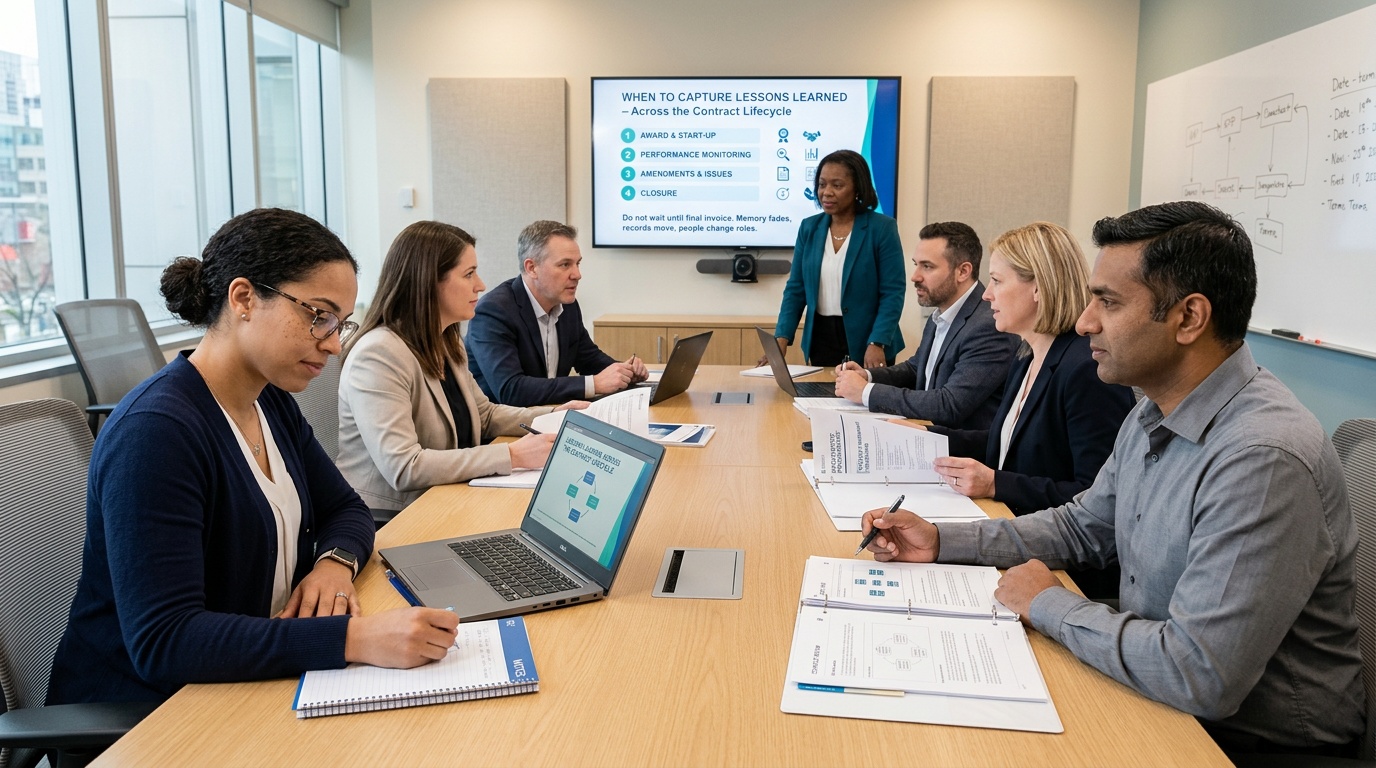
When to capture lessons learned across the contract lifecycle
Do not wait until the final invoice to collect every observation. Memory fades, records become harder to locate and people may move to other roles. Short reviews at sensible points create a more reliable account of the contract. The right milestones differ among Canadian public bodies, so align the timing with internal policy, approval requirements and the contract’s risk profile.
At milestones and performance check-ins
Use scheduled reviews to capture implementation and performance insights while the details remain current. Ask whether deliverables, service levels, reporting, approvals and issue escalation are working as intended. Include the contract manager, business owner and appropriate subject matter contributors.
At renewal and amendment decisions
A renewal or amendment decision is an opportunity to test assumptions. Review supplier performance, unresolved risks, pricing information, business needs and the quality of the existing terms before recommending a path forward. Record which provisions supported effective administration and which required interpretation or repeated clarification.
At contract closeout
Closeout provides a deliberate point to assess the full contract, including acceptance, outstanding obligations, records, final payments, asset return and transition arrangements. Invite contributions from those who managed delivery and those who used the results. Keep the discussion proportionate to the contract’s complexity.
At trigger events, such as delays or disagreements
Capture a focused lesson after a significant delay, change request, disagreement, service failure, audit observation or unexpected success. A timely review can identify whether the cause involved scope, capacity, communication, governance, documentation or an external constraint. The purpose is learning and corrective action, not a substitute for formal incident, legal or dispute processes.
Teams building this capability may also consider Contract Management Training for teams. It provides RFx templates and user guide, model procurement and contracting procedures, trade-agreement compliant documentation, and a comprehensive procedures manual.
Timing should remain practical. A short, documented conversation may be sufficient for a routine purchase, while a complex, high-risk arrangement may require several structured reviews. The goal is a dependable learning record that can inform future procurement planning, contract documents, training and governance.
How to run a lessons learned review, step by step
A structured review turns experience into a usable record. It gives the team a fair way to examine decisions, evidence, performance and outcomes without treating the discussion as an investigation into individual fault. The process for documenting contract lessons learned can be scaled to the contract’s risk, value, complexity and governance requirements.
Step 1: Prepare by gathering the right people and documents
Choose a facilitator who can keep the discussion focused and neutral. Invite people with different views of the work, such as the procurement lead, contract manager, business owner, finance representative, subject matter expert and, where appropriate, a supplier representative. Gather the statement of work, solicitation, evaluation record, agreement, amendments, schedules, performance reports, issue logs, meeting notes, approvals, invoices and closeout records.
Step 2: Review with simple, neutral questions
Begin with the intended outcome and compare it with what occurred. Ask what worked well, where the process slowed down, which requirement or approval was unclear, what evidence supports the observation and what effect the issue had on cost, timing, quality, service or risk.
Step 3: Record each lesson with a description, root cause, recommendation and action owner
Use one entry for each meaningful observation. Record the situation, evidence, effect, contributing cause, recommended change, accountable owner and target timing. Include a status field so recommendations can be tracked rather than filed away.
Step 4: Apply lessons to templates, checklists and future contracts
Assign a practical destination for every accepted recommendation. A lesson about inconsistent reporting may belong in a RFx template or user guide. A recurring approval delay may require a responsibility matrix or revised workflow. Review changes with the appropriate policy, legal, finance and operational contacts before use.
Use a checklist to make the review repeatable
A short checklist can help a team prepare consistently without turning every review into a large administrative exercise. Include prompts for participants, records, confidentiality, intended outcomes, performance evidence, root cause, recommendations, owners, deadlines, approvals and follow-up.
What makes lessons learned stick, and common pitfalls to avoid
Success factors: leadership support, a learning culture and timeliness
Lessons become useful when leaders allow reasonable time for reflection and expect recommendations to receive a response. A learning culture welcomes evidence, records uncertainty honestly and connects observations to policy updates, templates, training and contract governance.
Common pitfalls: blame sessions, vague entries and no follow-up
A blame-focused meeting discourages candour and may cause participants to defend decisions rather than examine them. Vague entries create the appearance of documentation without offering direction. Keep the review proportionate, evidence-based and separate from formal discipline, dispute resolution or legal advice.
Before selecting guidance, ask who designed it, which jurisdiction it addresses, how current the material is and whether the provider can explain its limits. Good education builds judgement and helps teams procure with confidence.
Frequently asked questions about contract lessons learned
How do I document lessons learned from a contract negotiation?
Start while the negotiation record is still accessible. Note the objective, key issues, options considered, agreed position, approvals and outcome. Connect each observation to evidence and a practical recommendation.
How do lessons learned improve future contract outcomes?
A useful record gives future teams tested information for planning, drafting, evaluation, negotiation and administration. It may prompt clearer specifications, realistic schedules, better performance measures and improved transition arrangements.
How do I encourage my team or leadership to make time for this?
Connect the review to renewal planning, service continuity, audit readiness or risk management. Keep the first session proportionate and provide a short agenda with a clear output.
Where can I build contract management skills in Canada?
Look for education designed for Canadian public-sector requirements and covering the full contract lifecycle, including planning, solicitation, negotiation, performance monitoring, change control, records and closeout. NECI The Procurement School offers contract management learning options for individual professionals.
Frequently Asked Questions
What does the term lessons learned mean in contract management?
Contract lessons learned are documented insights collected across the contract lifecycle, from negotiation and implementation through performance and closeout, that identify what worked, what created friction, and what should change next time. Each observation links evidence to a practical action, helping public procurement teams make more consistent, defensible decisions while protecting accountability and public trust.
What are examples of lessons learned in public procurement contracts?
Examples include a statement of work that was difficult to interpret, a supplier deliverable that was delayed because approval roles were unclear, or a communication routine that helped resolve an issue quickly. A useful example names the situation, its effect on schedule, cost, quality, risk or the working relationship, the contributing cause, and the change recommended for future work.
What are the steps of a lessons learned process?
A typical lessons learned process has four steps: prepare people and documents, review with neutral questions, record each lesson with its cause and action owner, and apply accepted lessons to templates, checklists and future contracts. Scale each step to the contract’s risk, value and complexity.
What is a better way to say lessons learned?
Common alternatives include contract insights, continuous improvement notes, post-contract review findings, or experience reviews. In Canadian public procurement, some organizations prefer contract performance review because the phrase points toward forward-looking improvement rather than backward-looking fault, which helps keep the discussion constructive for employees and suppliers alike.
What does a good lessons learned document look like?
A good lessons learned document is specific, evidence-based and action-oriented. Each entry describes the situation, its effect on schedule, cost, quality, risk, compliance or the working relationship, the contributing cause, and a practical recommendation. The document also defines who may access the record, how confidential information is handled, and how recommendations are approved.
Why capture contract lessons learned before closeout instead of waiting until the end?
Waiting until the final invoice weakens the record because memory fades, files become harder to locate, and people may move to other roles. Short reviews at milestone check-ins, renewal and amendment decisions, and trigger events such as delays or disagreements create a more reliable account while details remain current.
How do you keep a lessons learned review from assigning blame?
A lessons learned review stays constructive by examining decisions, evidence and outcomes rather than individual fault. Link each observation to records such as schedules, amendments and performance reports, and describe effects on process, cost or compliance rather than on people. This balanced approach also helps separate a supplier performance issue from an internal process issue.
NECI The Procurement School Inc. provides Canadian procurement and contracts training for public-sector professionals, teams, and organizations. Its expert-led courses, webinars, and resources focus on practical procurement skills, accountability, ethics, compliance, and better contract outcomes.
Last reviewed: August 31, 2026 by the NECI The Procurement School Inc. Team
Disclaimer: The views and opinions expressed in this article are those of the Subject Matter Experts and do not necessarily reflect the official policy or position of The Procurement School.
This website uses cookies to improve your experience while you navigate through the website. Out of these, the cookies that are categorized as necessary are stored on your browser as they are essential for the working of basic functionalities of the website. We also use third-party cookies that help us analyze and understand how you use this website. These cookies will be stored in your browser only with your consent. You also have the option to opt-out of these cookies. But opting out of some of these cookies may affect your browsing experience.
Necessary cookies are absolutely essential for the website to function properly. These cookies ensure basic functionalities and security features of the website, anonymously.
Cookie
Duration
Description
cookielawinfo-checkbox-analytics
11 months
This cookie is set by GDPR Cookie Consent plugin. The cookie is used to store the user consent for the cookies in the category "Analytics".
cookielawinfo-checkbox-functional
11 months
The cookie is set by GDPR cookie consent to record the user consent for the cookies in the category "Functional".
cookielawinfo-checkbox-necessary
11 months
This cookie is set by GDPR Cookie Consent plugin. The cookies is used to store the user consent for the cookies in the category "Necessary".
cookielawinfo-checkbox-others
11 months
This cookie is set by GDPR Cookie Consent plugin. The cookie is used to store the user consent for the cookies in the category "Other.
cookielawinfo-checkbox-performance
11 months
This cookie is set by GDPR Cookie Consent plugin. The cookie is used to store the user consent for the cookies in the category "Performance".
viewed_cookie_policy
11 months
The cookie is set by the GDPR Cookie Consent plugin and is used to store whether or not user has consented to the use of cookies. It does not store any personal data.
Functional cookies help to perform certain functionalities like sharing the content of the website on social media platforms, collect feedbacks, and other third-party features.
Performance cookies are used to understand and analyze the key performance indexes of the website which helps in delivering a better user experience for the visitors.
Analytical cookies are used to understand how visitors interact with the website. These cookies help provide information on metrics the number of visitors, bounce rate, traffic source, etc.
Advertisement cookies are used to provide visitors with relevant ads and marketing campaigns. These cookies track visitors across websites and collect information to provide customized ads.