procurement due diligence
Before a public organization awards a contract, it needs evidence that the proposed supplier is correctly identified, capable of delivering the requirement, financially able to perform, and suitable for the organization’s risk profile. A practical procurement due diligence process creates that evidence without turning every purchase into an investigation.
Key Takeaways
- Strong supplier due diligence gives public organizations the proof they need to award contracts with confidence.
- An effective review confirms four things about a supplier: correct legal identity, delivery capability, financial stability, and fit with the organization’s risk tolerance.
- Good practice means verifying what actually matters for the purchase, so the process stays proportionate rather than becoming an investigation for every contract.
- The evidence collected during due diligence also builds a clear record that supports defensible evaluation and award decisions.
This guide explains due diligence and provides a checklist for the period between evaluation and award. The aim is a fair, documented decision that supports accountability, ethical practice, and public confidence.
What is Procurement Due Diligence? A Canadian Public Sector Primer
Procurement due diligence is the structured review of a supplier’s identity, qualifications, capacity, financial position, compliance information, and relevant risks before an organization commits to a contract. It is not a substitute for the published evaluation process. Checks must connect to the procurement documents, proposed contract, applicable organizational requirements, and level of risk.
Defining Procurement Due Diligence
Due diligence turns supplier information into a reasoned record. Depending on the purchase, a buyer may confirm corporate registration, review references, validate insurance, examine financial information, check certifications, or confirm proposed resources and delivery arrangements. A low-risk supply order may need a focused review, while a long-term technology, construction, health, or critical service contract may require broader verification.
- Supplier due diligence
- Checks performed to understand whether a prospective supplier is suitable for the procurement and able to meet the stated requirements.
- Vendor due diligence
- A commonly used term for reviewing a business before, during, or after engagement. It may include operational, financial, privacy, security, and performance considerations.
- Verification evidence
- Documents, confirmations, references, interview notes, registry records, or other reliable material that supports a finding.
Supplier vs. Vendor Due Diligence: Understanding the Nuances
In everyday business language, “supplier” and “vendor” often describe the same organization. Public procurement teams may prefer “supplier” because it fits a competitive procurement and contract setting. “Vendor due diligence meaning” can be broader, particularly when a vendor provides software, data processing, hosting, or outsourced operations. The label matters less than the scope: identify the organization, understand its services and dependencies, assess material risks, and record how evidence supports the decision.
Why It Matters: The Public Sector Imperative for Fairness and Accountability
Public buyers must explain why an award was made and show that suppliers were treated consistently. A documented review separates relevant evidence from assumptions, protects confidential information, and gives decision-makers a basis for accepting, resolving, or escalating a concern. It can also prevent late surprises involving capacity, subcontractors, financial pressure, conflicts of interest, or unmet mandatory conditions.
When to Conduct Due Diligence in the Procurement Lifecycle
Plan the work early, even when most verification occurs after evaluation. During planning, identify supplier risks and required evidence. In the solicitation, describe relevant conditions, submission requirements, and verification rights. During evaluation, collect only information related to the stated process. Before award, complete permitted checks and resolve material questions. After approval, retain the record with the procurement file and carry applicable requirements into the contract.
Building Your Supplier Due Diligence Checklist for Evaluation and Award

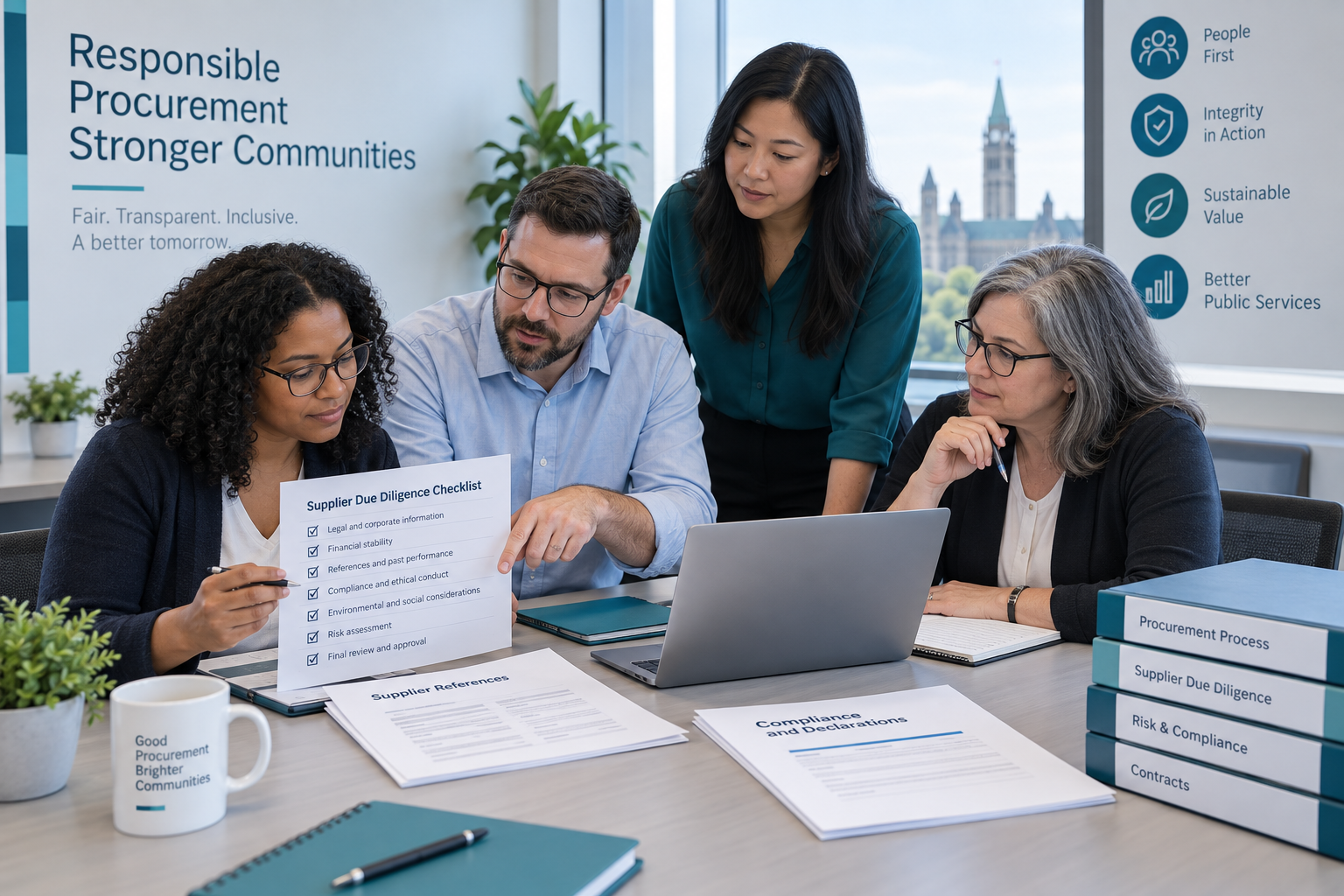
A supplier due diligence checklist should be a control document, not a generic list copied from another purchase. Start with the requirement, proposed contract, consequences of failure, and information already received through the competition. Identify the smallest set of checks that can support a defensible decision. This gives procurement staff a clear process while allowing technical, finance, privacy, security, and operational colleagues to contribute within defined roles. Teams can also use RFx templates and a user guide to structure solicitation documentation and evidence requirements.
The Core Components of a Canadian Public Sector Checklist
Include the supplier’s legal name and business identity, contact information, ownership or operating details where relevant, mandatory qualifications, financial information, delivery capacity, references, proposed personnel, subcontracting arrangements, insurance, security requirements, privacy obligations, conflicts declarations, and contract-specific certifications. Add fields for each source, date checked, reviewer, finding, follow-up question, and final disposition. Another informed person should be able to understand the review without relying on an undocumented conversation.
Risk-Tiered Approach: Basic, Expanded, and Enhanced Checks
Risk tiering directs review time toward protecting the public interest. Set the tier before reviewing a preferred supplier, considering contract value, service criticality, personal information, public safety, delivery complexity, subcontractors, and contract duration. The categories below are a planning model; organizational policy and procurement documents determine permitted and required checks.
| Review level | Typical focus | Evidence to consider |
|---|---|---|
| Basic | Identity, mandatory conditions, pricing and delivery fit | Registration details, declarations, references, insurance confirmation |
| Expanded | Capacity, financial health, personnel and subcontractors | Financial information, project history, resource confirmation, credit or reference checks where permitted |
| Enhanced | Security, privacy, continuity and complex delivery exposure | Security documentation, privacy controls, continuity plans, site or process review, specialized attestations |
Key Verification Areas: Identity, Financial Health, Capability, and Compliance
Organize the review around four questions: Is this the legal entity that submitted the proposal? Does available information indicate sufficient financial capacity? Can the supplier provide the people, equipment, systems, schedule, and management controls promised? Has it addressed applicable legal, policy, privacy, security, insurance, accessibility, health and safety, and conflict-of-interest requirements? Request evidence connected to the contract rather than information merely because it is available.
Gathering Evidence: What to Ask and Where to Look
Begin with the supplier’s submission and procurement file. Follow up with questions that identify the requested document, relevant period, responsible contact, and response deadline. Depending on the requirement, evidence may include client references, interviews, demonstrations, audited accounts, registry checks, insurance certificates, security documentation, and written confirmations from proposed subcontractors. Use official government registries, organizational records, and approved internal systems where available. Record the source and date, and do not treat an unverified online statement as proof.
Assigning Owners and Tracking Status
Give every check one owner and reviewer. Procurement can manage the schedule, consistency, file record, and supplier communication. Finance can review financial information, while privacy, security, legal, or operational specialists can assess matters within their authority. Use statuses such as not started, requested, received, verified, clarification required, accepted, or escalated. A maintained tracker shows what was checked, what remains open, and who approved the finding.
Teams building a shared foundation may benefit from Procurement Training for Teams, which provides a Canadian-focused public sector procurement curriculum and a progressive certification pathway from essentials to procurement expert level. Procurement Training for Teams can help align buyers and internal stakeholders around terminology, documentation, and ethical decision-making. NECI.
Working with Technical Stakeholders: Bridging Gaps in Supplier Assessment
Procurement professionals do not need to become engineers, architects, analysts, or system administrators to assess technical capability well. Their role is to create a fair process, connect questions to the solicitation and contract, and ensure technical advice is recorded clearly. Subject matter experts (SMEs) provide specialized knowledge, while the buyer protects consistency, confidentiality, evaluation discipline, and the procurement file.
Defining Roles: Buyer vs. Subject Matter Expert (SME)
The buyer manages the process and confirms that each question is relevant, permitted, and applied consistently. The SME assesses technical content against the published requirement, such as system performance, implementation method, staffing model, safety controls, or service continuity. Agree on responsibilities before reviewing supplier material, including who may contact the supplier, record technical findings, and resolve differences of interpretation.
Framing Questions for Technical Capability Assessment
Ask questions answerable with evidence rather than impressions. A useful question identifies the requirement, proposed approach, proof requested, and consequence if capability is absent. Examples include: Which proposed resource will perform this work? What comparable project demonstrates the stated capacity? How will the supplier test, document, and correct defects? What dependency could affect the delivery schedule? These questions help a non-technical buyer guide discussion without claiming specialist expertise.
Interpreting Technical Evidence: Objectivity and Documentation
Technical evidence may include demonstrations, design documents, work plans, certifications, reference responses, test results, interviews, or site observations. Ask the SME to explain the finding in plain language and connect it to a stated criterion or contractual obligation. Record the evidence reviewed, assessment, uncertainty, and recommended disposition. Avoid “the solution feels unsuitable.” Prefer: “The submission does not demonstrate the required recovery process, and the evidence provided does not address the stated continuity requirement.”
Managing Information Sharing and Confidentiality
Share only the supplier information each reviewer needs. Use approved systems, follow privacy and security requirements, and identify personal, commercial, or protected information. Technical reviewers should not circulate one supplier’s proprietary approach to another or use confidential content outside the evaluation purpose. Route supplier clarification through the designated procurement contact so communications remain controlled and, where applicable, shared fairly with all proponents.
Ensuring a Fair Evaluation Process with Technical Input
Use the same evaluation framework for every supplier. Do not reward an answer because it resembles the organization’s preferred technology or introduce a new technical preference after proposals are opened. A short sequence can keep the panel aligned:
- Review the requirement and evaluation criteria together.
- Separate mandatory conditions from rated technical strengths.
- Identify the evidence supporting each finding.
- Record questions and obtain permitted clarification through procurement.
- Have the buyer check consistency, completeness, and file documentation.
Navigating Issues: A Decision Pathway for Due Diligence Findings
A finding should lead to a defined next step, not an informal preference for or against a supplier. Identify the connected requirement, evidence reviewed, and whether the issue affects eligibility, rated evaluation, contract performance, security, financial exposure, or another permitted consideration. Then determine whether an allowed clarification can resolve it or whether policy requires escalation.
Scenario 1: Clean Findings, Proceeding with Award
When checks are complete and evidence supports the proposed supplier, confirm that mandatory conditions remain satisfied. Verify approval authority, pricing, contract terms, insurance, security requirements, and conditions required before signature. The award record should state which checks were completed, who reviewed them, and why the evidence supports proceeding. A clean finding means material questions identified for this procurement have been addressed sufficiently for the authorized decision.
Scenario 2: Minor Gaps or Clarifications Needed
A missing date, unclear document reference, or incomplete explanation may be manageable when it does not change the proposal or improve the supplier’s competitive position. Ask a focused question through the established channel, set a deadline, and record the request and reply. Apply the same approach to comparable gaps. If the answer changes a material aspect of the submission, pause and obtain procurement or legal guidance.
Scenario 3: Serious Concerns, Remediation or Escalation
Escalate concerns involving misrepresentation, inability to meet a mandatory requirement, unresolved security exposure, financial distress, undisclosed subcontracting, conflict of interest, or material capacity shortfall. Do not make accusations based on an unverified signal. Confirm the source, provide any response opportunity permitted by the process, and involve finance, privacy, security, legal, or senior procurement leadership as appropriate. Distinguish verified facts from allegations, professional judgement, and open questions.
Scenario 4: Unresolved Issues, Conditional Award or Non-Award
If a material issue remains unresolved, assess whether a conditional award is authorized and protects the organization. Conditions should be specific, measurable, assigned to an accountable party, and tied to a deadline or contract control. A condition must not conceal failure to meet a mandatory requirement. If the documents or organizational rules do not support a conditional path, the decision may be to withhold award, take the next permitted step, or seek formal direction.
Documenting Decisions and Maintaining Procurement Integrity
Keep a decision record that another reviewer can follow without attending meetings. Include the issue, applicable criterion or contract term, evidence source, reviewer, supplier response, risk assessment, decision, approval, and follow-up action. A verification matrix can provide structure.
| Finding | Evidence | Action | Decision record |
|---|---|---|---|
| Requirement demonstrated | Reference and technical review | Proceed through approval | Record rationale and reviewer |
| Information incomplete | Missing or unclear document | Request permitted clarification | Attach request and response |
| Material concern | Unverified or adverse evidence | Confirm, assess, and escalate | Separate facts from judgement |
| Issue unresolved | Insufficient response or failed condition | Apply authorized decision path | Document authority and reasons |
This discipline protects fairness and gives the organization a defensible explanation for its action. It also shows technical stakeholders how their input affected the decision without allowing specialized opinion to operate outside the approved process.
Beyond the Award: Continuous Supplier Monitoring and Risk Management

An award is not the end of procurement due diligence. It begins management of the supplier’s obligations in practice. Ongoing review confirms that delivery, reporting, security, privacy, insurance, staffing, and payment conditions remain aligned with the contract. The monitoring plan should match service risk and be built into contract administration from the start. Teams responsible for this work can strengthen their skills through contract management training for individuals.
Why Ongoing Due Diligence is Essential Post-Award
Supplier circumstances can change during a multi-year agreement. A contract manager may track service levels, incidents, financial signals, subcontracting changes, regulatory requirements, and corrective action. Performance meetings, contract reports, acceptance records, and issue logs create an informed relationship. The contract remains the primary reference, so monitoring should focus on agreed obligations and controls.
Triggers for Re-evaluation: What to Watch For
Define triggers before concerns arise, then document the response when one occurs. Relevant signals may include:
- Repeated missed milestones, service-level failures, or unresolved complaints.
- A change in ownership, legal name, key personnel, subcontractors, or delivery location.
- New privacy, security, insurance, licensing, or regulatory concerns.
- Material financial pressure, insolvency information, or reduced delivery capacity.
- A serious incident, data exposure, conflict disclosure, or unexpected dependency.
- A significant change to the organization’s requirement or risk profile.
Maintaining Compliance and Contractual Obligations
Assign each monitoring activity a named owner and set review dates, evidence requirements, escalation points, and retention rules. Confirm that invoices match accepted deliverables and that reports, certifications, security measures, accessibility commitments, and insurance renewals are current. A missed obligation should receive a documented response, such as clarification, corrective action, a cure notice, or escalation under the agreement.
Building Long-Term Supplier Relationships on Trust and Transparency
Strong supplier management is candid and balanced. Share performance expectations early, recognize satisfactory delivery, raise concerns with evidence, and give the supplier a fair opportunity to respond. Clear communication reduces surprise and helps operational stakeholders view procurement as a partner in accountability rather than a late-stage obstacle.
Learning and Adapting: Improving Future Due Diligence Processes
At contract close or after a significant issue, review which checks predicted risk, which evidence arrived late, and where roles were unclear. Update templates, intake questions, contract clauses, training, and monitoring calendars based on those lessons. Procurement consulting services can help organizations review and improve their due diligence processes.
Frequently Asked Questions
What are the Four P's of procurement due diligence?
The Four P’s of procurement due diligence can be understood as people, process, performance, and proof. People covers ownership, personnel, and decision-makers; process covers how requirements will be delivered; performance considers capacity and past results; proof means reliable records that support each finding. Organizations may define the Four P’s differently, so their procurement policy and solicitation documents should guide the review.
What are the seven steps of the procurement process?
The seven common steps of the procurement process are planning, defining requirements, choosing a procurement method, preparing solicitation documents, inviting and evaluating submissions, awarding the contract, and managing performance. Procurement due diligence mainly supports planning, evaluation, and award, while evidence and conditions should carry forward into contract management.
What are the five core parts of procurement due diligence?
The five core parts of procurement due diligence are supplier identity, capability, financial capacity, compliance, and risk. Identity confirms the legal organization; capability tests delivery capacity; financial review considers ability to perform; compliance checks required conditions; and risk review considers matters such as privacy, security, subcontractors, and service criticality.
What are the five P's of procurement?
The five P’s of procurement are often described as purpose, people, process, performance, and proof in a public-sector due diligence setting. Purpose connects the review to the requirement, people identifies responsible parties, process sets consistent steps, performance tests delivery ability, and proof creates an auditable record. Terminology can vary by organization.
What are the five pillars of procurement due diligence?
The five pillars of procurement due diligence are identity, qualifications, capacity, financial standing, and risk suitability. These pillars help a public organization decide whether a proposed supplier is properly identified, able to meet the requirement, financially positioned to perform, and suitable for the contract’s risk profile. Checks should match the procurement documents and applicable policy.
What evidence should a public buyer collect during supplier due diligence?
A public buyer should collect evidence that supports identity, qualifications, capacity, financial position, compliance, and risk findings. Suitable records may include registry results, references, insurance confirmations, financial information, certifications, conflict declarations, resource details, and subcontractor information. Each record should show its source, date checked, reviewer, finding, follow-up, and final disposition.