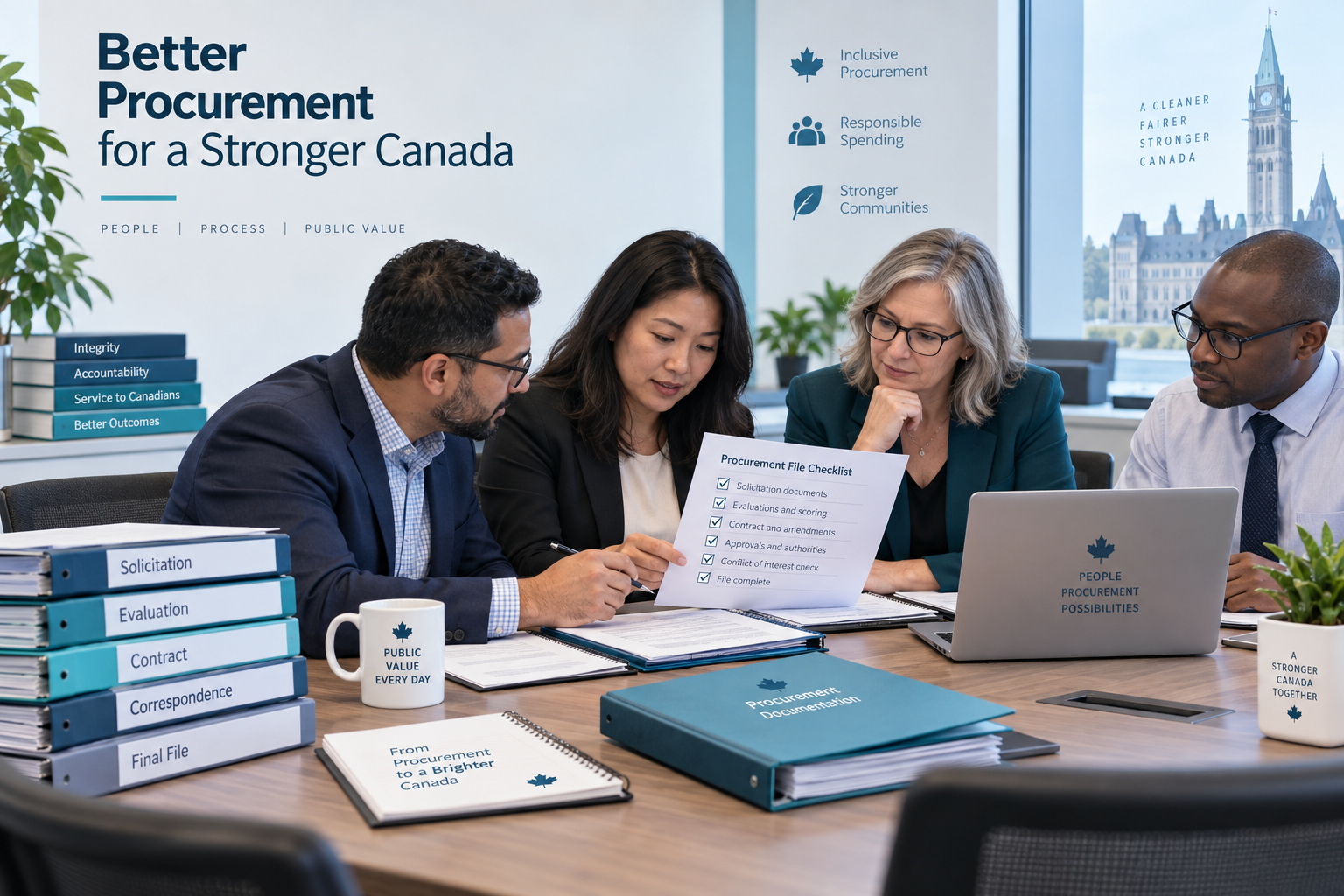
procurement documentation assessment
Good records make public procurement decisions easier to understand, review and defend. A procurement documentation assessment examines whether the file tells a complete, orderly story from the initial need through supplier selection, contract award and payment.
Key Takeaways
- A thorough documentation review confirms that your procurement file follows a clear path from the original business need all the way through supplier selection, award and final payment.
- Well organized records allow colleagues, auditors and the public to follow your reasoning without needing extra explanation after the fact.
- Checking documentation during the process helps you spot and fix gaps before they become difficult to explain at review time.
- Strong record keeping habits give Canadian procurement teams the confidence to defend their decisions at any stage.
For a new practitioner, the purpose is practical: identify gaps before they become delays, disputes or difficult questions. The review should connect documentation to a real decision, such as improving file quality, preparing for an internal review, strengthening contract management or confirming readiness for an audit or access-to-information request.
What is procurement documentation assessment?
A procurement documentation assessment is a structured review of procurement records against the organization’s approved policies, procedures, delegated authorities, trade obligations, records requirements and privacy expectations. It considers both the presence of documents and the quality of the evidence within them.
A complete review may follow the file through planning, requisition, market research, solicitation, evaluation, approvals, award, contract administration, amendments, invoice verification and closeout. The reviewer looks for a clear business need, fair treatment of suppliers, appropriate approvals, consistent evaluation records, conflict-of-interest declarations, communications, financial controls and an explanation for material decisions.
The assessment is not automatically the same as a formal audit. An audit generally follows a defined assurance mandate and reporting method. An assessment can be narrower and more improvement-focused. It may sample files, map the approval trail, test naming and storage practices, or examine whether a decision can be understood by someone who was not involved at the time.
Benefits of procurement documentation assessment

The main benefit is visibility. A careful review shows whether records are complete, accurate, consistently named and stored in an approved location. It can reveal scattered email approvals, missing evaluation notes, unsigned forms, unclear version control, unsupported sole-source reasoning or contract changes that were not connected to the original authority. These findings give managers a basis for focused corrective action rather than relying on assumptions.
Better documentation also supports accountability. Public procurement decisions involve public funds and may be reviewed by senior leadership, an auditor, a supplier, an oversight body or an access-to-information process. A coherent record helps demonstrate that requirements were defined fairly, information was handled appropriately, approvals matched delegated authority and supplier communications were managed consistently.
The review can improve operational performance as well. When teams know which records belong at each stage, they spend less time searching for evidence and less time reconstructing decisions after the fact. A shared checklist can support intake, solicitation design, bid evaluation, award approval, purchase orders, invoice matching and contract monitoring. It can also identify training needs, unclear templates, weak handoffs and unrealistic timelines.
Assessment findings are most valuable when they lead to a decision. For example, a department may decide to revise its file index, establish a quality check before award, assign responsibility for contract amendments or provide training on evaluation records. NECI’s Procurement Training for Teams can help teams build shared knowledge through a Canadian-focused public sector procurement curriculum and a progressive certification pathway from essentials to procurement expert level. Procurement Training for Teams.
Requirements vary by municipality, province, territory, agency, institution, funding source and governing policy. An assessment should identify the applicable jurisdiction and recordkeeping rules before judging a file. It should educate the team, preserve fairness and strengthen ethical practice, while leaving legal interpretation to the organization’s qualified advisers.
How to Choose procurement documentation assessment
Begin with the decision the review must support. A useful procurement documentation assessment should not produce a report that sits unused. Decide whether the immediate need is file readiness, process improvement, staff development, contract oversight or preparation for an internal review. This purpose determines the scope, sample of files, assessment criteria and level of detail. It also gives the team a sensible way to prioritize findings instead of treating every issue as equally urgent.
Next, define the authority against which records will be examined. Gather the organization’s procurement policy, procedures, delegated signing authorities, applicable trade obligations, privacy direction, records-management requirements and procurement procedures manual. Requirements can differ between a municipality, provincial organization, federal department, school, hospital, post-secondary institution or publicly funded agency. The review should identify the relevant jurisdiction, funding conditions and approval framework before a finding is made.
Choose an assessment method that follows the procurement lifecycle rather than checking documents in isolation. A practical file map may include the business need, planning record, budget confirmation, market research, solicitation, supplier questions, bids received, evaluation materials, conflict declarations, approvals, award notice, contract, amendments, invoices, performance records and closeout. For each stage, ask whether the record exists, whether it is dated and authorized, whether the content supports the decision, and whether an independent reader could follow the sequence.
Look for a process that records reasoning, not merely forms. A completed template has limited value if it does not explain the requirement, evaluation approach, approval path or contract change. The assessor should also test how email, shared drives, procurement software, purchase orders and financial records connect. Scattered information can make a compliant decision difficult to demonstrate, while inconsistent file names can slow retrieval during management review, supplier challenge or an access-to-information request. Teams that need standardized procurement resources may also review the procurement templates collection.
Consider who will conduct the work. An internal review may provide operational knowledge and encourage ownership. An independent reviewer may notice assumptions that the regular team no longer sees. In either case, the method should be respectful, evidence-based and clear about limitations. Findings should distinguish a policy gap, training need, documentation omission, approval concern and possible legal issue. Staff education can support consistent practice, and Procurement Training for Teams offers a Canadian-focused public sector procurement curriculum for shared learning. Procurement Training for Teams also provides a progressive certification pathway from essentials to procurement expert level.
Finally, confirm how results will be used after delivery. A strong procurement documentation assessment ends with an action register, responsible owners, review dates and a method for checking whether changes were adopted. That follow-through turns observations into better file management, clearer accountability and more confident procurement decisions.