
🍂 Thanksgiving Deals: save up to $250 on courses & webinars. Ends Nov 30, 2026
Call Now to Connect with an Expert : 250-370-0041
Canadian Procurement & Contracts Training

Procurement Automation Governance: A Guide

Procurement Automation Governance: A Guide

procurement automation governance

Procurement automation governance is the way an organization sets boundaries, assigns responsibility and reviews automated procurement activity. Automation can move a requisition, match an invoice or organize supplier information quickly. It cannot decide what is fair, defensible or appropriate for the public interest.

Key Takeaways

  • Governance gives automated procurement tools clear boundaries so technology supports your process instead of replacing oversight.
  • Assigning responsibility for automated activity means someone is always answerable when systems route requisitions or match invoices.
  • Regular review of automated work helps teams confirm that outcomes remain fair, defensible and aligned with the public interest.
  • Automation shines at speed and organization, but judgment about what is appropriate for the public belongs to people.
  • Public sector buyers can adopt automation with confidence when a solid governance structure guides how the technology operates.

For a team new to this topic, the best starting point is not a tool demonstration. It is a shared understanding of what automation may do, what requires human judgment and who remains responsible. Procurement Training for Teams can support that common foundation.

What does procurement automation governance mean?

Procurement automation governance is the set of policies, responsibilities, controls and review practices used to manage automated procurement activities and the technology behind them. It helps an organization pursue efficiency without allowing software or artificial intelligence to replace accountable human judgment, fair supplier treatment, reliable records or applicable public-sector requirements.

A short definition you can quote

Governance means setting operating rules around automation. Those rules identify which activities may be automated, what information a system may use, when a person must review an output, how exceptions are handled and how decisions are recorded.

What might automation cover?

In a procurement office, automation may support requisition intake, approval routing, purchase order creation, invoice matching, supplier onboarding, contract reminders or sourcing support. Each activity still needs dependable information, suitable permissions and a way to correct errors.

Why does ungoverned automation create risk?
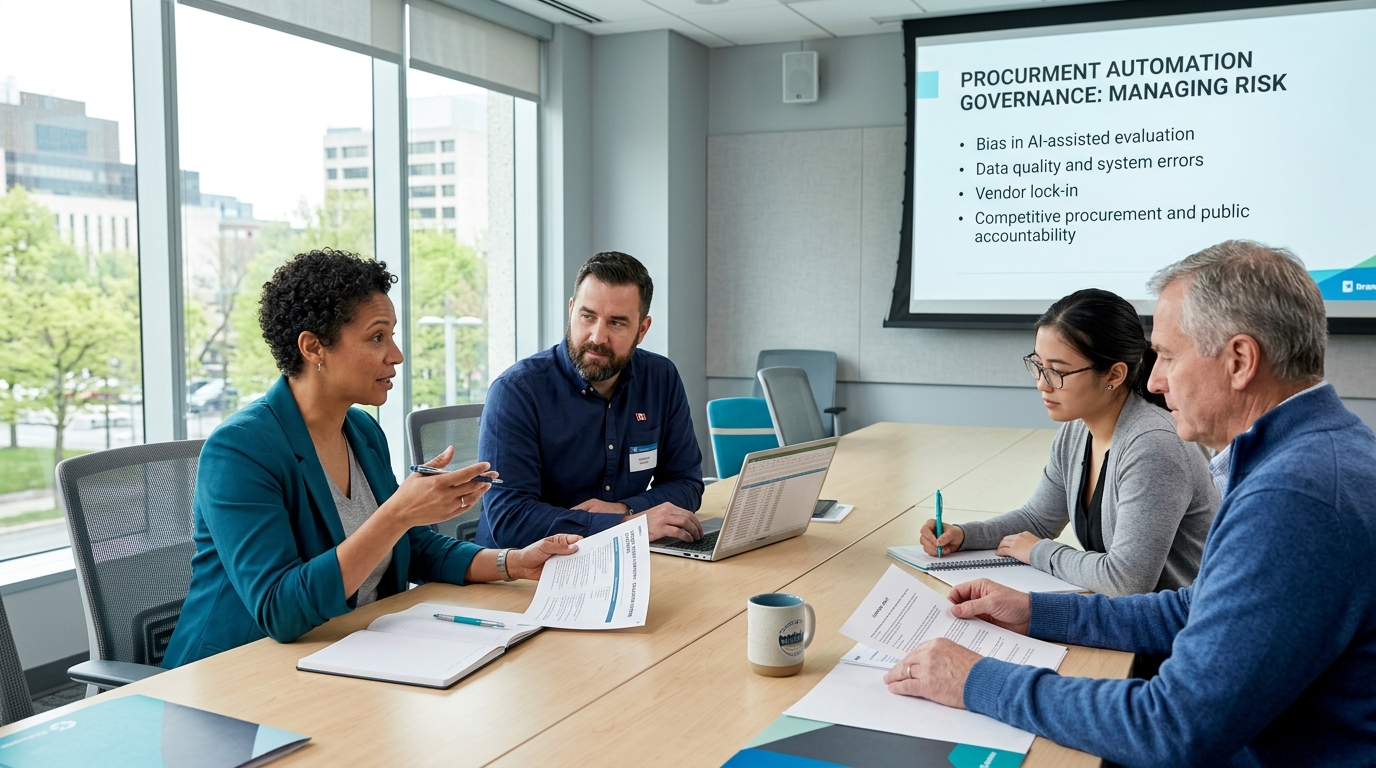
Why ungoverned automation creates risk in competitive public procurement

In competitive public procurement, an automated step still sits inside a process that requires accountability. Poor supplier data, system errors, unclear permissions or an AI-assisted recommendation can affect how suppliers are treated. A useful record connects the approved process, relevant inputs, system output, human review, exceptions and final decision.

Speed is only one measure of a procurement process. The organization also needs to show how it defined the requirement, communicated with suppliers, evaluated information and reached its decision. Human review is part of that chain.

What records should a team retain?

Depending on the organization’s rules and the activity involved, records may include decision logs, access histories, evaluation material, supplier communications and approved system changes. These records help a team reconstruct what happened during an audit, oversight review or access-to-information process.

How can a team build a governance framework?

A practical framework connects each automated task to a purpose, a control and a named accountable role. It should also identify the points where a person must review, question or stop the workflow.

Six useful governance areas

A team can organize its framework around policy; roles and delegated authority; controls; monitoring; review; and documentation. These areas can apply to a rules-based workflow, an artificial intelligence tool, a supplier portal or an integration between procurement and financial systems.

Who is accountable when automation fails?

Assign accountability before implementation. The responsible role should have enough authority to pause the workflow, investigate an issue, use the organization’s notification process and arrange corrective action. A system may produce an output, but it does not hold organizational accountability.

Which decisions should stay human?

Automation fits repeatable administrative work such as sorting, routing, reminders and duplicate detection. Human review should remain where judgment may affect supplier treatment, public expenditure or the meaning of a procurement requirement.

Organizations strengthening controls for renewals, obligations and amendments may also benefit from contract management training for teams.

How should success be measured?

Use measures that show control as well as speed. Examples include review rates, documentation completeness, unresolved exceptions, correction time, access-control findings and automated changes approved before release.

What should Canadian teams consider?

What applies at the federal level?

For federal institutions, the Government of Canada’s Directive on Automated Decision-Making addresses subjects including impact assessment, notice, explanation, human intervention, testing, data quality and recourse. Its application depends on the institution and system involved.

Why do jurisdictional differences matter?

Procurement rules and organizational policies differ among federal, provincial, territorial and municipal governments. Before approving an automated workflow, identify the official framework that applies to the organization and the authority responsible for interpreting it.

How should automation support a fair process?

At a general level, an automated control should support openness, transparency, consistent supplier treatment and the requirements communicated in the procurement process. It should not quietly create a barrier or apply a new criterion that suppliers were not told about.

This article is introductory, not legal or procurement advice. For a live situation, consult the relevant official government guidance, your organization’s policies and qualified procurement or legal professionals.

What is a governance-first implementation roadmap?

A governance-first roadmap and how to build team capability

Start with the decision and its controls, not the software. Define the need, applicable policy, accountable roles, information requirements and human review points before selecting a platform or activating an artificial intelligence feature.

Implementation roadmap

  1. Set the policy position. Record acceptable and prohibited uses, approval authority, privacy and security expectations, retention requirements, supplier obligations and escalation routes.
  2. Choose a contained pilot. Select a low-risk administrative activity, define success criteria and keep a manual process available.
  3. Run in parallel. Compare automated outputs with the existing process. Check accuracy, exceptions, permissions and official records.
  4. Install controls before expansion. Approve test results, assign monitoring duties, document changes and establish a pause mechanism.
  5. Scale in stages. Extend use only when the evidence supports the change.

What belongs on a pre-launch checklist?

Confirm that the purpose, scope, owners, data sources, permissions, testing, human review, records, contingency process, monitoring dates and escalation contacts are documented before release.

Why is training a governance control?

People decide whether an automated output is accepted, questioned or escalated. Shared learning can cover procurement fundamentals, ethical conduct, delegated authority, contract management, data stewardship, supplier communication and incident response. Teams needing practical guidance on responsible AI use can explore artificial intelligence procurement training for teams.

Teams may also use a procurement procedures manual to support consistent procedures, controls and documentation.

A small, documented pilot gives a team a sensible way to learn, check its controls and build confidence before expanding automation.

Frequently Asked Questions

What are the 5 P's of procurement?

The 5 P’s of procurement are commonly described as purpose, people, process, performance and partnership, although the exact list can vary by organization. In public procurement, these ideas support clear requirements, responsible roles, fair procedures, measurable results and constructive supplier relationships. Governance helps connect each area to documented controls.

What is governance in procurement?

Procurement governance is the system of policies, responsibilities, approvals and records that guides purchasing decisions. Procurement governance makes clear who may act, which rules apply, when human review is required and how exceptions are handled. Good governance supports fairness, transparency, accountability and reliable audit records.

What is procurement automation and how does it work?

Procurement automation uses software or artificial intelligence to complete repeatable purchasing tasks, such as routing requisitions, matching invoices, organizing supplier data and sending contract reminders. Procurement automation works through defined rules, data, permissions and workflows. Human review remains necessary when an output affects supplier treatment, public spending or procurement judgment.

What are the 7 stages of procurement?

The 7 stages of procurement are commonly need identification, requirement definition, market research, solicitation, evaluation, contract award and contract management or closeout. Procurement automation can assist with routing, records and reminders across these stages. Accountable staff must still approve key decisions and maintain a defensible record of the process.

What are the three P's of procurement?

The three P’s of procurement are often presented as people, process and technology, though some organizations use a different model. People provide judgment and accountability, processes set consistent steps and controls, and technology supports approved activities. Procurement automation governance keeps technology aligned with policy, public interest and fair supplier treatment.

How do you govern automated procurement decisions?

Automated procurement decisions are governed through approved policies, assigned accountability, access controls, testing, human review, monitoring and complete records. The responsible role should be able to pause a workflow, investigate an error and arrange corrective action. Decision logs should capture relevant inputs, system outputs, reviews, exceptions and final decisions.


NECI The Procurement School Inc. provides Canadian procurement and contracts training for public-sector professionals, teams, and organizations. Its expert-led courses, webinars, and resources focus on practical procurement skills, accountability, ethics, compliance, and better contract outcomes.

Last reviewed: August 30, 2026 by the NECI The Procurement School Inc. Team

Disclaimer: The views and opinions expressed in this article are those of the Subject Matter Experts and do not necessarily reflect the official policy or position of The Procurement School.


Leave a Reply

Your email address will not be published. Required fields are marked *

Procurement Automation Governance: A Guide

procurement automation governance

Procurement automation governance is the way an organization sets boundaries, assigns responsibility and reviews automated procurement activity. Automation can move a requisition, match an invoice or organize supplier information quickly. It cannot decide what is fair, defensible or appropriate for the public interest.

Key Takeaways

  • Governance gives automated procurement tools clear boundaries so technology supports your process instead of replacing oversight.
  • Assigning responsibility for automated activity means someone is always answerable when systems route requisitions or match invoices.
  • Regular review of automated work helps teams confirm that outcomes remain fair, defensible and aligned with the public interest.
  • Automation shines at speed and organization, but judgment about what is appropriate for the public belongs to people.
  • Public sector buyers can adopt automation with confidence when a solid governance structure guides how the technology operates.

For a team new to this topic, the best starting point is not a tool demonstration. It is a shared understanding of what automation may do, what requires human judgment and who remains responsible. Procurement Training for Teams can support that common foundation.

What does procurement automation governance mean?

Procurement automation governance is the set of policies, responsibilities, controls and review practices used to manage automated procurement activities and the technology behind them. It helps an organization pursue efficiency without allowing software or artificial intelligence to replace accountable human judgment, fair supplier treatment, reliable records or applicable public-sector requirements.

A short definition you can quote

Governance means setting operating rules around automation. Those rules identify which activities may be automated, what information a system may use, when a person must review an output, how exceptions are handled and how decisions are recorded.

What might automation cover?

In a procurement office, automation may support requisition intake, approval routing, purchase order creation, invoice matching, supplier onboarding, contract reminders or sourcing support. Each activity still needs dependable information, suitable permissions and a way to correct errors.

Why does ungoverned automation create risk?

Why ungoverned automation creates risk in competitive public procurement

In competitive public procurement, an automated step still sits inside a process that requires accountability. Poor supplier data, system errors, unclear permissions or an AI-assisted recommendation can affect how suppliers are treated. A useful record connects the approved process, relevant inputs, system output, human review, exceptions and final decision.

Speed is only one measure of a procurement process. The organization also needs to show how it defined the requirement, communicated with suppliers, evaluated information and reached its decision. Human review is part of that chain.

What records should a team retain?

Depending on the organization’s rules and the activity involved, records may include decision logs, access histories, evaluation material, supplier communications and approved system changes. These records help a team reconstruct what happened during an audit, oversight review or access-to-information process.

How can a team build a governance framework?

A practical framework connects each automated task to a purpose, a control and a named accountable role. It should also identify the points where a person must review, question or stop the workflow.

Six useful governance areas

A team can organize its framework around policy; roles and delegated authority; controls; monitoring; review; and documentation. These areas can apply to a rules-based workflow, an artificial intelligence tool, a supplier portal or an integration between procurement and financial systems.

Who is accountable when automation fails?

Assign accountability before implementation. The responsible role should have enough authority to pause the workflow, investigate an issue, use the organization’s notification process and arrange corrective action. A system may produce an output, but it does not hold organizational accountability.

Which decisions should stay human?

Automation fits repeatable administrative work such as sorting, routing, reminders and duplicate detection. Human review should remain where judgment may affect supplier treatment, public expenditure or the meaning of a procurement requirement.

Organizations strengthening controls for renewals, obligations and amendments may also benefit from contract management training for teams.

How should success be measured?

Use measures that show control as well as speed. Examples include review rates, documentation completeness, unresolved exceptions, correction time, access-control findings and automated changes approved before release.

What should Canadian teams consider?

What applies at the federal level?

For federal institutions, the Government of Canada’s Directive on Automated Decision-Making addresses subjects including impact assessment, notice, explanation, human intervention, testing, data quality and recourse. Its application depends on the institution and system involved.

Why do jurisdictional differences matter?

Procurement rules and organizational policies differ among federal, provincial, territorial and municipal governments. Before approving an automated workflow, identify the official framework that applies to the organization and the authority responsible for interpreting it.

How should automation support a fair process?

At a general level, an automated control should support openness, transparency, consistent supplier treatment and the requirements communicated in the procurement process. It should not quietly create a barrier or apply a new criterion that suppliers were not told about.

This article is introductory, not legal or procurement advice. For a live situation, consult the relevant official government guidance, your organization’s policies and qualified procurement or legal professionals.

What is a governance-first implementation roadmap?

A governance-first roadmap and how to build team capability

Start with the decision and its controls, not the software. Define the need, applicable policy, accountable roles, information requirements and human review points before selecting a platform or activating an artificial intelligence feature.

Implementation roadmap

  1. Set the policy position. Record acceptable and prohibited uses, approval authority, privacy and security expectations, retention requirements, supplier obligations and escalation routes.
  2. Choose a contained pilot. Select a low-risk administrative activity, define success criteria and keep a manual process available.
  3. Run in parallel. Compare automated outputs with the existing process. Check accuracy, exceptions, permissions and official records.
  4. Install controls before expansion. Approve test results, assign monitoring duties, document changes and establish a pause mechanism.
  5. Scale in stages. Extend use only when the evidence supports the change.

What belongs on a pre-launch checklist?

Confirm that the purpose, scope, owners, data sources, permissions, testing, human review, records, contingency process, monitoring dates and escalation contacts are documented before release.

Why is training a governance control?

People decide whether an automated output is accepted, questioned or escalated. Shared learning can cover procurement fundamentals, ethical conduct, delegated authority, contract management, data stewardship, supplier communication and incident response. Teams needing practical guidance on responsible AI use can explore artificial intelligence procurement training for teams.

Teams may also use a procurement procedures manual to support consistent procedures, controls and documentation.

A small, documented pilot gives a team a sensible way to learn, check its controls and build confidence before expanding automation.

Frequently Asked Questions

What are the 5 P's of procurement?

The 5 P’s of procurement are commonly described as purpose, people, process, performance and partnership, although the exact list can vary by organization. In public procurement, these ideas support clear requirements, responsible roles, fair procedures, measurable results and constructive supplier relationships. Governance helps connect each area to documented controls.

What is governance in procurement?

Procurement governance is the system of policies, responsibilities, approvals and records that guides purchasing decisions. Procurement governance makes clear who may act, which rules apply, when human review is required and how exceptions are handled. Good governance supports fairness, transparency, accountability and reliable audit records.

What is procurement automation and how does it work?

Procurement automation uses software or artificial intelligence to complete repeatable purchasing tasks, such as routing requisitions, matching invoices, organizing supplier data and sending contract reminders. Procurement automation works through defined rules, data, permissions and workflows. Human review remains necessary when an output affects supplier treatment, public spending or procurement judgment.

What are the 7 stages of procurement?

The 7 stages of procurement are commonly need identification, requirement definition, market research, solicitation, evaluation, contract award and contract management or closeout. Procurement automation can assist with routing, records and reminders across these stages. Accountable staff must still approve key decisions and maintain a defensible record of the process.

What are the three P's of procurement?

The three P’s of procurement are often presented as people, process and technology, though some organizations use a different model. People provide judgment and accountability, processes set consistent steps and controls, and technology supports approved activities. Procurement automation governance keeps technology aligned with policy, public interest and fair supplier treatment.

How do you govern automated procurement decisions?

Automated procurement decisions are governed through approved policies, assigned accountability, access controls, testing, human review, monitoring and complete records. The responsible role should be able to pause a workflow, investigate an error and arrange corrective action. Decision logs should capture relevant inputs, system outputs, reviews, exceptions and final decisions.

NECI The Procurement School Inc. provides Canadian procurement and contracts training for public-sector professionals, teams, and organizations. Its expert-led courses, webinars, and resources focus on practical procurement skills, accountability, ethics, compliance, and better contract outcomes.

Last reviewed: August 30, 2026 by the NECI The Procurement School Inc. Team

Disclaimer: The views and opinions expressed in this article are those of the Subject Matter Experts and do not necessarily reflect the official policy or position of The Procurement School.


Leave a Reply

Your email address will not be published. Required fields are marked *

Procurement Automation Governance: A Guide

procurement automation governance

Procurement automation governance is the way an organization sets boundaries, assigns responsibility and reviews automated procurement activity. Automation can move a requisition, match an invoice or organize supplier information quickly. It cannot decide what is fair, defensible or appropriate for the public interest.

Key Takeaways

  • Governance gives automated procurement tools clear boundaries so technology supports your process instead of replacing oversight.
  • Assigning responsibility for automated activity means someone is always answerable when systems route requisitions or match invoices.
  • Regular review of automated work helps teams confirm that outcomes remain fair, defensible and aligned with the public interest.
  • Automation shines at speed and organization, but judgment about what is appropriate for the public belongs to people.
  • Public sector buyers can adopt automation with confidence when a solid governance structure guides how the technology operates.

For a team new to this topic, the best starting point is not a tool demonstration. It is a shared understanding of what automation may do, what requires human judgment and who remains responsible. Procurement Training for Teams can support that common foundation.

What does procurement automation governance mean?

Procurement automation governance is the set of policies, responsibilities, controls and review practices used to manage automated procurement activities and the technology behind them. It helps an organization pursue efficiency without allowing software or artificial intelligence to replace accountable human judgment, fair supplier treatment, reliable records or applicable public-sector requirements.

A short definition you can quote

Governance means setting operating rules around automation. Those rules identify which activities may be automated, what information a system may use, when a person must review an output, how exceptions are handled and how decisions are recorded.

What might automation cover?

In a procurement office, automation may support requisition intake, approval routing, purchase order creation, invoice matching, supplier onboarding, contract reminders or sourcing support. Each activity still needs dependable information, suitable permissions and a way to correct errors.

Why does ungoverned automation create risk?

Why ungoverned automation creates risk in competitive public procurement

In competitive public procurement, an automated step still sits inside a process that requires accountability. Poor supplier data, system errors, unclear permissions or an AI-assisted recommendation can affect how suppliers are treated. A useful record connects the approved process, relevant inputs, system output, human review, exceptions and final decision.

Speed is only one measure of a procurement process. The organization also needs to show how it defined the requirement, communicated with suppliers, evaluated information and reached its decision. Human review is part of that chain.

What records should a team retain?

Depending on the organization’s rules and the activity involved, records may include decision logs, access histories, evaluation material, supplier communications and approved system changes. These records help a team reconstruct what happened during an audit, oversight review or access-to-information process.

How can a team build a governance framework?

A practical framework connects each automated task to a purpose, a control and a named accountable role. It should also identify the points where a person must review, question or stop the workflow.

Six useful governance areas

A team can organize its framework around policy; roles and delegated authority; controls; monitoring; review; and documentation. These areas can apply to a rules-based workflow, an artificial intelligence tool, a supplier portal or an integration between procurement and financial systems.

Who is accountable when automation fails?

Assign accountability before implementation. The responsible role should have enough authority to pause the workflow, investigate an issue, use the organization’s notification process and arrange corrective action. A system may produce an output, but it does not hold organizational accountability.

Which decisions should stay human?

Automation fits repeatable administrative work such as sorting, routing, reminders and duplicate detection. Human review should remain where judgment may affect supplier treatment, public expenditure or the meaning of a procurement requirement.

Organizations strengthening controls for renewals, obligations and amendments may also benefit from contract management training for teams.

How should success be measured?

Use measures that show control as well as speed. Examples include review rates, documentation completeness, unresolved exceptions, correction time, access-control findings and automated changes approved before release.

What should Canadian teams consider?

What applies at the federal level?

For federal institutions, the Government of Canada’s Directive on Automated Decision-Making addresses subjects including impact assessment, notice, explanation, human intervention, testing, data quality and recourse. Its application depends on the institution and system involved.

Why do jurisdictional differences matter?

Procurement rules and organizational policies differ among federal, provincial, territorial and municipal governments. Before approving an automated workflow, identify the official framework that applies to the organization and the authority responsible for interpreting it.

How should automation support a fair process?

At a general level, an automated control should support openness, transparency, consistent supplier treatment and the requirements communicated in the procurement process. It should not quietly create a barrier or apply a new criterion that suppliers were not told about.

This article is introductory, not legal or procurement advice. For a live situation, consult the relevant official government guidance, your organization’s policies and qualified procurement or legal professionals.

What is a governance-first implementation roadmap?

A governance-first roadmap and how to build team capability

Start with the decision and its controls, not the software. Define the need, applicable policy, accountable roles, information requirements and human review points before selecting a platform or activating an artificial intelligence feature.

Implementation roadmap

  1. Set the policy position. Record acceptable and prohibited uses, approval authority, privacy and security expectations, retention requirements, supplier obligations and escalation routes.
  2. Choose a contained pilot. Select a low-risk administrative activity, define success criteria and keep a manual process available.
  3. Run in parallel. Compare automated outputs with the existing process. Check accuracy, exceptions, permissions and official records.
  4. Install controls before expansion. Approve test results, assign monitoring duties, document changes and establish a pause mechanism.
  5. Scale in stages. Extend use only when the evidence supports the change.

What belongs on a pre-launch checklist?

Confirm that the purpose, scope, owners, data sources, permissions, testing, human review, records, contingency process, monitoring dates and escalation contacts are documented before release.

Why is training a governance control?

People decide whether an automated output is accepted, questioned or escalated. Shared learning can cover procurement fundamentals, ethical conduct, delegated authority, contract management, data stewardship, supplier communication and incident response. Teams needing practical guidance on responsible AI use can explore artificial intelligence procurement training for teams.

Teams may also use a procurement procedures manual to support consistent procedures, controls and documentation.

A small, documented pilot gives a team a sensible way to learn, check its controls and build confidence before expanding automation.

Frequently Asked Questions

What are the 5 P's of procurement?

The 5 P’s of procurement are commonly described as purpose, people, process, performance and partnership, although the exact list can vary by organization. In public procurement, these ideas support clear requirements, responsible roles, fair procedures, measurable results and constructive supplier relationships. Governance helps connect each area to documented controls.

What is governance in procurement?

Procurement governance is the system of policies, responsibilities, approvals and records that guides purchasing decisions. Procurement governance makes clear who may act, which rules apply, when human review is required and how exceptions are handled. Good governance supports fairness, transparency, accountability and reliable audit records.

What is procurement automation and how does it work?

Procurement automation uses software or artificial intelligence to complete repeatable purchasing tasks, such as routing requisitions, matching invoices, organizing supplier data and sending contract reminders. Procurement automation works through defined rules, data, permissions and workflows. Human review remains necessary when an output affects supplier treatment, public spending or procurement judgment.

What are the 7 stages of procurement?

The 7 stages of procurement are commonly need identification, requirement definition, market research, solicitation, evaluation, contract award and contract management or closeout. Procurement automation can assist with routing, records and reminders across these stages. Accountable staff must still approve key decisions and maintain a defensible record of the process.

What are the three P's of procurement?

The three P’s of procurement are often presented as people, process and technology, though some organizations use a different model. People provide judgment and accountability, processes set consistent steps and controls, and technology supports approved activities. Procurement automation governance keeps technology aligned with policy, public interest and fair supplier treatment.

How do you govern automated procurement decisions?

Automated procurement decisions are governed through approved policies, assigned accountability, access controls, testing, human review, monitoring and complete records. The responsible role should be able to pause a workflow, investigate an error and arrange corrective action. Decision logs should capture relevant inputs, system outputs, reviews, exceptions and final decisions.

NECI The Procurement School Inc. provides Canadian procurement and contracts training for public-sector professionals, teams, and organizations. Its expert-led courses, webinars, and resources focus on practical procurement skills, accountability, ethics, compliance, and better contract outcomes.

Last reviewed: August 30, 2026 by the NECI The Procurement School Inc. Team

Disclaimer: The views and opinions expressed in this article are those of the Subject Matter Experts and do not necessarily reflect the official policy or position of The Procurement School.


Leave a Reply

Your email address will not be published. Required fields are marked *