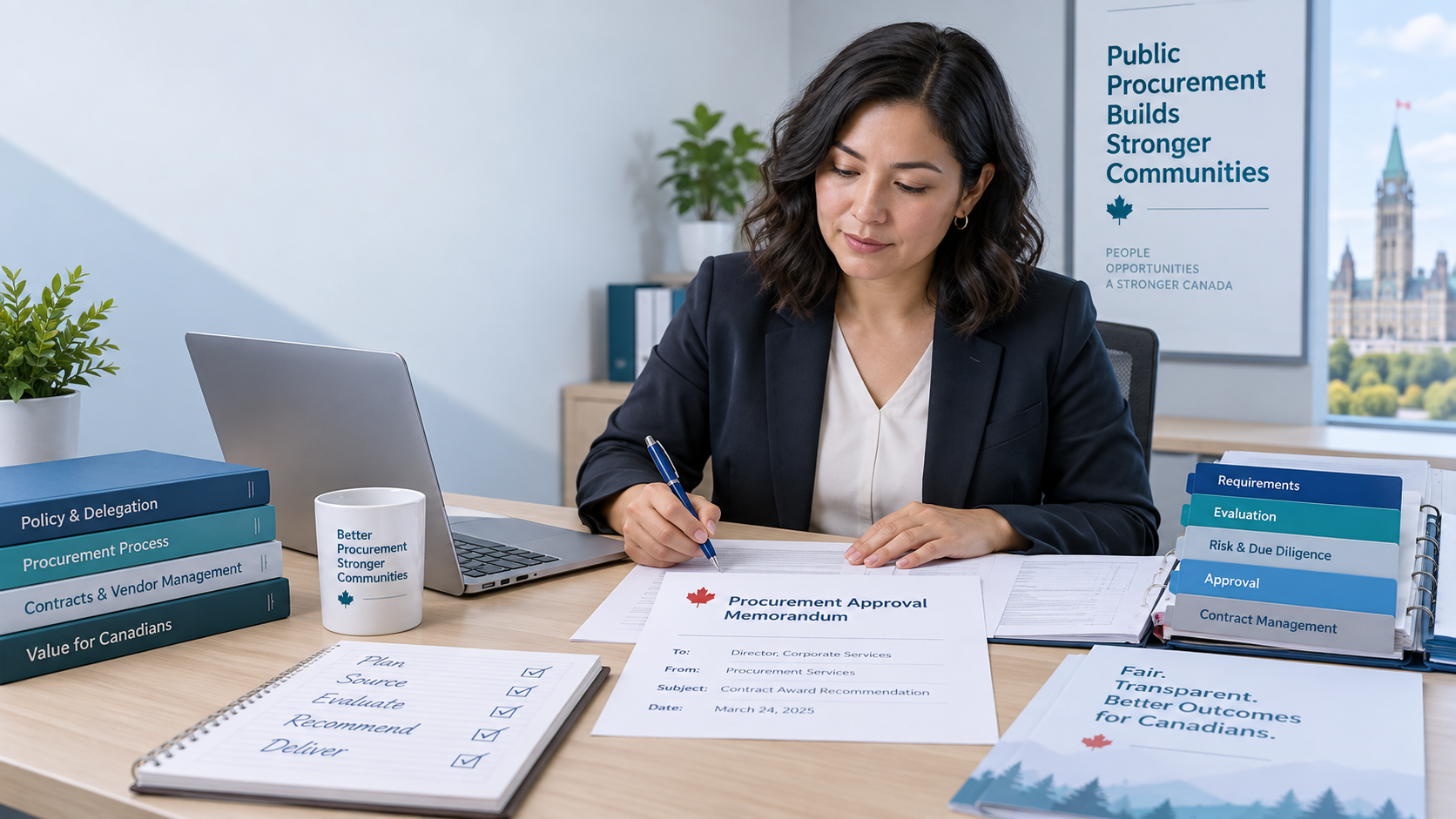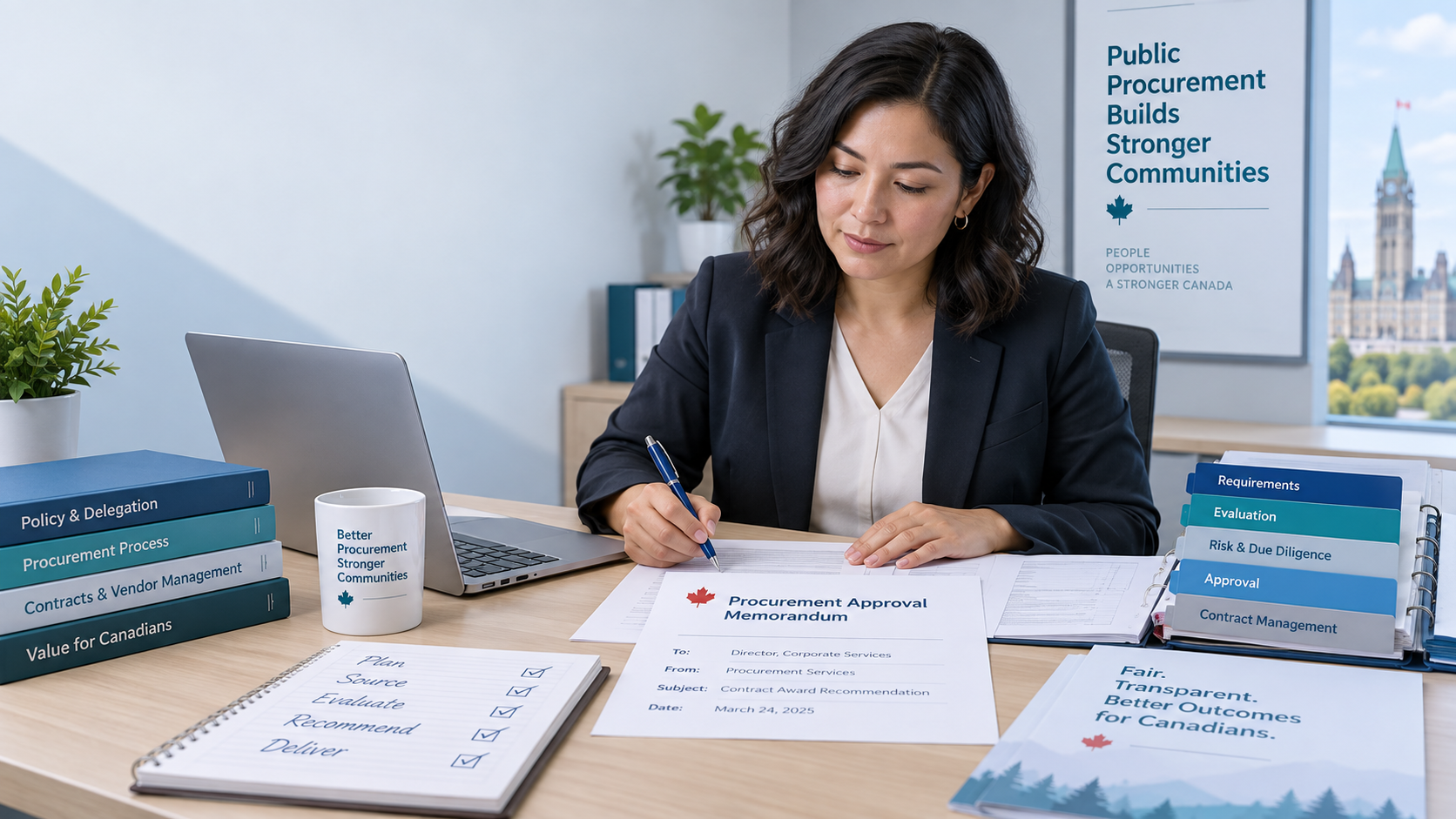
procurement approval memo
A procurement approval memo gives an authorized decision-maker a clear record of why a public contract should proceed. It connects the completed evaluation with the proposed award, contract value, funding, risks, and required approvals. A clear memo helps the organization make a decision that others can understand and review later.
Teams building shared knowledge can use Procurement Training for Teams to develop consistent Canadian public-sector procurement language and documentation habits. The program supports evaluators, procurement officers, program managers, and approvers.
What Is a Procurement Approval Memo?
A procurement approval memo is an internal document that requests authorization for an award or another procurement decision. It normally summarizes the requirement, solicitation method, evaluation process, results, recommended supplier, contract value, funding, risks, and approval route. The memo does not replace the evaluation record. It gives the approving authority enough accurate information to make and record an informed decision.
The Document’s Purpose
The memo connects the completed evaluation to the proposed award. It should show how the recommendation relates to the published evaluation criteria, applicable organizational policies, solicitation terms, and approval process. The recommendation should be based on documented evidence rather than a supplier’s general reputation or personal preference.
Several people may rely on the document. An approver needs a concise decision brief. Procurement and finance staff need accurate transaction details. A program manager or reviewer may later need to understand how the organization reached its decision. Dated records, conflict-of-interest declarations, evaluator results, and supporting attachments make that review easier.
How It Differs from Related Documents
Public organizations use different names for internal records. The title alone does not determine a document’s function. Before drafting, check the organization’s procurement policy, financial procedures, records requirements, and delegation-of-authority instrument. A procurement procedures manual may help an organization create a consistent internal framework.
| Document | Primary purpose | Typical timing |
|---|---|---|
| Procurement approval memo | Requests and records authorization for an award or related procurement decision. | After evaluation and before award or contract commitment. |
| Purchase approval form | Captures a standardized purchasing or spending request, often with coding and funding details. | Before a purchase order, payment commitment, or purchasing action. |
| Approval letter | Communicates an approval, direction, or decision to a recipient. | After the authorized decision has been made. |
| Information memorandum | Provides information for awareness or discussion without necessarily requesting an approval. | When leadership needs context, status, or background. |
When You Need a Procurement Approval Memo
Use a memo when the organization’s procedure calls for a documented award recommendation or when an approval authority needs a formal record before public funds are committed. The required content can vary by contract value, procurement method, funding source, risk, and the authority assigned to the signatory. Federal, provincial, territorial, regional, and municipal practices may differ, so follow the rules that apply to your organization.
The procurement lead or project owner often prepares the memo with input from evaluators, finance, legal or policy specialists, and the business unit. Preparation does not equal approval. The signatory must hold the appropriate delegated authority and should receive the complete evaluation record, not only the recommendation page. If an exception is needed, document the reason and follow the organization’s escalation procedure.
The Approval Memo in the Evaluation and Award Stage

The memo belongs after evaluation and before the organization communicates an award or makes a contract commitment. It links the documented evaluation to the proposed decision, while keeping assessment and authorization separate. The exact sequence depends on the organization’s policy and approval workflow.
Connecting Evaluation to Authorization
Evaluation materials show how submissions were assessed. The approval memo explains how those results support the proposed award. It should identify the solicitation, summarize the approved evaluation approach, and state why the recommended supplier achieved the strongest outcome under the published criteria.
The roles should remain distinct. Evaluators assess submissions. Procurement staff check process requirements and records. The delegated authority decides whether the organization may proceed. Clear separation helps protect the integrity of the process and makes the decision easier to review.
Steps from Evaluation Completion to an Authorized Award
- Close the evaluation. Confirm that evaluators completed conflict-of-interest and confidentiality declarations, applied the stated criteria, and documented any clarification or consensus process.
- Validate the result. Check calculations, mandatory requirements, evaluator comments, consensus scores, price analysis, and required internal reviews.
- Confirm the contract picture. Record the recommended supplier, potential value, term, options, taxes, funding source, budget confirmation, deliverables, and material risks.
- Check the applicable framework. Review the organization’s policy and any relevant controls, such as security, privacy, accessibility, or funding requirements. Practices can vary across Canadian jurisdictions.
- Draft the decision record. Present the facts in a logical order and connect the recommendation to the solicitation and evaluation documents.
- Route for review. Obtain the procurement, finance, contract management, legal, program, or executive reviews required by the organization.
- Obtain authorization before commitment. The appropriate authority approves through the established workflow before the next procurement or contracting step proceeds.
Teams seeking a common working approach can consider custom procurement training for their team to build consistent documentation and approval practices.
Essential Components of a Procurement Approval Memo
A strong procurement approval memo gives the approver the information needed for a decision without requiring a search through scattered emails, evaluation worksheets, and budget notes. It should be concise enough to read efficiently and detailed enough to show how the recommendation was reached.
A Section-by-Section Template
- Decision requested: State the action clearly and identify whether the request concerns an award, amendment, extension, or other decision.
- Business requirement: Describe the goods, services, or construction need and the intended operational outcome.
- Procurement process: Name the solicitation method, reference number, dates, submissions, and approved changes.
- Evaluation result: Summarize mandatory requirements, rated criteria, price assessment, consensus process, and the recommended supplier’s result.
- Contract and financial details: Identify the term, options, estimated total value, taxes, funding source, budget confirmation, and payment structure.
- Risks and controls: Note material risks involving delivery, privacy, security, accessibility, insurance, conflicts of interest, intellectual property, or supplier capacity.
- Approval and attachments: Name the required approval authority and list the supporting documents.
Common weaknesses include a recommendation without a clear decision sentence, a value that omits options or known costs, unexplained changes to the evaluation record, and attachments that do not match the narrative. Before routing, compare names, dates, totals, supplier identifiers, and document versions across the file.
Writing a Rationale Linked to the Evaluation Criteria
The rationale should explain why the recommended outcome follows from the published process. Use evidence, not preference. A reviewer should be able to trace each material conclusion to a solicitation clause, evaluation worksheet, clarification record, or approved financial document.
Budget, Risk, and Other Review Details
Record the evaluation price, expected contract value, options, applicable taxes, currency, funding source, budget availability, procurement method, and material risks with proposed controls. If trade-agreement coverage or another specialized requirement may apply, follow the organization’s current official guidance rather than relying on a general template. Specific requirements vary by jurisdiction and circumstance.
Who Approves What: Understanding Delegation of Authority in the Canadian Public Sector
Delegation of authority is the formal assignment of decision-making power within a public organization. It identifies which role may approve an award, contract amendment, purchase commitment, or exception, and under which conditions. The route can depend on value, method, risk, funding, and policy. Each organization’s instrument must be checked directly.
How Value and Procurement Method Affect the Approval Path
Contract value may help determine routing, but it is only one consideration. Competitive procurements, direct awards, urgent purchases, standing arrangement call-ups, and amendments may have different approval paths. Privacy, security, construction, public sensitivity, funding restrictions, or exceptions to competition may also require specialist review.
Identifying the Signing Authority
Identify the decision requested, the relevant policy or delegation instrument, the proposed signatory, and the conditions that must be met before contract execution. A review comment is not the same as approval, and a person who helped prepare the memo may not have authority to sign it.
What Happens When a Memo Goes to the Wrong Approver?
A package sent to the wrong approver may be returned, delayed, or escalated for correction. Keep the routing history, do not overwrite dates or signatures, and record corrective steps openly. Ask the organization’s procurement or finance contact how the file should proceed.
Common Audit Findings and How to Avoid Them

Documentation problems often appear when the recommendation, evaluation record, budget information, and approval history do not agree. A complete file gives a reviewer a clear path from the requirement to the authorized decision.
Five Documentation Failures to Check
- Missing rationale: The file names a recommended supplier but does not connect the outcome to published criteria.
- Approval after commitment: A contract or purchasing commitment occurs before authorization.
- Inconsistent scores: Different documents show different evaluation results.
- Incomplete financial information: The stated amount omits options, extensions, taxes, or known costs.
- Wrong approval level: The signatory lacks authority for the value, method, risk, or exception.
How to Keep the File Ready for Review
Use objective wording, distinguish fact from analysis, protect confidential supplier information under applicable rules, and keep the signed approval, evaluation materials, clarifications, declarations, financial confirmation, contract, and routing history together. Records should remain readable, current, and stored in the approved location.
A Pre-Submission Checklist
- Match supplier names, references, dates, totals, and evaluation results across documents.
- Confirm the recommendation follows the stated criteria.
- Verify the full contract value, funding, term, options, taxes, and budget availability.
- Record material risks, controls, declarations, and specialist reviews.
- Check the applicable policy, jurisdictional requirements, exceptions, and notice requirements.
- Identify the delegated authority and obtain approval before commitment.
- Check that attachments are complete, readable, current, and stored appropriately.
Frequently Asked Questions
What is included in a procurement approval memo?
A procurement approval memo typically summarizes the procurement requirement, solicitation method, evaluation process and results, recommended supplier, contract value, funding source, risks, and approval route. It gives the delegated authority enough accurate information to make and record an informed decision, supported by the complete evaluation record.
What are some examples of procurement documents?
Common procurement documents include the procurement approval memo, purchase approval form, approval letter, and information memorandum. Each serves a different purpose: the memo requests authorization to award, the form captures a standardized spending request, the letter communicates a decision already made, and the memorandum shares context without requesting approval.
How is a procurement approval memo different from an approval letter?
A procurement approval memo requests and records authorization for an award, while an approval letter communicates a decision that has already been made. Timing marks the key difference: the memo is prepared after evaluation and before contract commitment, and the letter follows the authorized decision.
Who prepares a procurement approval memo?
The procurement lead or project owner normally prepares the memo, with input from evaluators, finance, legal or policy specialists, and the business unit. Preparation does not equal approval: the signatory must hold the appropriate delegated authority and should receive the complete evaluation record, not only the recommendation page.
What steps lead from evaluation completion to an authorized award?
The steps include closing the evaluation with conflict-of-interest and confidentiality declarations, validating calculations and price analysis, confirming the contract picture such as value, term, and funding, and checking the applicable procurement framework. Keeping evaluation, verification, and authorization roles distinct helps your team procure with confidence.
Does a procurement approval memo replace the evaluation record?
No, a procurement approval memo never replaces the evaluation record. Its purpose is to give the approving authority enough accurate information to make and record an informed decision, linking the recommendation to the published evaluation criteria, budget, risks, and required approvals so the outcome can be understood and defended later.
Can urgency justify retroactive approval in procurement?
No, urgency is never permission to seek retroactive approval of a procurement decision. If a process exception is genuinely required, document the reason and follow the organization’s escalation procedure. A dated, defensible approval record protects the public interest during audit or review.