
negotiated procurement process
A negotiated procurement process gives a public organization a structured way to discuss proposals before awarding a contract. It can help the buyer assess factors beyond the initial price, such as delivery approach, risk allocation, service levels, implementation needs, total cost, and opportunities for innovation.
Key Takeaways
- A negotiated procurement invites dialogue between the buyer and suppliers before any contract is awarded, which supports more informed decisions.
- Looking beyond the opening bid allows a public organization to weigh delivery methods, risk sharing, and service commitments alongside price.
- Discussing implementation requirements and total cost during negotiation helps buyers avoid surprises once the contract is underway.
- Negotiation opens the door to innovative ideas and creative solutions that a purely price-driven competition might miss.
- Learning when and how to use a negotiated approach helps public sector teams procure with confidence and achieve better overall value.
The method also carries responsibility. Canadian procurement rules vary by province, municipality, agency, institution, funding source, trade agreement, and internal delegation. A sound approach connects flexibility with fairness, transparency, ethical conduct, and a clear record of each decision.
What is a negotiated procurement process?
A negotiated procurement process is a competitive purchasing method in which the buyer may communicate with qualified proponents, seek clarification, discuss elements of a proposal, and invite revisions before selecting the successful supplier. The procurement documents should explain the negotiation structure, evaluation criteria, permitted topics, communication rules, and award method before suppliers respond.
Unlike a straightforward bid, which generally evaluates offers against fixed requirements and submitted prices, negotiation creates a planned opportunity to understand how each proposed solution will work. The evaluation may consider technical quality, qualifications, governance, schedule, operational fit, payment terms, lifecycle cost, contract risk, and supplier capacity. Price remains relevant, but it may not be the only measure of value.
How does it differ from competitive bidding?
Competitive bidding usually asks proponents to submit their best offer against defined specifications, with limited discussion after closing. A negotiated method permits a structured exchange while maintaining competition. That exchange might address an unclear deliverable, implementation sequence, service standard, warranty provision, data requirement, or pricing model.
The buyer should not change the opportunity for one supplier alone or give a proponent information that others do not receive. An evaluation plan, trained evaluators, conflict-of-interest declarations, approval checkpoints, and negotiation records help the team apply the process consistently. The contract handoff should preserve the final decisions so procurement, finance, program staff, and contract managers share the same understanding.
Is negotiation the same as a sole source or direct award?
No. Negotiation can involve several proponents within a defined competitive process. A sole-source or direct-award approach generally involves purchasing from one supplier under an authorized exception or other applicable authority. Terminology and permitted uses differ across Canadian jurisdictions, so buyers should confirm the relevant policy, approval level, notice requirements, and trade-agreement obligations before proceeding.
Negotiation also does not give a buyer unrestricted freedom to bargain. Public funds require a defensible path from need identification to contract award. A lower immediate payment is not automatically better value; the team should consider the full financial and operational effect within its approved controls.
When may this method be appropriate?
Negotiation may suit a complex requirement that cannot be described well through fixed specifications alone. Examples include specialized professional services, technology implementation, multi-stage delivery, outcome-based services, or projects where technical choices could affect cost and risk. It may also support innovation when the buyer can describe the desired result without prescribing every part of the solution.
Before choosing the method, the organization should confirm that its policy permits negotiation and that the procurement strategy fits the requirement. Preparation should cover the business need, market knowledge, evaluation weighting, negotiation authority, supplier communications plan, approval route, confidentiality controls, recordkeeping expectations, and contract-management model.
Teams building this foundation may consider Procurement Training for Teams, which provides a Canadian-focused public sector procurement curriculum.
With preparation, negotiation becomes a controlled procurement activity rather than an informal conversation. The buyer can support fair participation, evaluate value in context, protect public trust, and create an agreement the organization can manage.
What should be documented before supplier discussions?
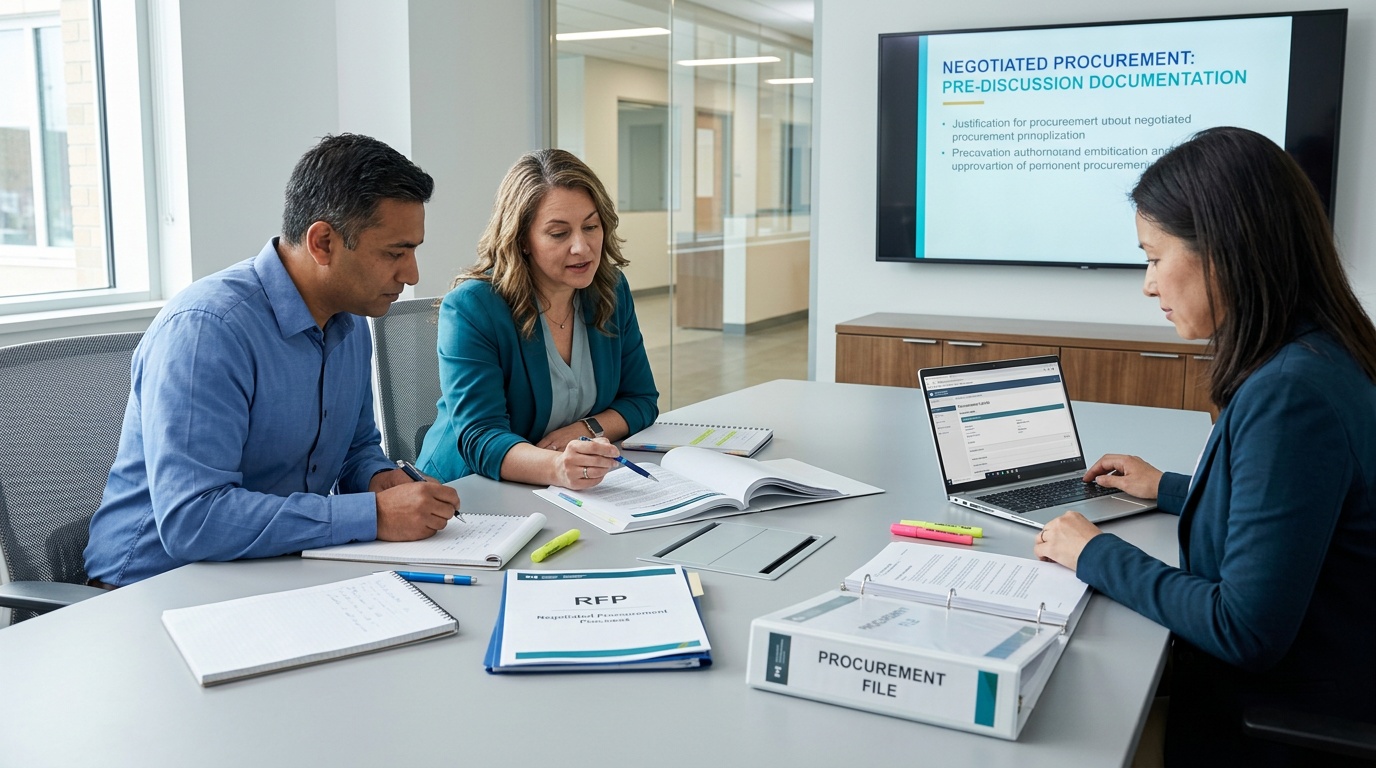
Before discussions begin, the procurement file should explain why this method suits the requirement and how the process will remain fair. Record the business need, desired outcomes, scope, estimated value, market conditions, approval authority, evaluation criteria, scoring model, negotiation limits, and intended contract structure.
The procurement documents should also state whether discussions are available to every eligible proponent, whether revised proposals may be requested, and how the final offer will be assessed. This preparation gives evaluators a shared reference point and helps distinguish clarification from negotiation.
A clarification seeks understanding without changing a supplier’s offer. Negotiation may address service levels, implementation milestones, risk allocation, support obligations, pricing structure, deliverables, or performance measures, provided the process permits those discussions. Any material change should be managed consistently and recorded with enough detail to support the award recommendation.
Key insight
Flexibility must be designed before it is used. If the buyer has not defined the boundaries, negotiation can create unequal access, inconsistent evaluation, unclear approvals, or an agreement that does not match the original need.
A practical record can include the date of each meeting, attendees, questions asked, responses received, documents exchanged, unresolved issues, pricing assumptions, concessions considered, and approvals obtained. It should show how the buyer protected confidential information, treated proponents consistently, and connected the recommendation to the published evaluation approach.
After award, the contract manager needs the final requirements, commitments, reporting duties, escalation process, and acceptance criteria. Teams can build these habits through Contract Management Training for Teams, which supports a shared vocabulary for supplier communication, contract administration, and ethical decision-making.
A confidence checklist for the procurement file
A well-prepared negotiated procurement process should answer these questions before release:
- What outcome does the organization need?
- Which requirements are fixed, and which may be discussed?
- How will technical merit, price, lifecycle cost, delivery risk, accessibility, sustainability, and organizational fit be assessed?
- Who may communicate with proponents?
- Who can approve changes?
- What evidence will support the final selection?
The answers should align with the applicable legislation, trade obligations, government directive, institutional policy, municipal procedure, funding conditions, and delegation schedule. Requirements differ across Canada, so a general explanation cannot replace jurisdiction-specific verification. If uncertainty remains, the procurement team should obtain appropriate internal guidance and confirm authority before contacting suppliers.
When those controls are in place, negotiation supports better-informed decisions without weakening accountability. The objective is not to bargain for its own sake. It is to create a fair path toward a deliverable agreement that reflects price, quality, risk, service, timing, and expected contract performance.
How should an organization decide whether to negotiate?
The decision should begin with the requirement, not a preference for a particular purchasing method. Negotiation may be suitable when supplier expertise is needed to shape the solution, when risks cannot be allocated fairly through standard terms, or when several technically credible approaches could meet the intended outcome.
A fixed-price bid may be more appropriate when specifications are clear, offers can be evaluated consistently without discussion, and price is a reliable indicator of value. A useful decision test asks whether discussion will produce information or improvements that the initial solicitation cannot reasonably obtain. If not, added complexity may not be justified.
If discussion is warranted, identify which matters may be discussed, how proponents will participate, and how final offers will be evaluated. This supports proportionality: the process and controls should fit the requirement’s value, complexity, risk, and public interest.
Controls that support a fair outcome
Establish the process before contacting suppliers. Publish meaningful rules, use the same communication channels, protect confidential information, and ensure evaluators understand their responsibilities. Negotiators should know the organization’s approval limits, budget position, mandatory requirements, and unacceptable contract risks.
Negotiation notes should be clear enough for an informed reviewer to follow the decision. Connect each material discussion to the evaluation framework, revised proposal, approval, and final contract term. Record assumptions where pricing depends on volumes, implementation timing, optional services, renewal provisions, or supplier-owned technology.
Practical verdict
Use negotiation when it solves a defined procurement problem, not merely because it offers more flexibility. Proceed only when the organization has authority, a fair structure, capable evaluators, documented boundaries, and enough time to manage supplier dialogue properly.
What should teams consider for future procurements?
Teams may need to consider outcomes beyond purchase price, including accessibility, environmental performance, social value, cybersecurity, data stewardship, Indigenous participation, resilience, service continuity, and measurable contract results. These considerations should relate to the requirement and appear as clear criteria, evidence requests, performance measures, or contract obligations.
Planning should continue after award. A well-negotiated agreement can still struggle if ownership, reporting, milestones, or change control are unclear. Before award, identify the contract manager, governance meetings, acceptance process, issue-escalation route, payment verification, and renewal review.
Technology may support records, evaluation workflows, market research, and contract monitoring, but it does not replace judgement. Automated tools require appropriate oversight, reliable information, privacy safeguards, and human review when decisions affect supplier opportunity, public funds, confidential information, or essential services.
The next step for procurement confidence

Organizations beginning this work can take a measured approach: confirm the governing policy, define the business outcome, select a proportionate method, prepare the evaluation model, train the people involved, and test the file from an independent reviewer’s perspective.
Ask whether a supplier could understand the opportunity, whether each proponent would receive fair treatment, and whether the final recommendation could be explained to an auditor, oversight body, elected official, or member of the public.