procurement learning advisory
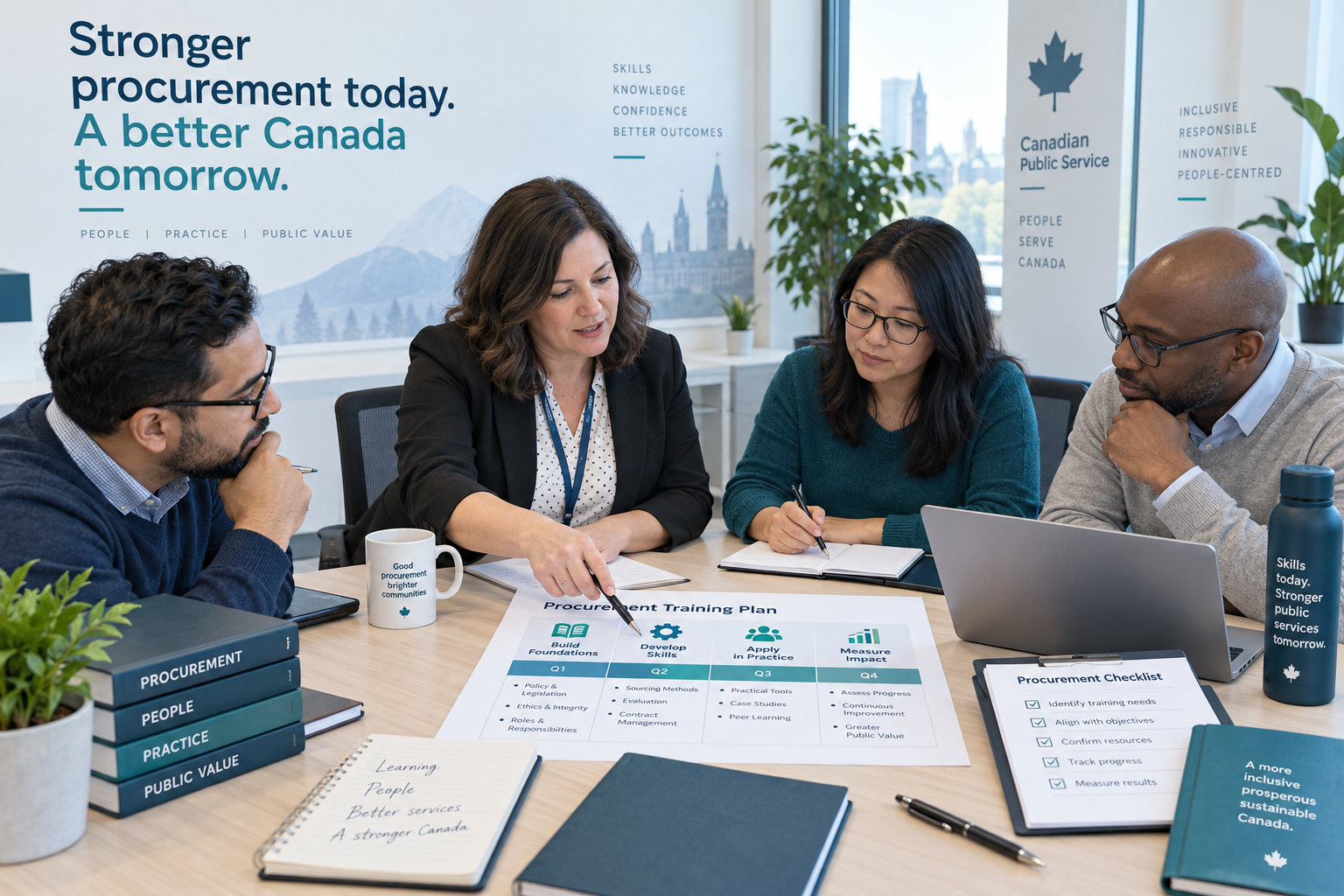
Choosing procurement training involves more than selecting a course. A team may need shared fundamentals, role-specific practice, contract-management support, or a capability plan. Procurement learning advisory connects those needs to a practical learning path, helping public-sector professionals build confidence while maintaining accountability, documentation, fairness, and public value.
Key Takeaways
- Procurement learning advisory begins with an honest look at what your team already does well and where skill gaps slow projects down.
- A strong training plan blends shared fundamentals with role-specific practice so each learner gets guidance that fits their daily responsibilities.
- Public-sector teams gain the most when every learning path reinforces accountability, documentation, fairness, and public value.
- Advisory support helps you sequence courses, workshops, and coaching into a realistic schedule that respects budgets and workloads.
- The right plan turns training from a one-time event into an ongoing capability your organization can measure and grow over time.
For Canadian public-sector organizations, support should reflect the people involved in purchasing, organizational policies, contract complexity, and the decisions staff make. The aim is a defensible learning approach, not training activity for its own sake.
What Is Procurement Learning Advisory?
Procurement learning advisory is a structured service that helps an organization identify capability needs and decide how to address them. It connects roles, responsibilities, knowledge gaps, process discipline, evaluation, contract administration, and learning outcomes. Recommendations may include self-paced study, webinars for teams, custom team training, a progressive certification pathway, consulting, or a combination.
Defining procurement learning advisory
The work begins with questions rather than a predetermined course. Who participates in requisitioning, sourcing, evaluation, approvals, supplier communication, and contract oversight? Which responsibilities are clear, and where do employees rely on informal practice? Are managers able to review procurement files? Do contract managers understand performance monitoring, amendments, records, and closeout? Answers to these questions shape a learning plan relevant to the organization.
This differs from treating training as a one-time event. An advisory approach considers the learner’s role, experience, desired capability, delivery format, timing, and follow-up. It also separates education from legal or operational advice. Training can build understanding and professional judgement; consulting may address a specific procurement process, document, sourcing activity, or contract-management problem.
How it differs from standard training courses, webinars, and full consulting
A standard course provides a defined curriculum for a broad objective. A webinar is shorter and focused on a topic such as planning, evaluation, ethics, or supplier relationships. Custom team training adapts examples and exercises for a group. Full consulting addresses an operational need and may involve reviewing or developing work products. Advisory support sits between these options, helping determine which form of support fits before the organization commits time and resources.
| Support option | Best suited to | Typical outcome |
|---|---|---|
| Self-paced course | An individual building foundational knowledge | Personal understanding and structured study |
| Webinar | A focused topic or shared introduction | Awareness, discussion, and practical prompts |
| Custom team training | A group with common duties or a shared process | Consistent language, examples, and team practice |
| Learning advisory | An organization uncertain about its capability priorities | A documented learning direction and recommended pathway |
| Consulting | A defined operational or contract-management challenge | Practical support connected to a specific work requirement |
Why Canadian public-sector organizations need a tailored approach
Public procurement involves more than purchasing knowledge. Employees may need to understand delegated authority, transparency, conflict-of-interest controls, competition, evaluation records, privacy, accessibility, trade obligations, supplier communication, and approval requirements. The framework varies by jurisdiction and organization. A tailored plan helps people understand their responsibilities without assuming every learner needs the same depth of study.
NECI The Procurement School Inc. supports learning with a Canadian-focused public sector procurement curriculum and a progressive certification pathway from essentials to procurement expert level. For organizations seeking a shared starting point, Procurement Training for Teams can bring colleagues into a common learning experience. The program.
When Should Your Organization Consider Procurement Learning Advisory?

Common signs your team needs a learning strategy, not just a course
Consider advisory support when training decisions feel uncertain or disconnected from daily work. Signs include inconsistent file documentation, different process interpretations across locations, unclear roles between requisitioners and procurement officers, repeated evaluation questions, or contract managers without practical guidance for monitoring supplier performance. Another sign is a catalogue of completed courses with little evidence that staff apply learning to planning, solicitation, award, administration, and closeout.
Advisory support may also fit organizational change, including new delegations, expanded purchasing responsibilities, revised policy, staff turnover, centralization, or increased contract activity. Employees may have different starting points and need coordinated objectives and manager support.
Decision tree: choose the right form of support
Use this decision path as a starting point. It does not replace applicable policy or advice on a specific procurement matter.
- Is there one defined topic to explain? Choose a webinar for brief awareness or a focused conversation.
- Does one learner need foundational or certification-pathway study? Choose a self-paced course when individual pacing is suitable.
- Do several people need the same skills for a shared process? Choose custom team training for common examples, discussion, and application.
- Are capability priorities unclear across roles or departments? Choose learning advisory support to assess needs and recommend a pathway.
- Is there a specific operational procurement or contract issue? Consider consulting, adding training when staff need related capability.
Pain points that point to a need for advisory support
The strongest case often appears when several pain points occur together. A team may know its policies but apply them inconsistently. Managers may approve requests without a shared understanding of risk. Evaluators may need stronger documentation habits, while contract owners need support with deliverables, changes, reporting, and supplier performance. Private-sector professionals entering public procurement may understand commercial buying but need orientation to public accountability and transparent decision-making.
What to weigh before choosing advisory support
Pros
- Connects learning priorities to actual roles and responsibilities.
- Helps prevent overtraining some employees while leaving other gaps unaddressed.
- Creates a basis for selecting courses, team training, or consulting.
- Supports stronger learning transfer into procurement files and contract work.
Cons
- Requires manager and subject-matter participant time during discovery.
- May identify process, governance, or documentation issues needing separate action.
- Is less suitable for one well-defined introductory topic.
If the exact skill is known, select the appropriate format. If capability is uneven but the response is unclear, procurement learning advisory provides structure for a confident decision. A team may then select custom team training for shared, organization-specific learning.
What Does a Procurement Learning Advisory Engagement Include?
Discovery: understanding your team, roles, and current capability
Procurement learning advisory begins with discovery. The purpose is to understand how procurement work is performed, not assume every employee needs the same course. Discussions may include procurement officers, requisitioners, evaluators, managers, contract owners, finance staff, and executives. The review considers decision rights, delegated authority, approval points, supplier contact, documentation practices, and the goods, services, and contracts handled.
Questions include: Which roles participate in planning, solicitation, evaluation, award, and contract administration? Where do employees need confidence? Which processes vary between departments or locations? Are new employees learning through informal coaching? This information separates a learning need from a policy, governance, or operational issue.
Capability assessment: evaluating knowledge, judgement, and process discipline
A capability assessment considers what people know, what they can apply, and how consistently they document decisions. It can cover procurement fundamentals, ethical practice, conflict-of-interest awareness, market research, evaluation methods, records management, risk identification, supplier communication, and contract performance monitoring. Contract management requires attention after award through deliverables, amendments, issue resolution, reporting, renewal decisions, and closeout.
A structured assessment can follow five steps:
- Map responsibilities: identify each role’s procurement and contract-management duties.
- Review current evidence: examine procedures, templates, learning records, anonymized files, and manager observations where appropriate.
- Identify capability gaps: distinguish missing knowledge from weak judgement, unclear ownership, or inconsistent documentation.
- Set expected behaviours: describe what a learner should plan, explain, document, review, or monitor.
- Prioritize action: rank needs by operational importance, learner group, timing, and available support.
Roadmap development: connecting gaps to practical learning pathways
Findings are organized into a learning roadmap. It may begin with shared essentials for employees who influence purchasing, followed by role-specific study for procurement practitioners or contract managers. It can identify subjects requiring manager participation, such as approval controls, file review, escalation, or performance governance. A progressive certification pathway from essentials to procurement expert level may suit learners needing planned development rather than a single event.
The roadmap should state the reason for each recommendation. Inconsistent evaluation records may point to foundational learning and guided practice. A contract owner who understands the statement of work but lacks a monitoring routine may need contract-management training. A defined procurement file requiring immediate attention may call for consulting, with learning for staff handling future files.
Delivery recommendations: courses, custom training, consulting, or a blend
Delivery should match the gap, audience, and work environment. Self-paced courses support individual study. Webinars introduce a focused subject to a broad group. Custom training uses organizational terminology, workflows, and anonymized scenarios. Consulting fits a specific procurement process, document, contract issue, or implementation task. A blended plan can serve roles requiring different support.
Follow-up and measurement
Follow-up tests whether learning reaches the work. Measures can include learner confidence, completion, manager observations, procurement-record quality, evaluation-documentation consistency, and use of contract-management tools. Completion alone does not show whether employees apply judgement or maintain an accountable process.
After an agreed period, revisit the capability map, gather feedback, and adjust the roadmap. The value of procurement learning advisory is the structured connection between capability, learning, and day-to-day public procurement practice.
How to Match Capability Gaps with the Right Learning Pathway
Capability planning connects a work responsibility to a learning outcome. A procurement officer may need sourcing and evaluation skills, while a requisitioner may need planning, specifications, approvals, and records. Contract managers require post-award knowledge. Managers and executives need enough understanding to provide oversight, ask informed questions, and support ethical decisions.
Role-based learning needs across the organization
Map people to the decisions they make. Roles may overlap, especially in smaller municipalities, agencies, and departments. The purpose is to identify the knowledge, judgement, documentation, and communication skills required for actual duties.
Mapping gaps to PSPP®, contract management, and custom training
PSPP® pathway courses suit individuals needing structured progression through public procurement concepts. Contract management programs fit responsibilities continuing beyond award. Custom team training suits roles using the same intake process, templates, terminology, or controls. A Canadian-focused public sector procurement curriculum can give mixed-experience teams a shared foundation while allowing deeper study for specialist practitioners.
Choose consulting for operational assistance with a defined procurement activity, document, process, or contract matter. Choose learning support when the desired result is improved employee capability. A consultant may help complete or review a work product, while training should help learners perform comparable work independently.
Comparing learning formats by need
Format should follow the learning problem. Online courses support flexible individual study. Webinars work for a narrow topic, shared awareness, or timely discussion. Custom team training addresses common workflows and questions. Advisory planning fits organizations needing to determine priorities. Consulting addresses a defined operational requirement and may be paired with training for lasting capability.
Ensuring learning transfer into procurement work
Before selecting a pathway, state what learners should be able to do afterwards: prepare a procurement strategy, document an evaluation, recognize a conflict of interest, escalate a contract issue, or review a supplier report against requirements. Managers can reinforce transfer through file reviews, coaching, checklists, peer discussion, and follow-up.
The clearest recommendation links each capability gap to an observable behaviour, suitable format, and accountable owner. This keeps learning connected to public value, ethical practice, contract performance, and defensible decisions.
Frequently Asked Questions
How can procurement learning advisory help a public-sector team?
Procurement learning advisory helps a public-sector team identify capability needs and choose a practical learning path. The process connects roles, responsibilities, knowledge gaps, process discipline, evaluation, contract administration, and learning outcomes. Recommendations may include self-paced courses, webinars, custom team training, certification study, consulting, or a suitable combination.
What information is needed to create a procurement learning plan?
A procurement learning plan needs information about staff roles, purchasing responsibilities, experience levels, organizational policies, and contract complexity. The review may examine requisitioning, sourcing, evaluation, approvals, supplier communication, contract oversight, documentation, and manager support. These details help align learning with the work employees must perform.
How is procurement learning advisory different from consulting?
Procurement learning advisory helps an organization decide what people need to learn and which format fits those needs. Consulting addresses a defined operational requirement, such as reviewing a procurement process, document, sourcing activity, or contract-management issue. Advisory support can identify when consulting is appropriate without treating training as a substitute for operational advice.
Can procurement learning advisory support contract managers?
Procurement learning advisory can support contract managers with learning needs related to performance monitoring, amendments, records, supplier communication, and closeout. The approach can identify differences between policy knowledge and day-to-day practice. A learning plan may then combine focused training with consulting when a specific contract or work product requires direct support.
When should an organization review its procurement capability needs?
An organization should review procurement capability needs when roles are unclear, file documentation varies, staff interpret processes differently, or contract managers lack practical guidance. A review also fits changes such as new delegations, staff turnover, centralized purchasing, revised policies, or increased contract activity. The goal is coordinated learning tied to workplace expectations.
How can Canadian public-sector procurement training reflect different roles?
Canadian public-sector procurement training can reflect different roles by matching learning depth to each person’s responsibilities and experience. Requisitioners, procurement officers, evaluators, approvers, managers, and contract administrators may need different knowledge. A tailored approach can address delegated authority, fairness, competition, privacy, accessibility, records, supplier communication, and approval requirements.