
procurement capacity building
Procurement capacity building helps an organization develop the people, processes, governance and practical habits needed to make sound purchasing decisions consistently. It is especially useful when a team is managing complex files, responding to audit observations, or welcoming staff from outside the public sector.
Key Takeaways
- Building procurement capability means investing in four connected areas: skilled people, clear processes, sound governance and everyday habits that support defensible purchasing decisions.
- Teams that strengthen their procurement foundation are better prepared to manage complex files with consistency and confidence.
- Organizations responding to audit observations can use capacity building as a practical way to turn recommendations into lasting improvements.
- Welcoming staff who are new to public sector purchasing goes more smoothly when structured training and clear guidance are part of onboarding.
- Consistent purchasing decisions come from deliberate development rather than good intentions alone.
This guide separates long-term organizational capability from one-time instruction. It also provides a simple way to think about the building blocks of public procurement, including fairness, transparency, documentation, contract management and accountability.
What is procurement capacity building?
A plain-language definition
Training is one part of procurement capacity building. The broader goal is to help an organization understand its responsibilities, apply a repeatable process and retain knowledge when staff change. That may involve foundational learning, clearer templates, role definitions, approval pathways, evaluation guidance, contract administration practices and regular review.
Capacity building versus one-time training
A course can introduce a concept, such as requirements definition, supplier communication or evaluation documentation. Capacity develops when people can apply that concept to real work, receive feedback and use supporting procedures afterwards. A small procurement office may need both individual learning and practical changes to intake, records management, delegated authority and contract monitoring.
One-time instruction can lose its effect when the lesson is not reinforced. A sustainable approach connects learning with supervision, peer discussion, current templates and opportunities to practise. It also includes departments, budget owners and evaluation committee members, since procurement outcomes depend on more than the procurement unit alone.
A note on the international development meaning
The phrase is also used in international development to describe efforts that strengthen institutions, public systems and local capability in countries or regions receiving development support. That meaning is legitimate, yet it is not the only use of the term. In a Canadian public-sector setting, the focus is usually the organization’s ability to plan, compete, award and manage purchasing in a fair and accountable manner.
Why Canadian public-sector organizations invest in it
Public procurement decisions must be explainable to suppliers, decision-makers, auditors and the communities that fund public services. A capable team is better prepared to document requirements, manage conflicts of interest, communicate consistently, protect confidential information and monitor contract performance. These practices support public trust without treating compliance as a substitute for sound judgement.
- New staff gain a shared understanding of public-sector fairness and transparency.
- Departments learn when to involve procurement professionals and how to prepare useful requirements.
- Leaders can see whether policies, controls and resources support the work assigned to the team.
- Knowledge is less dependent on one experienced employee.
For teams seeking a structured starting point, Procurement Training for Teams provides a Canadian-focused public sector procurement curriculum. Its progressive certification pathway from essentials to procurement expert level can help organizations plan learning for different experience levels.
The dimensions of procurement capacity
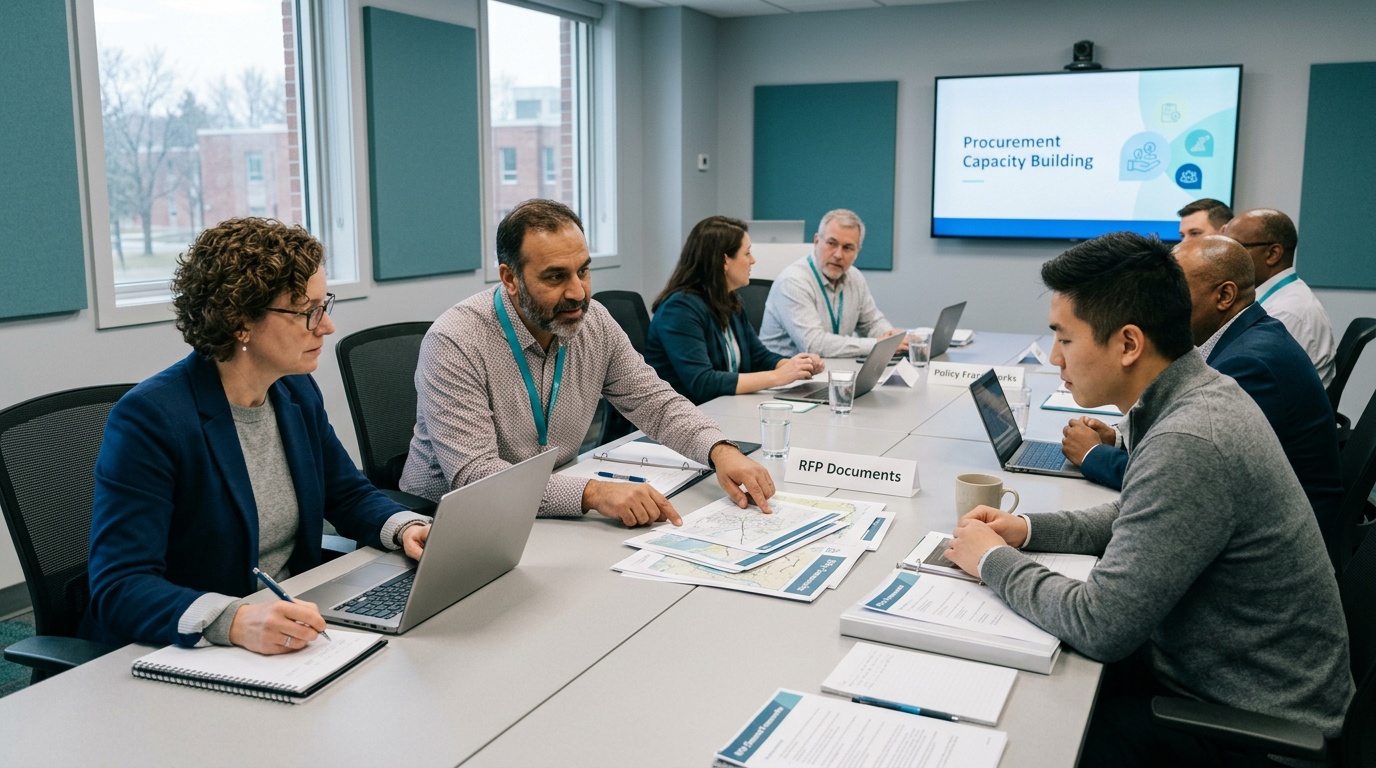
Procurement capacity has several connected dimensions. A team may have knowledgeable practitioners but weak records management, or clear policies but limited capability in contract oversight. Looking at each dimension prevents leadership from treating every performance concern as a training problem.
| Dimension | What it includes | Typical strengthening action |
|---|---|---|
| People | Knowledge, judgement, communication, negotiation and evaluation skills | Role-based learning, coaching and cross-training |
| Process and policy | Planning, approvals, sourcing methods, documentation and controls | Review procedures, clarify responsibilities and update templates |
| Tools and information | Files, systems, market research, checklists and reporting | Improve records, standardize forms and make guidance easy to find |
| Governance and culture | Leadership support, ethics, accountability, oversight and shared expectations | Set decision rights, discuss risks and reinforce professional conduct |
People: skills and competencies
Practitioners need technical knowledge and situational judgement. Departments need enough understanding to describe outcomes, participate appropriately in evaluations and manage supplier relationships after award. Private-sector newcomers may bring valuable commercial experience, while needing orientation to public accountability, open competition and the importance of a defensible record.
Process, policy, and tools
Written policy is useful only when people can follow it during a busy file. Intake forms, procurement plans, approval records, evaluation materials, award notices and contract files should support consistent decisions. Technology can help with visibility and reporting, yet a system cannot correct unclear authority or incomplete requirements.
Governance and organizational culture
Leadership signals whether ethical practice is treated as part of service delivery or as an administrative burden. A healthy culture welcomes questions, records decisions, manages conflicts and gives staff a clear route for escalation. It also recognizes that accountability belongs to the organization, not only to the procurement specialist.
A simple maturity progression
This progression is a discussion tool, not a scorecard. An organization can sit at different stages across different activities.
| Stage | Observable pattern | Next practical focus |
|---|---|---|
| Ad hoc | Work depends heavily on individual memory | Document basic steps and responsibilities |
| Compliant | Policies and approvals are generally understood | Improve consistency, records and role-based learning |
| Managed | Performance, risks and contract results are reviewed | Use evidence to refine planning and controls |
| Strategic | Procurement supports service outcomes and informed decision-making | Maintain capability through succession and continuous improvement |
Organizations do not need to reach the highest stage immediately. A clear baseline, practical priorities and shared language provide a responsible foundation for procurement capacity building. For team-based learning, custom team training can help align learning with an organization’s procedures, roles and priorities.
How to assess your procurement capacity before you invest
Before choosing a course, consultant or new position, assess your procurement capacity building needs. A short, structured review can show whether the main gap involves skills, workload, process design, documentation, contract oversight or organizational understanding. This prevents a common mistake: treating every procurement concern as a training issue when the real cause may be unclear authority, incomplete templates or limited review time.
Run a simple gap analysis
Start with evidence from recent files, staff discussions and service-area feedback. Review a small sample of procurements from planning through contract closeout. Look for patterns rather than assigning blame. Ask where work slows down, where decisions are difficult to explain, and where knowledge depends on one person. Include procurement staff, budget owners, technical specialists, evaluators and contract managers. Each role sees a different part of the operating process.
Record each observation under four headings: capability, process, documentation and capacity. A capability gap may call for instruction or coaching. A process gap may require a clearer intake route or approval workflow. A documentation gap may point to better file controls. A capacity gap may indicate that the team has more work than its available time and resources can support.
A needs-assessment checklist you can use this week
Use the questions below in a 30-minute team discussion. Mark each item as clear, partly clear or uncertain, then note one piece of evidence. The purpose is not to produce a perfect score. It is to identify the few conditions that most affect fair competition, consistent decision-making and contract performance.
- Can staff explain who owns each stage of the procurement process?
- Do departments know when procurement support is required?
- Can the team define business requirements without prescribing an unnecessary solution?
- Are market research and supplier communications recorded consistently?
- Do evaluators understand their roles, criteria and confidentiality obligations?
- Can the organization explain how evaluation decisions were reached?
- Are approvals and delegated authorities easy to verify?
- Can staff locate current policies, templates and guidance quickly?
- Are contract milestones, deliverables, amendments and issues monitored?
- Is there a clear process for managing conflicts of interest?
- Can someone other than the file lead understand the procurement record?
- Do private-sector hires receive orientation to public accountability and transparency?
- Do budget owners and technical teams use the same procurement terminology?
- What happens when a procurement officer is absent or leaves the organization?
Prioritizing what to strengthen first
Rank each gap by public impact, frequency, risk and effort. Begin with issues that affect several files or could undermine the defensibility of a decision. A quick improvement might include a standard intake form, a file checklist, a decision log or a short orientation for evaluators. These actions create consistency while larger work is planned.
Longer-term priorities may include revising procedures, improving contract management, clarifying roles, introducing a records structure or creating a learning pathway for different experience levels. Set an owner and a review date for each action. This makes the assessment useful for leadership discussions and gives the team a practical basis for procurement capacity building rather than another unfinished diagnostic.
Build, buy, or borrow: choosing your development path
Once the needs are understood, leadership can decide how the organization will respond. “Build” means developing people already on the team. “Buy” means recruiting experienced procurement professionals. “Borrow” means obtaining temporary expertise through advisory, consulting or specialized support. These paths can be combined, but each solves a different problem. The right choice depends on urgency, available workload, internal experience, budget authority and the capability the organization needs to retain.
| Path | What it provides | When it fits | What to plan for |
|---|---|---|---|
| Build | Learning, coaching, practice and progression for current employees | The team has committed people and enough time for development | Protected learning time, supervision and opportunities to apply new skills |
| Buy | Experienced practitioners who can assume responsibility quickly | Workload or specialized requirements exceed current internal capability | Recruitment effort, onboarding and knowledge transfer to the wider team |
| Borrow | Focused outside assistance for a defined issue or period | The organization needs process review, complex guidance or a training plan | A clear scope, internal owner and plan for retaining the knowledge |
Build: developing your existing team
Building capability is often suitable when employees understand the organization, demonstrate sound judgement and can grow into broader responsibilities. A development plan can combine foundational instruction, file reviews, mentoring, peer learning and supervised assignments. Map learning to real duties, such as preparing solicitation documents, supporting an evaluation committee or monitoring contract obligations. This approach supports continuity, yet it requires managers to protect time for learning instead of adding development to an already full workload.
Buy: hiring experienced procurement professionals
Recruitment may be appropriate when demand is persistent, the function lacks experienced leadership or specialized knowledge is required immediately. An experienced hire can provide professional judgement and establish stronger routines. The organization still needs an onboarding plan. Public-sector procurement includes expectations around fairness, transparency, records and accountability that may differ from private-sector purchasing. Pairing the new employee with internal stakeholders helps turn individual experience into shared practice.
Borrow: engaging advisory and consulting support
Outside support can be useful for a defined process review, capability assessment, training strategy, complex procurement question or temporary workload pressure. Before engaging support, describe the decision that needs to improve, the records available, the people who must participate and the intended deliverable. Ask for practical knowledge transfer, not only a report. Specific situations may involve legislation, trade obligations, policy interpretation or an active dispute. Official government guidance and qualified professionals should inform those decisions.
Matching learning formats to your needs
Choose the format according to the learning objective. A certification pathway can support progressive development from essentials to procurement expert level. A short course may suit a defined topic or a new responsibility. Custom team training can align a group around common terminology, roles and procedures. A webinar may provide an accessible introduction, while coaching and case discussion help staff apply concepts to live work.
Development path considerations
Pros
- Assessment-led planning directs resources toward genuine organizational needs.
- Team learning creates a shared operating language across procurement and departments.
- Advisory support can address process design while internal staff retain ownership.
Cons
- Training cannot correct insufficient staffing or unclear decision authority by itself.
- A new hire may remain a single point of failure without knowledge transfer.
- Outside advice has limited lasting value when the organization does not assign an internal owner.
For organizations that need a coordinated learning option, team procurement webinars offer an accessible format for shared development across procurement staff, budget owners and other participants in the buying process.
Sustaining capacity over time

Capability can weaken when experienced employees leave, procedures change or learning is not applied in daily work. The World Bank Independent Evaluation Group has identified the risk that capacity-strengthening gains may erode after external support ends. The lesson for Canadian public organizations is practical: development needs an owner, regular reinforcement and a place within normal operations. A sustainable procurement capacity building plan does not need to be elaborate. It needs to remain visible when workloads increase.
Small teams and one-person procurement offices
Small municipalities and part-time procurement offices can begin with controls that reduce dependence on individual memory. Keep current templates in one accessible location, use a standard intake record and schedule brief file reviews for active procurements. A second employee, even outside the procurement function, can be designated to understand key deadlines, approvals and records. This creates basic coverage during vacation, illness or turnover without suggesting that an untrained employee should make specialized decisions alone.
- Reserve a recurring period for reviewing upcoming procurements and contract obligations.
- Maintain a short guide explaining contacts, approvals, templates and escalation routes.
- Use a shared calendar for solicitation milestones, renewals and performance discussions.
- Record decisions in the file while the reasoning is still fresh.
Train the whole buying community, not just procurement
Procurement staff cannot carry the entire control environment. Program managers define needs, budget owners authorize spending, technical specialists support requirements and evaluators assess submissions. Each participant needs role-appropriate instruction on fairness, confidentiality, conflicts of interest, documentation and communication with suppliers. Shared terminology helps departments involve procurement at the right time and reduces informal workarounds caused by uncertainty.
Coordinated team development can support shared instruction across procurement staff, budget owners and other participants in the buying process.
Knowledge transfer through turnover and retirement
Do not wait for a resignation notice before transferring institutional knowledge. Pair less experienced employees with file leads, document recurring judgement calls and use structured handoffs for open procurements. A closeout review should capture what was purchased, which issues arose, how amendments were handled and what future teams should know. These records support continuity while preserving appropriate confidentiality and access controls.
Simple indicators to show progress
Progress can be demonstrated through evidence rather than inflated scores. Track whether current procedures are easy to find, whether files contain required decision records, whether evaluators receive orientation and whether contract reviews occur when planned. Also monitor learning participation, cross-training coverage, recurring questions and the time required to prepare a procurement file. Review these indicators periodically with leadership, then adjust priorities to reflect workload, risk and service needs.
Use official federal, provincial, territorial or municipal guidance for applicable requirements. This educational article is not legal advice. For a specific procurement, dispute, trade obligation or policy interpretation, consult the relevant government authority and qualified professionals.
Frequently Asked Questions
What are the three types of capacity building?
The three types of capacity building are people, process and governance. People capacity covers knowledge, judgement and communication skills; process capacity covers procedures, templates and controls; and governance capacity covers leadership support, ethics and accountability. In procurement, tools and records management form a supporting layer that keeps these three working together.
What are the 5 P's in procurement?
The 5 P’s in procurement are people, process, policy, paperwork and performance. People bring the skills, process gives a repeatable path from planning to award, policy sets the rules, paperwork creates the defensible record, and performance keeps contracts managed after signing. The phrase is also popular as proper planning prevents poor performance.
What counts as capacity building?
Capacity building counts as any planned effort that helps an organization perform work consistently over time, not just one-time instruction. In procurement this includes role-based learning, clearer templates, defined approval pathways, evaluation guidance, contract administration practices and regular review. A course only becomes capacity building when lessons are applied to real files and reinforced afterwards.
What are examples of procurement capacity building activities?
Examples include role-based training, coaching, cross-training, updating intake forms and templates, improving records management, clarifying delegated authority, and strengthening contract monitoring. Peer discussion, orientation for private-sector newcomers on public accountability, and a progressive certification pathway from essentials to expert level are practical activities many Canadian teams use.
What to say instead of capacity building?
Instead of capacity building, common alternatives include capability development, skills development, professional development, organizational development and institutional strengthening. In a procurement context, capability development is often the clearest choice because it points to an organization’s ability to plan, compete, award and manage purchasing in a fair and accountable manner.
Who should be involved in procurement capacity building?
Procurement capacity building should involve more than the procurement unit, including departments, budget owners, evaluation committee members and leadership. Departments learn when to involve procurement professionals and how to prepare useful requirements, while leaders confirm that policies, controls and resources support the work. Procurement outcomes depend on everyone who touches the process.