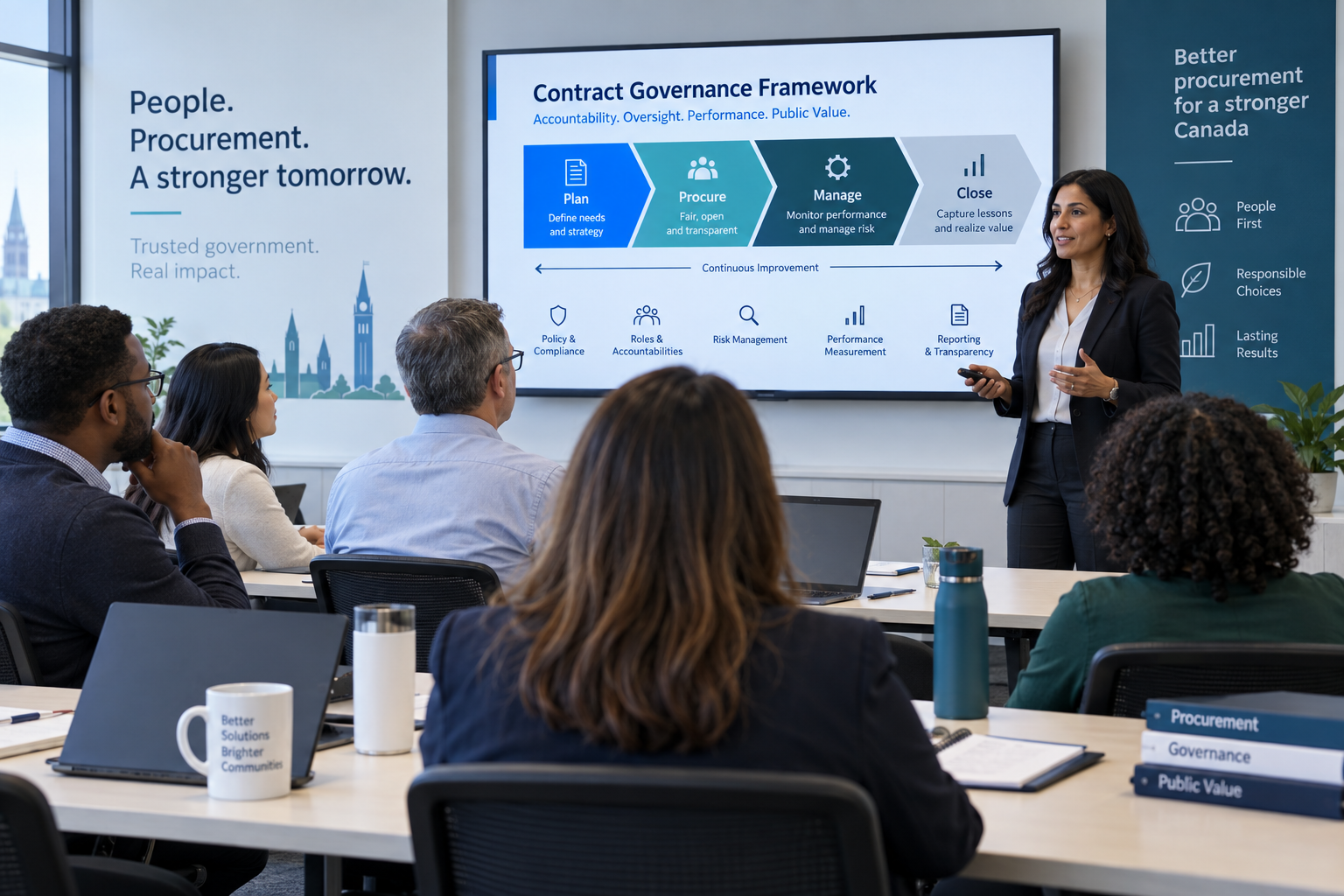
contract governance framework
Public procurement continues after a contract is signed. The organization still needs to confirm delivery, verify payments, monitor performance, address risks, and document decisions. A contract governance framework gives people a practical way to manage those responsibilities from award through renewal, closeout, or a new procurement.
Key Takeaways
- A contract governance framework gives procurement teams a practical structure for managing responsibilities well beyond the signing stage.
- Confirming delivery and verifying payments ensures suppliers provide what was promised and that public funds are spent correctly.
- Ongoing performance monitoring helps organizations spot risks early and address problems before they grow into costly disputes.
- Documenting decisions throughout the contract life cycle supports transparency and accountability, two pillars of Canadian public procurement.
- A clear framework guides teams from the initial award through renewal, closeout, or the launch of a new procurement process.
For someone new to procurement, governance can sound more complicated than it is. The basic questions are clear: who makes each decision, what must be recorded, when is performance reviewed, and how are issues escalated? Answering those questions creates a consistent path for the team.
What is a contract governance framework?
A contract governance framework is a set of roles, procedures, controls, records, and review points used to oversee a contract after award. It connects the agreement with daily administration, including deliverables, service levels, invoices, amendments, reporting, supplier communication, issues, and renewal decisions.
Governance is broader than contract lifecycle management, often called CLM. CLM describes the stages and tools used to create, approve, store, monitor, and close contracts. Governance sets the decision rights and accountability around those stages. A CLM system might send an expiry reminder; governance asks who reviews the requirement, what information supports the decision, and whether enough time remains for the next step.
A reliable contract register is a useful foundation. Each record should identify the agreement owner, supplier, value, term, deliverables, key dates, funding source, approval history, performance measures, and known risks. Assign someone to maintain the information and check its quality. A system cannot compensate for missing or outdated records.
Roles should be agreed before a problem occurs. A contract manager may monitor performance and maintain records. A business owner may confirm operational needs. Finance may review invoices and commitments, while procurement, legal, privacy, or technical specialists provide advice within their responsibilities. The structure will vary, but each decision needs an owner and an escalation route.
What are the benefits of a contract governance framework?

A governance framework helps a team connect the contract with the original need, procurement record, budget, and expected results. Clear obligations make it easier to spot missed deliverables, late reports, invoice discrepancies, or service concerns early. Good records also help maintain continuity when an employee changes roles.
Defined approval responsibilities support accountability. An approval matrix can show who accepts a deliverable, verifies payment, approves a change, recommends escalation, or records a decision. This reduces informal decision-making and gives the organization a consistent basis for reviewing supplier performance and contract changes.
Planning should extend beyond the contract expiry date. A team may need time to assess the ongoing need, secure approvals, run a new procurement, or prepare a transition. The governance calendar can also track insurance renewals, reporting dates, price reviews, option periods, and other obligations stated in the agreement.
Regular performance meetings give the supplier and organization a structured place to discuss results, emerging concerns, accessibility, sustainability commitments, and service improvements. Meeting notes should separate confirmed facts from opinions, identify action owners, and include due dates. That simple discipline supports fair communication and a useful audit trail.
Contract reviews can also improve future work. Recurring issues may point to unclear specifications, weak service levels, incomplete intake information, or poor handoffs. Teams can use those findings to improve templates, onboarding, records management, and training. Technology, including artificial intelligence tools, may assist with organizing information, but people remain responsible for reviewing outputs and decisions.
How to choose a contract governance framework
Choose a contract governance framework that staff can use during ordinary contract work. Begin with the decisions that require control: who approves amendments, accepts deliverables, checks invoices, monitors performance, and considers renewal, transition, or closeout. The right framework is practical enough to follow and clear enough to support accountability.
Review the contract portfolio before selecting new procedures or software. Check whether each record includes the supplier, agreement owner, value, funding information, term, renewal options, deliverables, service levels, reporting dates, and known risks. Assign responsibility for correcting gaps, then schedule regular checks so the register remains useful.
Map the operating model across procurement, contract management, finance, legal, privacy, information technology, and the business owner. Document the approval matrix, records management rules, issue escalation steps, performance review schedule, change control, payment verification, and closeout process. Include planning points before expiry rather than relying on a single reminder.
Technology should support the process rather than define it. When reviewing contract management software, consider searchable records, obligation tracking, reminders, role-based access, audit history, reporting, document retention, and the team’s ability to maintain the system. If artificial intelligence helps draft or review language, require appropriate human review. It is not a substitute for legal or procurement advice.
Test the framework with a realistic scenario, such as a missed deliverable, an invoice discrepancy, or a proposed renewal. Short procedures, meeting agendas, issue logs, and decision records can help staff apply the process consistently. Gather their questions before expanding the approach across the organization.
Teams that want a shared foundation can consider Contract Management Training for Teams from NECI The Procurement School. The program is designed for public-sector teams and focuses on building shared contract management knowledge through structured learning.